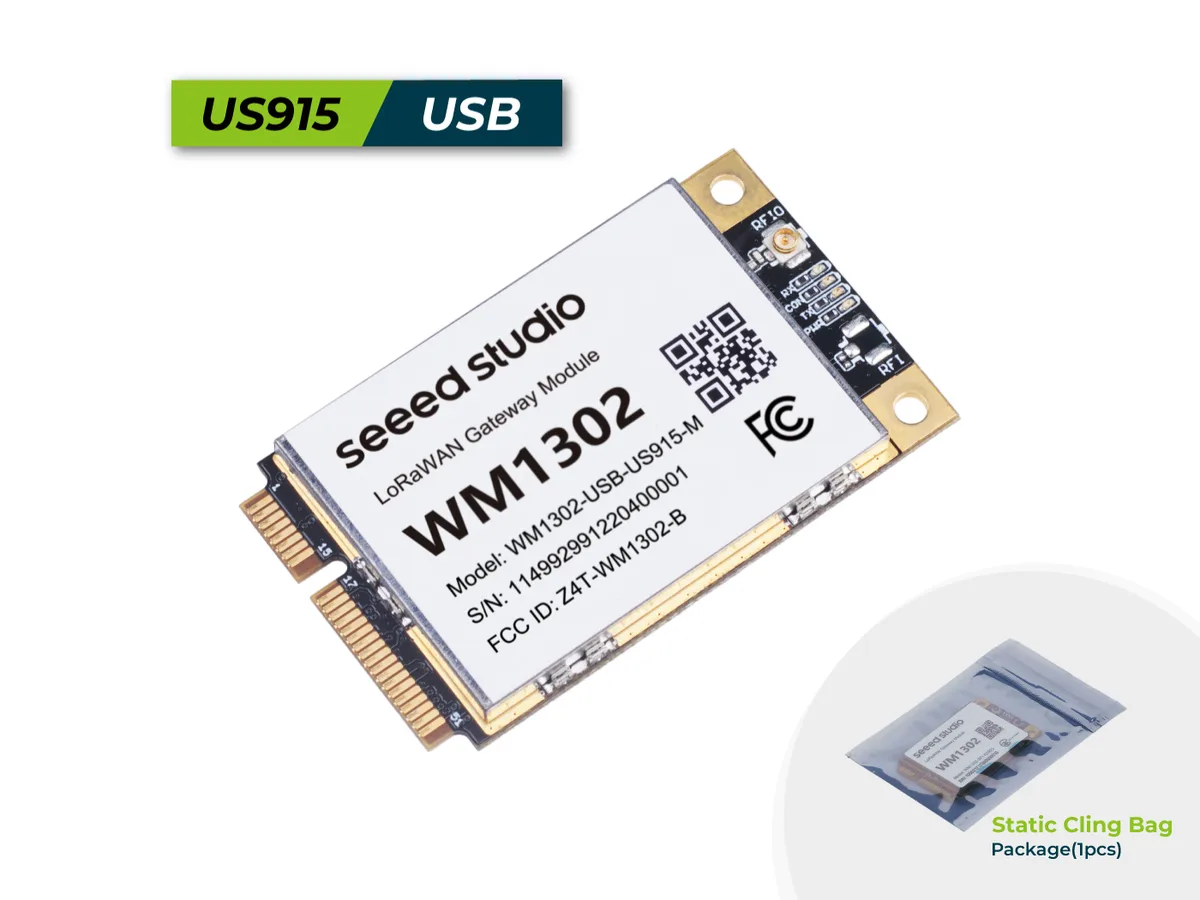
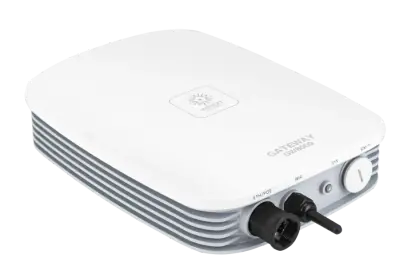
The WM1302 is a LoRaWAN gateway module in Mini PCIe form factor, based on the Semtech SX1302 chip, for LPWAN gateways and M2M and IoT applications on the 902-928 MHz band.
Operating Temperature-40°C to 85°C
Frequency902-928MHz
Dimensions30 mm (width) × 50.95 mm (length)
Form factorMini PCIe, 52pin Golden Finger
Antenna ConnectorU.FL
CertificationCE
Product overview
Overview. The Seeed Studio WM1302 is a LoRaWAN gateway module in Mini PCIe form factor, based on the Semtech SX1302 baseband chip. It is designed for LPWAN gateways and M2M and IoT applications requiring long-range transmission.
Main characteristics. The module operates on the 902-928 MHz frequency band. It offers a sensitivity of -125 dBm at 125K/SF7 and -139 dBm at 125K/SF12, with a Tx power of 25 dBm at a 3.3 V power supply. LBT (Listen Before Talk) is supported.
Interfaces and connectivity. The module has a U.FL antenna connector and a standard 52-pin Mini PCIe golden finger connector for integration into gateway devices. SPI and USB versions are available.
Power and environment. In the USB version, consumption is 20 mA in standby, 425 mA at maximum TX power and 53 mA in RX. In the SPI version, it is 7.5 mA in standby, 415 mA at maximum TX power and 40 mA in RX. The operating temperature range is -40 °C to 85 °C. Dimensions are 30 mm × 50.95 mm. The module is CE certified.
Integration. The module simplifies the development of LoRaWAN gateways and reduces design time. Available on quotation from Atlas Electronics.
No published question about this part yet. Questions are reviewed before publication.
Complete specifications
Every characteristic recorded for 114992991, with where it comes from. Use the filters to find one quickly.
All specifications (12)
Characteristic
Value
Dimensions
30 mm (width) × 50.95 mm (length)
Form factor
Mini PCIe, 52pin Golden Finger
Antenna Connector
U.FL
Certification
CE
Frequency
902-928MHz
LBT(Listen Before Talk)
Support
LEDs
Power: Green Config: Red TX: Green RX: Blue
Operating Temperature
-40°C to 85°C
Power Consumption (SPI version)
Standby: 7.5 mA; TX maximum power: 415 mA; RX: 40 mA
Power Consumption (USB version)
Standby: 20 mA; TX maximum power: 425 mA; RX: 53 mA
Sensitivity
-125dBm @125K/SF7; -139dBm @125K/SF12
Tx Power
25 dBm (with 3.3V power supply)
No specification matches.
Last verification : 2026-11-01
Technical documentation
Official documents and the technical data recorded for 114992991. For a missing document or a specific revision, our experts send it to you.
1. Technical overview
The WM1302 is a LoRaWAN gateway module in Mini PCIe form factor, based on the Semtech SX1302 chip, for LPWAN gateways and M2M and IoT applications on the 902-928 MHz band.
Operating Temperature-40°C to 85°C
Frequency902-928MHz
Dimensions30 mm (width) × 50.95 mm (length)
Form factorMini PCIe, 52pin Golden Finger
Antenna ConnectorU.FL
2. Datasheet extract (recorded values)
Parameter
Value
Dimensions
30 mm (width) × 50.95 mm (length)
Form factor
Mini PCIe, 52pin Golden Finger
Antenna Connector
U.FL
Certification
CE
Frequency
902-928MHz
LBT(Listen Before Talk)
Support
LEDs
Power: Green Config: Red TX: Green RX: Blue
Operating Temperature
-40°C to 85°C
Power Consumption (SPI version)
Standby: 7.5 mA; TX maximum power: 415 mA; RX: 40 mA
Power Consumption (USB version)
Standby: 20 mA; TX maximum power: 425 mA; RX: 53 mA
Sensitivity
-125dBm @125K/SF7; -139dBm @125K/SF12
Tx Power
25 dBm (with 3.3V power supply)
Integration
Points to check before using 114992991 in a design. They are derived from the recorded characteristics, not from the manufacturer's application circuits.
1Thermalrated operating range -40°C to 85°C — check it against the installation environment.
Power and communication
Power Consumption (SPI version)
Standby: 7.5 mA; TX maximum power: 415 mA; RX: 40 mA
Power Consumption (USB version)
Standby: 20 mA; TX maximum power: 425 mA; RX: 53 mA
Tx Power
25 dBm (with 3.3V power supply)
Check the exact pin assignment and the application circuit in the datasheet, or ask our experts.
Implementation checklist
Thermal : rated operating range -40°C to 85°C — check it against the installation environment.
Applications and use cases
Architectures in which 114992991 can play a role, derived from its category. This is not a compatibility statement: check the specifications against your requirements.
Energy bills give one total for the whole site. Submetering places meters and current sensors on each circuit or usage and collects their readings through a gateway, so consumption can be followed per building, floor or machine
To check
Number of circuits and phases to meter, and the current range of each
Wired Modbus bus or wireless LoRaWAN, depending on cabling access in the switchboards
Accuracy class required for internal allocation or for billing
Offices and classrooms get stuffy without anyone measuring why. Indoor air quality monitoring places CO2, VOC and particle sensors in the rooms and reports their values through a gateway, so ventilation can be adjusted to real occupancy
To check
Parameters to measure (CO2 alone or CO2, VOC and particles)
Battery-powered sensors or mains-powered sensors with display
Integration with the ventilation control or building management system
A leak under a sink or in a technical room is often found days later. Leak detection places wireless sensors where water can appear and sends an alert through a gateway as soon as one of them gets wet
To check
Locations at risk: kitchens, bathrooms, plant rooms, server rooms
Alert path (SMS, e-mail, application) and who receives it
Battery life and the way a low battery is reported
A fridge that drifts at night can ruin a whole stock. Temperature loggers in cold rooms and trucks report through a gateway or a tracker and raise an alert when a threshold is crossed
To check
Temperature range and accuracy required by the product
Record keeping required by the applicable regulations
A LoRaWAN project needs sensors, gateways, a network server and an application that work together. Sensor nodes report to indoor or outdoor gateways, which forward the data to the network server and the customer’s platform
To check
Regional frequency plan (EU868, US915 and others)
Network server: public, private or embedded in the gateway
A building’s energy, comfort and occupancy data sit in separate systems. Sensors, meters and gateways feed one model of the building, room by room, to compare scenarios and steer the installations
Milesight sensors, LoRaWAN gateways and cellular routers can be brought together on the Milesight Development Platform, which manages the devices and passes their data to other applications through an API and webhooks
To check
Development Platform for device management, API and webhooks, or another network server and application
Devices provisioned through Milesight RPS must have that provisioning removed before being added to the Development Platform
Data flows to the customer’s own application through webhooks
RAKwireless WisGate gateways run WisGateOS 2 and are managed from WisDM, RAKwireless’ cloud device management platform with a built-in network server, alongside RAK sensor nodes, radio modules and concentrators
To check
WisDM built-in network server, or a third-party one (ChirpStack, TTN/TTS, AWS IoT Core, Actility)
Remote configuration and updates of the gateways from WisDM
Regional frequency plan of the gateways and nodes
Associated system blocks
GatewaysSensors and modulesDevelopment boardsMounting
Need a complete solution?
Send a request for 114992991 and the other parts of your project.
Similar parts to answer your needs. Compare the main characteristics. A recorded replacement is a documented relation; a similar product is a similarity only, never a compatibility claim.
No advertising or analytics cookies. A single, strictly necessary cookie is set only if you sign in to your account. Your quote basket and comparison stay in your browser. Details