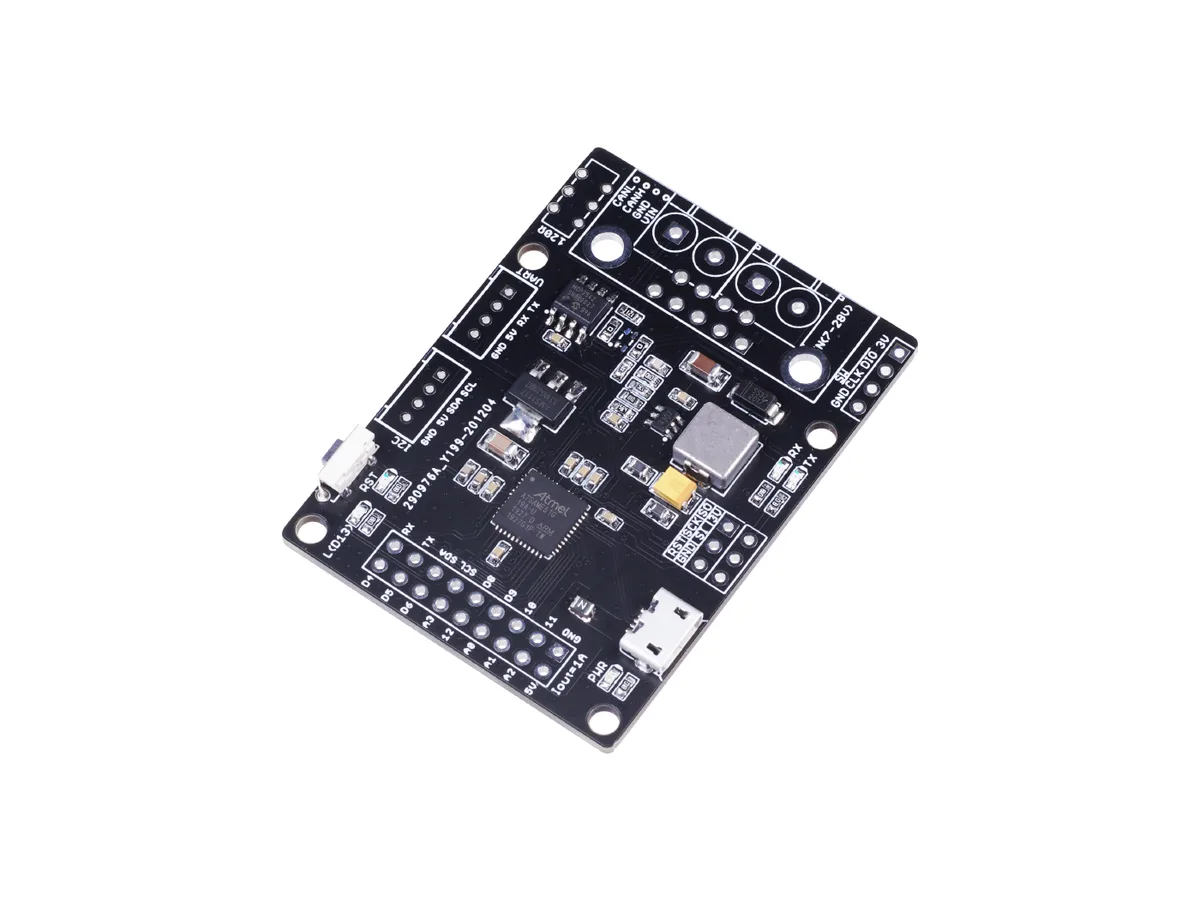
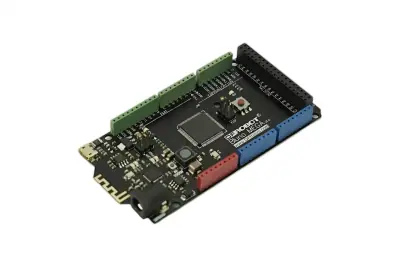
Development board built around the ATSAME51G19A Cortex M4 microcontroller and MCP2542FD CAN-FD transceiver, for prototyping communicating systems on CAN-FD and CAN2.0 buses.
Input InterfaceSub-D as well as Terminal
Input Voltage7~28V
Clock Speed120MHz
Flash memory512KB
RAM192KB
SRAM192KB
Product overview
Overview. The Seeed Studio CANBed M4 development board, reference ATSAME51G19A, is a microcontroller development board integrating the ATSAME51 32-bit Cortex M4 MCU and the MCP2542FD CAN transceiver. It supports the CAN-FD and CAN2.0 protocols.
Main characteristics. Clocked at 120 MHz, the board provides 512 KB of Flash memory and 192 KB of SRAM. It has no EEPROM. Its dimensions are 56 x 41 mm.
Interfaces and connectivity. The board offers an industrial standard 9-pin Sub-D connector or a 4-pin terminal connector. The OBD-II and standard CAN pinouts are selectable at the Sub-D connector. A 2x4-pin connector is compatible with the Grove ecosystem. An SPI interface, a reset button and a Micro USB connector for programming are also provided.
Power and environment. The CAN bus operating voltage is 7 to 28 V, and the Micro USB operating voltage is 5 V.
Typical uses. The CAN bus, known for its long travel distance, medium communication speed and high reliability, is commonly found on modern machine tools and on automotive diagnostic buses. The board can be connected directly to a vehicle's OBD interface to acquire data such as temperature, position or stability, and supports rapid prototype development.
No published question about this part yet. Questions are reviewed before publication.
Complete specifications
Every characteristic recorded for ATSAME51G19A, with where it comes from. Use the filters to find one quickly.
All specifications (12)
Characteristic
Value
Clock Speed
120MHz
EEPROM
No EEPROM
Flash memory
512KB
Input Interface
Sub-D as well as Terminal
Input Voltage
7~28V
MCU
ATSAME51 32bit Cortex M4 core
Operate Voltage(CAN-BUS)
7~28V
Operate Voltage (MicroUSB)
5V
Protocol
CANFD & CAN2.0
RAM
192KB
Size
56x41mm
SRAM
192KB
No specification matches.
Last verification : 2026-11-02
Technical documentation
Official documents and the technical data recorded for ATSAME51G19A. For a missing document or a specific revision, our experts send it to you.
1. Technical overview
Development board built around the ATSAME51G19A Cortex M4 microcontroller and MCP2542FD CAN-FD transceiver, for prototyping communicating systems on CAN-FD and CAN2.0 buses.
Input InterfaceSub-D as well as Terminal
Input Voltage7~28V
Clock Speed120MHz
Flash memory512KB
RAM192KB
2. Datasheet extract (recorded values)
Parameter
Value
Clock Speed
120MHz
EEPROM
No EEPROM
Flash memory
512KB
Input Interface
Sub-D as well as Terminal
Input Voltage
7~28V
MCU
ATSAME51 32bit Cortex M4 core
Operate Voltage(CAN-BUS)
7~28V
Operate Voltage (MicroUSB)
5V
Protocol
CANFD & CAN2.0
RAM
192KB
Size
56x41mm
SRAM
192KB
Applications and use cases
Architectures in which ATSAME51G19A can play a role, derived from its category. This is not a compatibility statement: check the specifications against your requirements.
RAKwireless WisGate gateways run WisGateOS 2 and are managed from WisDM, RAKwireless’ cloud device management platform with a built-in network server, alongside RAK sensor nodes, radio modules and concentrators
To check
WisDM built-in network server, or a third-party one (ChirpStack, TTN/TTS, AWS IoT Core, Actility)
Remote configuration and updates of the gateways from WisDM
Regional frequency plan of the gateways and nodes
Associated system blocks
GatewaysSensors and modulesDevelopment boardsMounting
Seeed SenseCAP sensors connect to Seeed’s SenseCAP cloud platform and app, and Seeed edge computers, camera modules, Grove and XIAO boards complete the chain for custom devices and local processing
To check
SenseCAP cloud platform and app, or the customer’s own network server
Prototype on Grove and XIAO, then move to industrial versions
Local processing on the edge computers or in the cloud
Associated system blocks
SensorsEdge computingDevelopment boards
Need a complete solution?
Send a request for ATSAME51G19A and the other parts of your project.
Similar parts to answer your needs. Compare the main characteristics. A recorded replacement is a documented relation; a similar product is a similarity only, never a compatibility claim.
Current productSeeed Studio
ATSAME51G19A
Microcontroller development board with CAN-FD bus, Cortex M4
What is recorded about the regulatory status and the life of this part.
Regulatory compliance
No compliance statement is recorded for this part. Ask the supplier for the RoHS and REACH declarations and, for a radio product, the EU declaration of conformity.
With your consent, we use Google cookies to measure the site’s audience and our advertising. Your quote basket and comparison stay in your browser either way. Details