Product overview
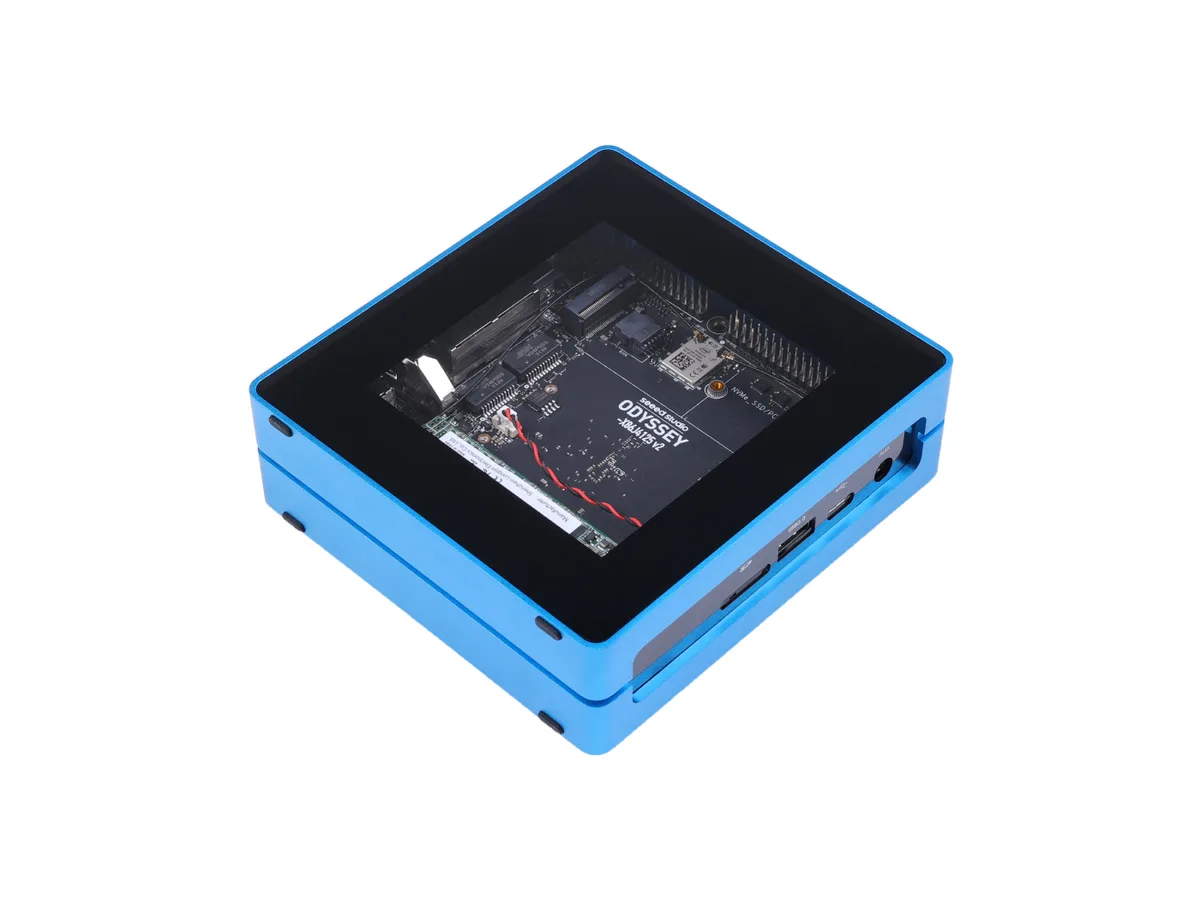
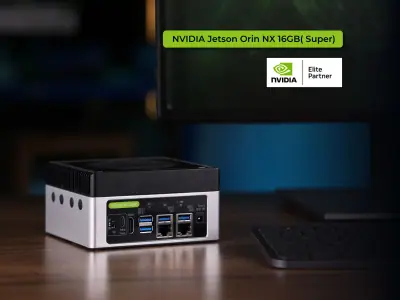
Overview. The Seeed Studio ODYSSEY X86J4125864 v2 is an edge computer mini PC (ODYSSEY Blue J4125 v2, 128GB M.2 SATA) built around a quad-core Intel Celeron J4125 processor running at 2.0 to 2.7GHz, paired with a Raspberry Pi RP2040 dual-core Cortex-M0+ coprocessor. It ships with Linux and a 128GB configuration, and the board measures 130x120x50mm.
Main characteristics. The board carries 8GB of LPDDR4 memory and an Intel UHD Graphics 600 GPU with a frequency of 250 to 750MHz. A built-in fTPM 2.0 is provided, with an optional external TPM 2.0.
Interfaces and connectivity. The system provides dual Intel I226-V PCIe 2.5GbE LAN with Wake-On-LAN and PXE support, and Wi-Fi 802.11 a/b/g/n/ac at 2.4/5 GHz HT160. Video outputs are HDMI 2.0a and DP 1.2a, both up to 4096x2160 at 60Hz with 24bpp. USB ports include 2 USB 2.0 Type-A, 1 USB 3.1 Type-A and 1 USB 3.1 Type-C. Expansion slots include an M.2 Key B (2242/2280) with SATA III, USB 2.0 and UIM, an M.2 Key M (2242/2280) with PCIe 2.0 x4, a micro SD socket, a SIM card socket and a SATA III connector. A 40-pin header compatible with Raspberry Pi, a 28-pin RP2040 header and a 4-pin UART header from the RP2040 are present.
Power and environment. Power is supplied through a 5.5/2.1mm DC jack at 12-19V DC or through Type-C at 15V DC. The board operates from 0°C to 75°C and includes a 4-pin 1.25mm PWM 5V fan port and a JST 1.0 CR2032 3V RTC battery connector. Announced certifications are FCC, CE, TELEC and UKCA.
Typical uses. This board can serve as a mini PC, a functional router, a media center or a development platform. The RP2040 and the Raspberry Pi compatible headers facilitate prototyping under Linux, Windows or OpenWRT. The manufacturer also cites the Frigate project, an open source NVR with AI object detection processed locally.
Integration. The board is compatible with the Grove ecosystem. A 4G LTE module, not included, can be added using the SIM card socket.