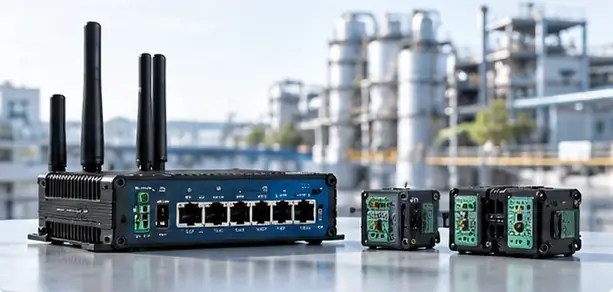
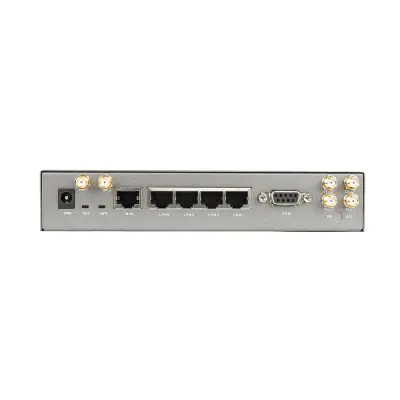
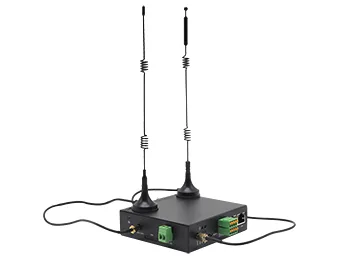
Overview. The USR-G806-A is an industrial 4G LTE router from USR IoT for North America. It accesses 3G and 4G networks through its WLAN interface or its Ethernet port, and includes a WAN port that can be configured as LAN as well as IEEE 802.11b/g/n Wi-Fi at 2.4 GHz in access point mode.
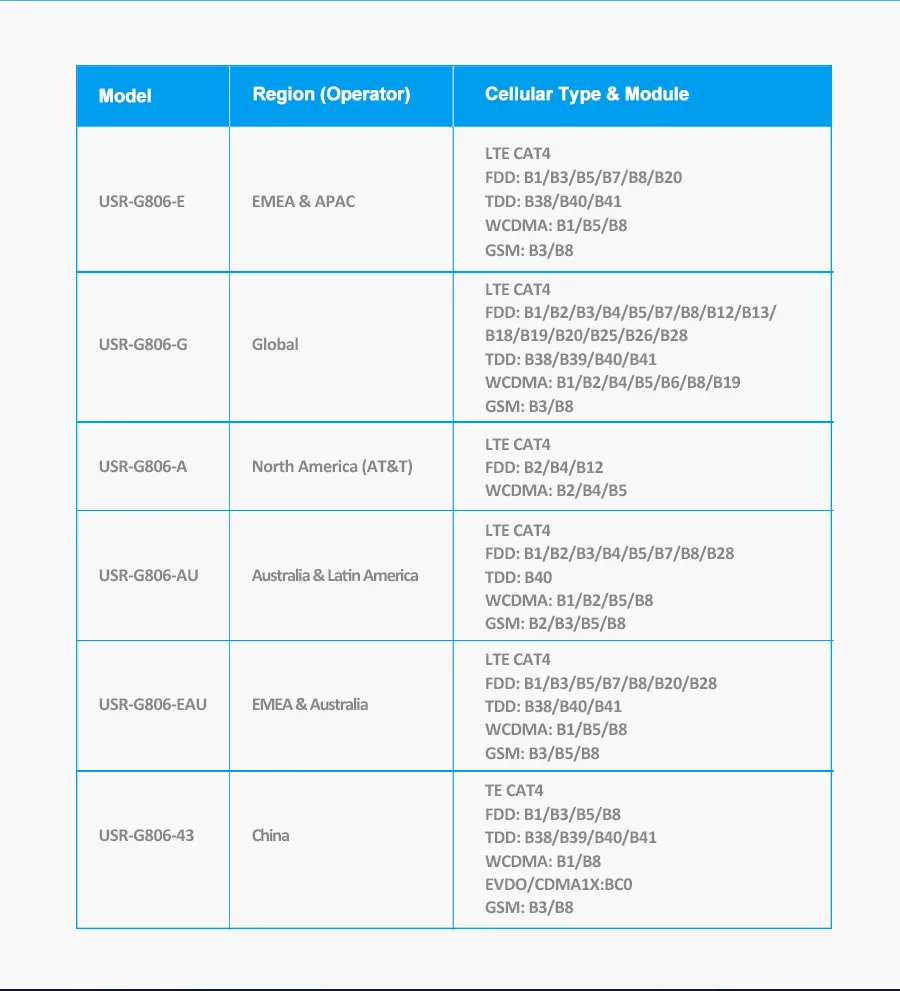
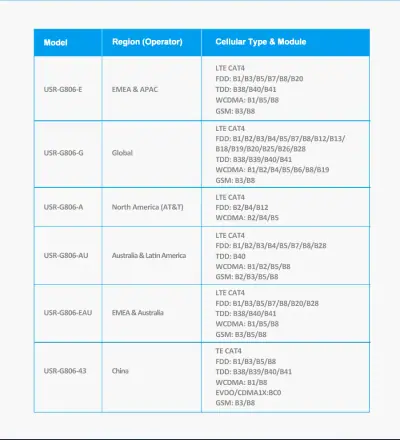
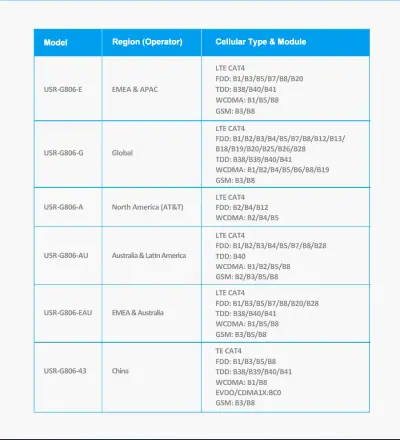
Main characteristics. The router has a 10/100 Mbps WAN/LAN port compliant with IEEE 802.3, with automatic MDI/MDIX detection and 1.5 kV network isolation. The LTE FDD bands B2, B4 and B12 and the WCDMA bands B2, B4 and B5 are supported. A standard 2FF SIM card drawer slot is provided, with two SMA 4G antenna connectors on North American models.
Connectivity and network. The WAN connection operates in PPP, PPPoE or DHCP client mode, and the LAN side provides a DHCP server, ARP and NAT, with static routing. The cellular network is configured automatically (auto APN/VPDN) and CHAP and PAP authentication are supported. Wi-Fi accepts TKIP and AES encryption under WPA/WPA2 PSK. Failover between 4G and WAN ensures automatic switching to the alternative backup connection.
Security. The firewall includes DMZ, anti-DoS protection, filtering by IP address, domain name or MAC address, port mapping and access control. PPTP, L2TP, GRE, IPSEC (IKEv1) and OPENVPN VPN protocols are supported.
Power and environment. The router is powered from DC 9 to 36 V, with reverse polarity protection, through a 5.5 x 2.1 mm DC barrel connector or a 2-pin industrial terminal block. The IP30 metal housing operates between -20 °C and +70 °C, with 5 % to 95 % RH humidity, non-condensing. It mounts on a panel or DIN rail and measures 110.0 x 94.0 x 29.0 mm.
Remote management. Configuration is available through the web interface, Telnet, SSH, AT commands or SNMP. The PUSR platform provides remote monitoring, remote upgrades, alarms by email or SMS, DDNS access and base station location.
Typical uses. This router suits distributed M2M and IoT applications, for example video surveillance cabinets, telecommunication tower monitoring, vending machines or environmental monitoring.