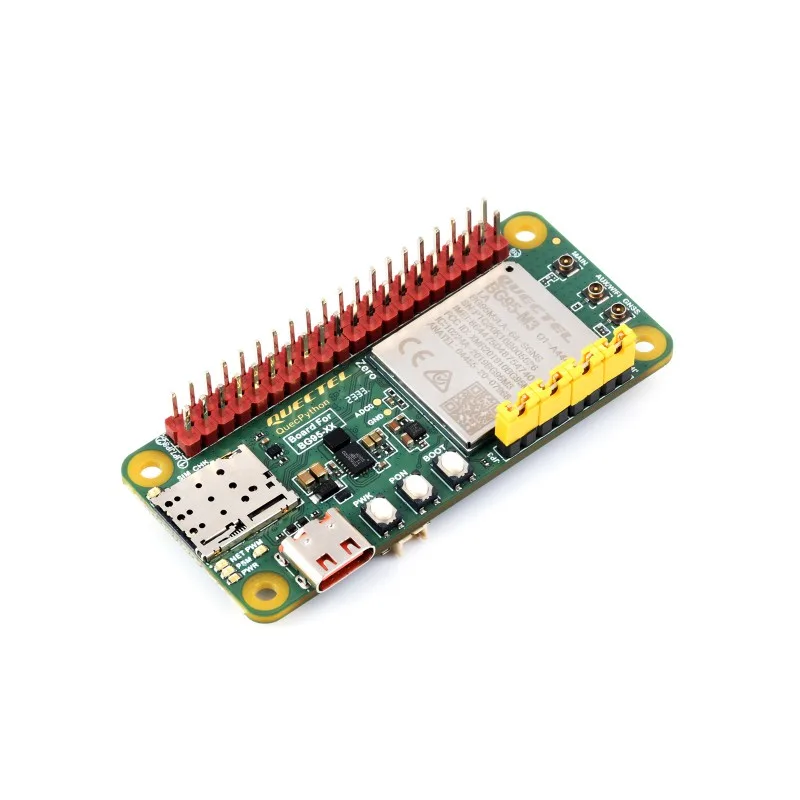
Overview. The Waveshare BG95 is an EVB development board for cellular IoT modules, designed for QuecPython, that lets you prototype LTE Cat M1 and NB-IoT communication applications with GNSS positioning. It is available on quotation from Atlas Electronics.
Main characteristics. LTE FDD Cat M1 bands: B1, B2, B3, B4, B5, B8, B12, B13, B18, B19, B20, B25, B26, B27, B28, B66, B85. LTE FDD Cat NB2 bands: B1, B2, B3, B4, B5, B8, B12, B13, B18, B19, B20, B25, B28, B66, B71, B85. GSM/GPRS/EDGE bands: 850, 900, 1800, 1900 MHz. Applicable region: Global. Nano SIM card slot, 1.8 V only.
Data rates. Cat M: DL 588 Kbps, UL 1119 Kbps. NB-IoT Cat NB2: DL 127 Kbps, UL 158.5 Kbps. NB-IoT Cat NB1: DL 32 Kbps, UL 70 Kbps.
Interfaces and connectivity. GNSS positioning: GPS, GLONASS, BDS, Galileo, QZSS. Communication protocols: PPP, TCP, UDP, SSL, TLS, FTP(S), HTTP(S), NITZ, PING, MQTT, LwM2M, CoAP, IPv6. Antenna connectors: LTE main, LTE DIV and GNSS. Type-C USB port for AT command testing, GNSS positioning and firmware upgrading.
User interface. PWK (power on/off), PON (PSM wake-up), BOOT (forcing into firmware burning mode) and USB ON/OFF (USB power consumption detection switch) buttons. SIM_CHK, NET, PSM, PWM and PWR indicators. Module power supply jumper: connect to DCDC to power the module.
Environment. Operating temperature -30 to 75 °C, storage temperature -45 to 90 °C.
Typical uses. Prototyping low power IoT devices that transmit data over a cellular network and determine their position, controlled by AT commands or QuecPython.