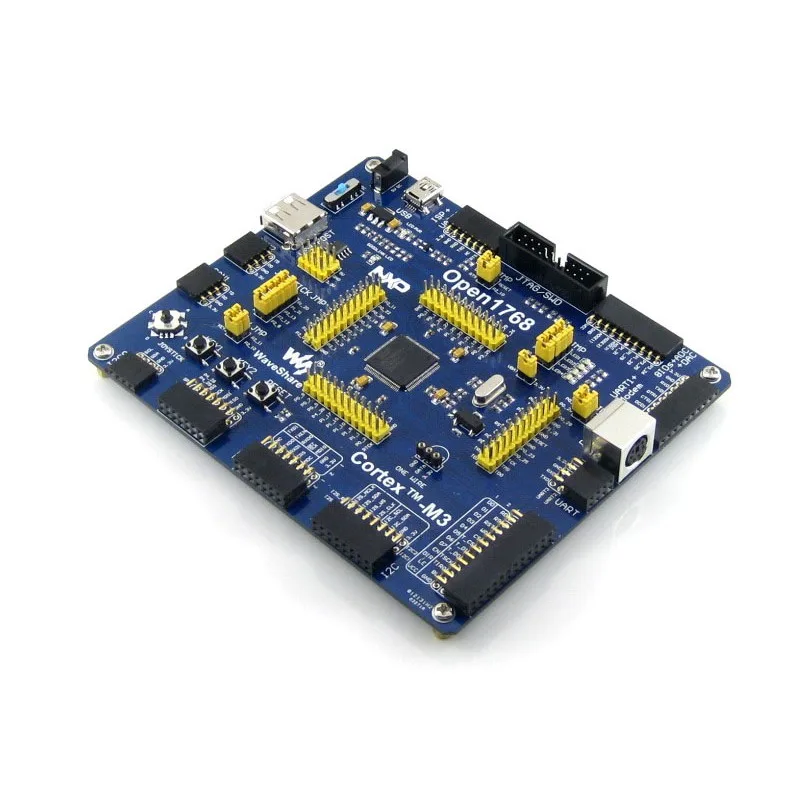
Waveshare Open1768 development board built around the ARM Cortex-M3 LPC1768 microcontroller, with multiple communication interfaces for prototyping and expansion.
JTAG/SWD interfacefor debugging/programming
Operating Frequency100MHz Max
PackageLQFP100
AMS1117-3.33.3V voltage regulator
I/Os70
Joystickfive positions
Product overview
Overview. The Waveshare Open1768 is an ARM Cortex-M3 development board designed for the NXP LPC series, built around the LPC1768 MCU and integrating several standard interfaces that make peripheral expansion straightforward.
Main characteristics. The MCU runs at up to 100 MHz and provides 512 kB of Flash and 64 kB of RAM, in an LQFP100 package. It offers 70 I/Os. The operating voltage ranges from 2.4 to 3.6 V (3.3 V typical).
Interfaces and connectivity. The board provides 2 SPI, 2 SSP, 4 UART, 3 I2C, 1 I2S, 6 PWM, 8 ADC and 1 DAC. Two CAN interfaces, CAN1 and CAN2, communicate with accessory boards featuring a CAN device. A USB port communicates with a PC, and a PS/2 interface connects a keyboard or mouse.
Power and protection. An AMS1117-3.3 regulator supplies 3.3 V, and an LM3526-L USB power switch provides over-current protection.
Debugging and programming. A JTAG/SWD interface supports debugging and programming, and ISP programming is supported through UART.
Use and integration. All MCU pins are accessible on the expansion connectors. LEDs indicate I/O status or program execution, and user keys and a five-position joystick allow I/O input testing and program control.
2 x SPI, 2 x SSP, 4 x UART, 3 x I2C, 1 x I2S, 6 x PWM, 8 x ADC, 1 x DAC
Debugging/Programming
supports SWD interfaces, supports ISP through UART
I/Os
70
Joystick
five positions
JTAG/SWD interface
for debugging/programming
LEDs
convenient for indicating I/O status and/or program running state
LM3526-L
USB power switch and over-current protection
MCU pins connector
all the MCU pins are accessible on expansion connectors for further expansion
Memories
512kB Flash, 64kB RAM
Operating Frequency
100MHz Max
Operating Voltage
2.4-3.6V (3.3V typical)
Package
LQFP100
PS/2 interface
easily connects to PS/2 keyboard and/or mouse
USB port
communicating with PC
User Keys
for I/O input test and/or program control
No specification matches.
Last verification : 2026-11-01
Technical documentation
Official documents and the technical data recorded for OPEN1768. For a missing document or a specific revision, our experts send it to you.
1. Technical overview
Waveshare Open1768 development board built around the ARM Cortex-M3 LPC1768 microcontroller, with multiple communication interfaces for prototyping and expansion.
JTAG/SWD interfacefor debugging/programming
Operating Frequency100MHz Max
PackageLQFP100
AMS1117-3.33.3V voltage regulator
I/Os70
2. Datasheet extract (recorded values)
Parameter
Value
AMS1117-3.3
3.3V voltage regulator
CAN1 interface
communicates with accessory boards which feature the CAN device conveniently
CAN2 interface
communicates with accessory boards which feature the CAN device conveniently
2 x SPI, 2 x SSP, 4 x UART, 3 x I2C, 1 x I2S, 6 x PWM, 8 x ADC, 1 x DAC
Debugging/Programming
supports SWD interfaces, supports ISP through UART
I/Os
70
Joystick
five positions
JTAG/SWD interface
for debugging/programming
LEDs
convenient for indicating I/O status and/or program running state
LM3526-L
USB power switch and over-current protection
MCU pins connector
all the MCU pins are accessible on expansion connectors for further expansion
Memories
512kB Flash, 64kB RAM
Operating Frequency
100MHz Max
Operating Voltage
2.4-3.6V (3.3V typical)
Package
LQFP100
PS/2 interface
easily connects to PS/2 keyboard and/or mouse
USB port
communicating with PC
User Keys
for I/O input test and/or program control
Applications and use cases
Architectures in which OPEN1768 can play a role, derived from its category. This is not a compatibility statement: check the specifications against your requirements.
RAKwireless WisGate gateways run WisGateOS 2 and are managed from WisDM, RAKwireless’ cloud device management platform with a built-in network server, alongside RAK sensor nodes, radio modules and concentrators
To check
WisDM built-in network server, or a third-party one (ChirpStack, TTN/TTS, AWS IoT Core, Actility)
Remote configuration and updates of the gateways from WisDM
Regional frequency plan of the gateways and nodes
Associated system blocks
GatewaysSensors and modulesDevelopment boardsMounting
Seeed SenseCAP sensors connect to Seeed’s SenseCAP cloud platform and app, and Seeed edge computers, camera modules, Grove and XIAO boards complete the chain for custom devices and local processing
To check
SenseCAP cloud platform and app, or the customer’s own network server
Prototype on Grove and XIAO, then move to industrial versions
Local processing on the edge computers or in the cloud
Associated system blocks
SensorsEdge computingDevelopment boards
Need a complete solution?
Send a request for OPEN1768 and the other parts of your project.
Similar parts to answer your needs. Compare the main characteristics. A recorded replacement is a documented relation; a similar product is a similarity only, never a compatibility claim.
What is recorded about the regulatory status and the life of this part.
Regulatory compliance
No compliance statement is recorded for this part. Ask the supplier for the RoHS and REACH declarations and, for a radio product, the EU declaration of conformity.
No advertising or analytics cookies. A single, strictly necessary cookie is set only if you sign in to your account. Your quote basket and comparison stay in your browser. Details