Product overview
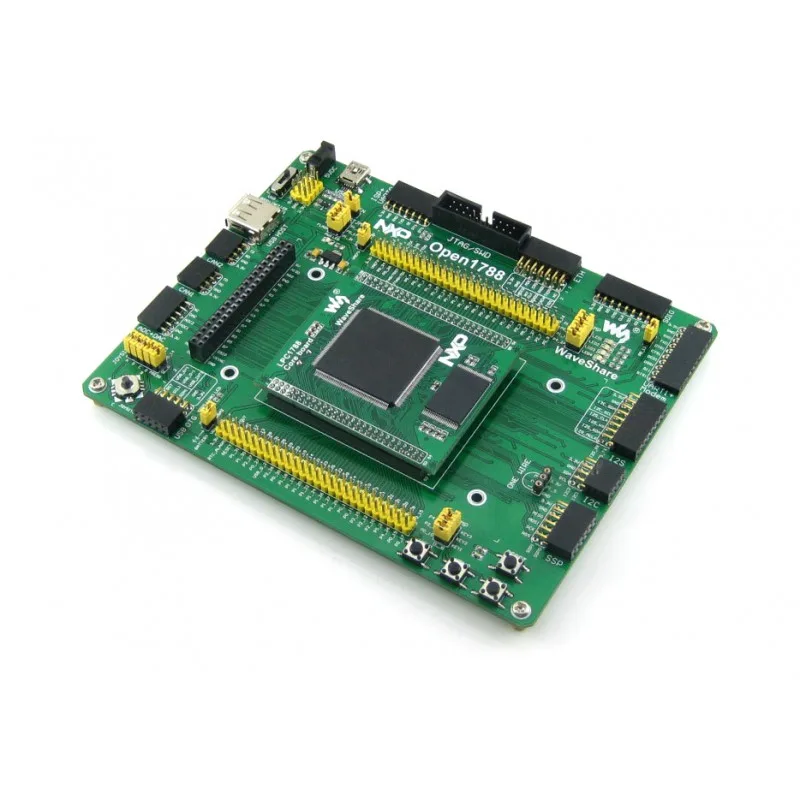
Overview. The Waveshare Electronics Open1788 LPC development board is a microcontroller development board built around the LPC1788FBD208 MCU, integrating several standard interfaces to ease peripheral expansion.
Main characteristics. The MCU runs at a maximum operating frequency of 120 MHz, with an operating voltage of 2.4 to 3.6 V (3.3 V typical) and an LQFP208 package. It provides 512 KB of Flash, 96 KB of SRAM and 4 KB of EEPROM. The board carries an H57V1262GTR-75C SDRAM (2 x 128 Mbit), a K9F1G08U0B NAND Flash (1 Gbit) and an SST39VF3201 NOR Flash (32 Mbit), and offers 165 I/Os.
Converters and interfaces. It includes 3 x 12-bit AD converters (1 µs, 24 shared channels) and 2 x 12-bit DA converters, with an AD+DA test interface. Two CAN interfaces, CAN1 and CAN2, communicate with accessory boards featuring CAN devices. An LCD interface connects a 4.3-inch touch screen LCD through an adapter, an SDIO interface connects a Micro SD module with faster access than SPI, and a USB type A interface accepts devices such as USB flash drives. A USB mini connector establishes USB communication between a PC and the board, and a USB OTG transceiver interface is also provided.
Debugging and programming. JTAG/SWD interfaces support debugging and programming, and ISP is supported via UART.
Expansion. An external Ethernet module, such as the DP83848 Ethernet Board, easily connects the MCU to an Ethernet network. All idle MCU pins are accessible on the expansion connectors. LEDs indicate I/O status and program execution, while a five-position joystick and a user key simplify inputs.