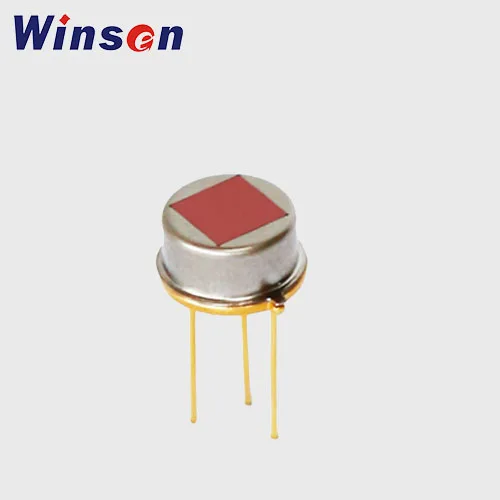
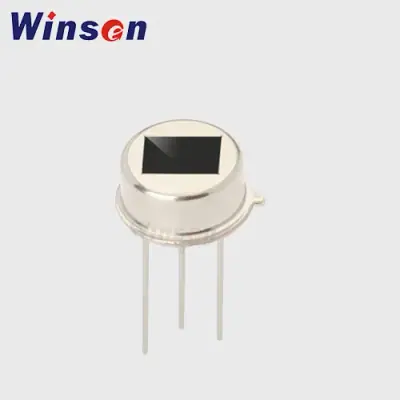
The RD-913FB1 from Winsen is a pyroelectric flame sensor with a lithium tantalate sensitive element, designed to detect flame signals in the 3.8 µm band.
Storage TemperatureTypical: -40~+80; Unit: ℃
Detection DistanceTypical: 35~50; Unit: m
Detection Principlepyroelectric effect
Electrical time constantTypical: 5; Unit: s
Field of View (FOV)Typical: >115; Unit: °
Filter center wavelengthTypical: 3.8; Unit: um
Product overview
Overview. The Winsen RD-913FB1 is a pyroelectric flame sensor (model RD-913FB1) with voltage-mode output in a single-channel TO-5 package. It uses a lithium tantalate single crystal as sensitive element, whose Curie temperature is above 600 °C.
Main characteristics. 3.8 µm detection band, typical field of view greater than 115°, typical detection distance of 35 to 50 m, low microphone effect and high detection rate. Typical output signal is 2.9 V ±10 % (500 K, 10 Hz, 25 °C) and typical output noise voltage is less than or equal to 150 mV.
Power and environment. Working voltage of 2 to 15 V, recommended voltage of 3 to 5 V, typical source voltage of 0.4 to 0.7 V. Working temperature from -30 to +75 °C and storage temperature from -40 to +80 °C.
Typical uses. Flame detection in high fire-risk areas such as oil storage stations, large warehouses, factory workshops, forests and charging piles.
Note. The manufacturer lists this product as discontinued and replaced by the RPFA913CC.
No published question about this part yet. Questions are reviewed before publication.
Complete specifications
Every characteristic recorded for RD-913FB1, with where it comes from. Use the filters to find one quickly.
All specifications (24)
Characteristic
Value
Characteristics
1、3.8um detection band; 2、TO-5 package, single channel, voltage mode; 3、Low microphone effect, large FOV, high detection rate; 4、Detection band measurement of flame signal
Detection Distance
Typical: 35~50; Unit: m
Detection Principle
pyroelectric effect
Electrical time constant
Typical: 5; Unit: s
Field of View (FOV)
Typical: >115; Unit: °
Filter center wavelength
Typical: 3.8; Unit: um
Model
RD-913FB1
Notes
This product has been discontinued and replaced by RPFA913CC
Output noise voltage VN (10HZ, BW1HZ, 25℃)
Typical: ≤ 150; Unit: mv
Output signal V0 (500K,10HZ,25℃)
Typical: 2.9±10%; Unit: v
Receiving wavelength:
3.8um
Recommended Voltage
Typical: 3~5; Unit: v
Sensitive element size
Typical: Φ 2.5; Unit: mm
Size
TO-5 9.1x4.5mm
Source Voltage
Typical: 0.4~0.7; Unit: v
Specific detection rate (no window) D* (500K, 10HZ, BW1HZ, 25℃)
Typical: ≥ 5×10⁸; Unit: cmHz½ /W
Storage Temperature
Typical: -40~+80; Unit: ℃
Target
Flame signal
Thermal time constant
Typical: 200; Unit: ms
Voltage response rate (no window) Rv (500K, 10HZ, 25°C)
Typical: ≥ 500; Unit: v/w
Window size:
Typical: 5.0*5.0; Unit: mm
Working Conditions
Working voltage:2-15V; Recommend voltage:3-5V
Working temperature
Typical: -30~+75; Unit: ℃
Working voltage
Typical: 2~15; Unit: v
No specification matches.
Last verification : 2026-11-02
Technical documentation
Official documents and the technical data recorded for RD-913FB1. For a missing document or a specific revision, our experts send it to you.
1. Technical overview
The RD-913FB1 from Winsen is a pyroelectric flame sensor with a lithium tantalate sensitive element, designed to detect flame signals in the 3.8 µm band.
Storage TemperatureTypical: -40~+80; Unit: ℃
Detection DistanceTypical: 35~50; Unit: m
Detection Principlepyroelectric effect
Electrical time constantTypical: 5; Unit: s
Field of View (FOV)Typical: >115; Unit: °
2. Datasheet extract (recorded values)
Parameter
Value
Characteristics
1、3.8um detection band; 2、TO-5 package, single channel, voltage mode; 3、Low microphone effect, large FOV, high detection rate; 4、Detection band measurement of flame signal
Detection Distance
Typical: 35~50; Unit: m
Detection Principle
pyroelectric effect
Electrical time constant
Typical: 5; Unit: s
Field of View (FOV)
Typical: >115; Unit: °
Filter center wavelength
Typical: 3.8; Unit: um
Model
RD-913FB1
Notes
This product has been discontinued and replaced by RPFA913CC
Output noise voltage VN (10HZ, BW1HZ, 25℃)
Typical: ≤ 150; Unit: mv
Output signal V0 (500K,10HZ,25℃)
Typical: 2.9±10%; Unit: v
Receiving wavelength:
3.8um
Recommended Voltage
Typical: 3~5; Unit: v
Sensitive element size
Typical: Φ 2.5; Unit: mm
Size
TO-5 9.1x4.5mm
Source Voltage
Typical: 0.4~0.7; Unit: v
Specific detection rate (no window) D* (500K, 10HZ, BW1HZ, 25℃)
Typical: ≥ 5×10⁸; Unit: cmHz½ /W
Storage Temperature
Typical: -40~+80; Unit: ℃
Target
Flame signal
Thermal time constant
Typical: 200; Unit: ms
Voltage response rate (no window) Rv (500K, 10HZ, 25°C)
Typical: ≥ 500; Unit: v/w
Window size:
Typical: 5.0*5.0; Unit: mm
Working Conditions
Working voltage:2-15V; Recommend voltage:3-5V
Working temperature
Typical: -30~+75; Unit: ℃
Working voltage
Typical: 2~15; Unit: v
Applications and use cases
Architectures in which RD-913FB1 can play a role, derived from its category. This is not a compatibility statement: check the specifications against your requirements.
Meeting rooms are booked but empty, and some areas are always full. Presence sensors, radars and counting cameras measure how spaces are really used, room by room or at entrances
To check
Presence per room or counting at entrances, or both
Privacy requirements, which favour radar or anonymous counting
Hotel rooms keep heating, cooling and lights on while empty. A room control system links thermostats, switches, door contacts and lighting controllers so the room adapts to the guest’s presence
To check
Wired bus or wireless system, depending on renovation or new build
Link with the property management system for check-in and check-out
Behaviour when the guest is absent (setback temperature, lights off)
Associated system blocks
Climate controlSwitches and panelsPresence detectionLighting control
A building’s energy, comfort and occupancy data sit in separate systems. Sensors, meters and gateways feed one model of the building, room by room, to compare scenarios and steer the installations
To check
Data model and building plans available
Software platform hosting the twin
Sensor density needed for a useful model
Associated system blocks
SensorsMetersGateways
Need a complete solution?
Send a request for RD-913FB1 and the other parts of your project.
Similar parts to answer your needs. Compare the main characteristics. A recorded replacement is a documented relation; a similar product is a similarity only, never a compatibility claim.
What is recorded about the regulatory status and the life of this part.
Regulatory compliance
No compliance statement is recorded for this part. Ask the supplier for the RoHS and REACH declarations and, for a radio product, the EU declaration of conformity.
No advertising or analytics cookies. A single, strictly necessary cookie is set only if you sign in to your account. Your quote basket and comparison stay in your browser. Details