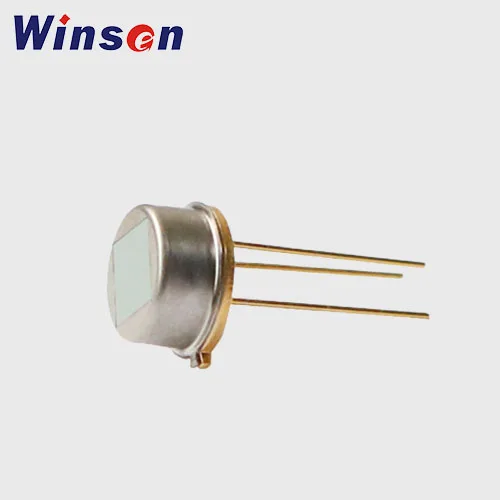
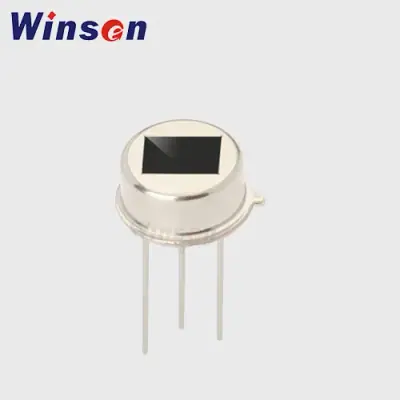
The Winsen RD-913FB3 is a TO-5 pyroelectric flame sensor that detects flame signals in the 5 µm band. It is intended for high fire-risk areas.
Storage TemperatureTypical: -40~+80; Unit: ℃
Detection DistanceTypical: 35~50; Unit: m
Detection Principlepyroelectric effect
Electrical time constantTypical: 5; Unit: s
Field of View (FOV)Typical: >115; Unit: °
Filter center wavelengthTypical: 5.0; Unit: um
Product overview
Overview. The Winsen RD-913FB3 is a pyroelectric flame sensor whose sensitive element is a lithium tantalate single crystal. It detects flame signals in the 5 µm band, with a typical filter centre wavelength of 5.0 µm.
Main characteristics. The single-channel TO-5 package operates in voltage mode. Typical detection distance is 35 to 50 m, with a typical field of view above 115° and low microphone effect. The typical thermal time constant is 200 ms and the typical electrical time constant is 5 s. Typical output signal V0 is 2.8 V ±10% (500 K, 10 Hz, 25 ℃) and typical output noise voltage VN is at most 150 mV.
Power and environment. The working voltage is 2 to 15 V, with a recommended voltage of 3 to 5 V. Typical working temperature is -30 to +75 ℃ and typical storage temperature is -40 to +80 ℃.
Typical uses. This sensor is designed for flame detection in high fire-risk areas such as oil storage stations, warehouses, factory workshops, forests and charging piles.
Integration. The manufacturer lists this product as discontinued and replaced by the RPFA913CE. The manufacturer states that the sensor has no sleeping mode and recommends calibration after stabilisation according to the application.
No published question about this part yet. Questions are reviewed before publication.
Complete specifications
Every characteristic recorded for RD-913FB3, with where it comes from. Use the filters to find one quickly.
All specifications (24)
Characteristic
Value
Characteristics
1、5um detection band; 2、TO-5 package,single channel,voltage mode; 3、Low microphone effect,large FOV,high detection rate; 4、Detection band measurement of flame signal
Detection Distance
Typical: 35~50; Unit: m
Detection Principle
pyroelectric effect
Electrical time constant
Typical: 5; Unit: s
Field of View (FOV)
Typical: >115; Unit: °
Filter center wavelength
Typical: 5.0; Unit: um
Model
RD-913FB3
Notes
This product has been discontinued and replaced by RPFA913CE
Output noise voltage VN (10HZ, BW1HZ, 25℃)
Typical: ≤ 150; Unit: mv
Output signal V0 (500K,10HZ,25℃)
Typical: 2.8±10%; Unit: v
Receiving wavelength:
5um
Recommended Voltage
Typical: 3~5; Unit: v
Sensitive element size
Typical: Φ 2.5; Unit: mm
Size
TO-5 9.1x4.5mm
Source Voltage
Typical: 0.4~0.7; Unit: v
Specific detection rate (no window) D* (500K, 10HZ, BW1HZ, 25℃)
Typical: ≥ 5×10⁸; Unit: cmHz½ /W
Storage Temperature
Typical: -40~+80; Unit: ℃
Target
Flame signal
Thermal time constant
Typical: 200; Unit: ms
Voltage response rate (no window) Rv (500K, 10HZ, 25°C)
Typical: ≥ 500; Unit: v/w
Window size:
Typical: 5.0*5.0; Unit: mm
Working Conditions
Working voltage:2-15V; Recommend voltage3-5V
Working temperature
Typical: -30~+75; Unit: ℃
Working voltage
Typical: 2~15; Unit: v
No specification matches.
Last verification : 2026-11-02
Technical documentation
Official documents and the technical data recorded for RD-913FB3. For a missing document or a specific revision, our experts send it to you.
1. Technical overview
The Winsen RD-913FB3 is a TO-5 pyroelectric flame sensor that detects flame signals in the 5 µm band. It is intended for high fire-risk areas.
Storage TemperatureTypical: -40~+80; Unit: ℃
Detection DistanceTypical: 35~50; Unit: m
Detection Principlepyroelectric effect
Electrical time constantTypical: 5; Unit: s
Field of View (FOV)Typical: >115; Unit: °
2. Datasheet extract (recorded values)
Parameter
Value
Characteristics
1、5um detection band; 2、TO-5 package,single channel,voltage mode; 3、Low microphone effect,large FOV,high detection rate; 4、Detection band measurement of flame signal
Detection Distance
Typical: 35~50; Unit: m
Detection Principle
pyroelectric effect
Electrical time constant
Typical: 5; Unit: s
Field of View (FOV)
Typical: >115; Unit: °
Filter center wavelength
Typical: 5.0; Unit: um
Model
RD-913FB3
Notes
This product has been discontinued and replaced by RPFA913CE
Output noise voltage VN (10HZ, BW1HZ, 25℃)
Typical: ≤ 150; Unit: mv
Output signal V0 (500K,10HZ,25℃)
Typical: 2.8±10%; Unit: v
Receiving wavelength:
5um
Recommended Voltage
Typical: 3~5; Unit: v
Sensitive element size
Typical: Φ 2.5; Unit: mm
Size
TO-5 9.1x4.5mm
Source Voltage
Typical: 0.4~0.7; Unit: v
Specific detection rate (no window) D* (500K, 10HZ, BW1HZ, 25℃)
Typical: ≥ 5×10⁸; Unit: cmHz½ /W
Storage Temperature
Typical: -40~+80; Unit: ℃
Target
Flame signal
Thermal time constant
Typical: 200; Unit: ms
Voltage response rate (no window) Rv (500K, 10HZ, 25°C)
Typical: ≥ 500; Unit: v/w
Window size:
Typical: 5.0*5.0; Unit: mm
Working Conditions
Working voltage:2-15V; Recommend voltage3-5V
Working temperature
Typical: -30~+75; Unit: ℃
Working voltage
Typical: 2~15; Unit: v
Applications and use cases
Architectures in which RD-913FB3 can play a role, derived from its category. This is not a compatibility statement: check the specifications against your requirements.
Meeting rooms are booked but empty, and some areas are always full. Presence sensors, radars and counting cameras measure how spaces are really used, room by room or at entrances
To check
Presence per room or counting at entrances, or both
Privacy requirements, which favour radar or anonymous counting
Hotel rooms keep heating, cooling and lights on while empty. A room control system links thermostats, switches, door contacts and lighting controllers so the room adapts to the guest’s presence
To check
Wired bus or wireless system, depending on renovation or new build
Link with the property management system for check-in and check-out
Behaviour when the guest is absent (setback temperature, lights off)
Associated system blocks
Climate controlSwitches and panelsPresence detectionLighting control
A building’s energy, comfort and occupancy data sit in separate systems. Sensors, meters and gateways feed one model of the building, room by room, to compare scenarios and steer the installations
To check
Data model and building plans available
Software platform hosting the twin
Sensor density needed for a useful model
Associated system blocks
SensorsMetersGateways
Need a complete solution?
Send a request for RD-913FB3 and the other parts of your project.
Similar parts to answer your needs. Compare the main characteristics. A recorded replacement is a documented relation; a similar product is a similarity only, never a compatibility claim.
What is recorded about the regulatory status and the life of this part.
Regulatory compliance
No compliance statement is recorded for this part. Ask the supplier for the RoHS and REACH declarations and, for a radio product, the EU declaration of conformity.
No advertising or analytics cookies. A single, strictly necessary cookie is set only if you sign in to your account. Your quote basket and comparison stay in your browser. Details