
NDIR CO2, PID VOC, PM2.5/PM 10 Particulate and Toxic Gas Sensing Principles
Selecting hardware across Environmental Sensors, Air Quality Sensors and Gas Sensors starts with matching the sensing physics to the target compound. For CO2 Sensors, non-dispersive infrared NDIR absorption measures optical attenuation at the characteristic carbon dioxide wavelength while minimizing interference from background gases. The Seeed Studio 101990665 module exemplifies this principle with a 400 to 10,000 ppm range, a τ 63% response time and native UART and I2C digital interfaces for embedded integration.
Within VOC Sensors, metal-oxide TVOC elements track broad indoor air quality trends, whereas a photoionization detector PID quantifies ionizable organic vapors, as implemented in the Honeywell Automation RAEGUARD-2-PID-GAS-DETECTOR fixed detector with internal pump. Laser scattering optics measure suspended PM2.5/PM 10 particulate fractions, while replaceable electrochemical cells target toxic gases and oxygen depletion.
Calibration Drift, Cross-Sensitivity and Thermal Compensation
Long-term stability governs maintenance cycles for Environmental and Gas Sensors. Optical emitter aging, catalyst poisoning or electrolyte depletion gradually shift zero baselines and span sensitivity. On the Seeed Studio 101990665 sensor, the datasheet states an accuracy drift below 0.25 %RH per year, relative humidity accuracy of ±3%RH at 25°C across 0 to 100 %RH, thermal compensation accuracy of ± (0.4°C + 0.023 × (T [°C] – 25°C)) over 0 to 50°C and a 400 ppm to 10,000 ppm lifetime CO2 span.
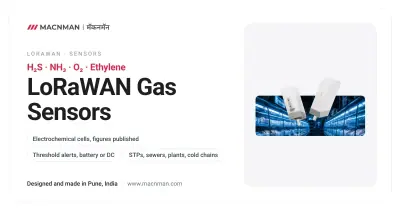
Cross-sensitivity to background solvents, humidity transients or interfering gases requires checking manufacturer cross-response tables in the datasheet prior to deployment. The Macnman LORAWAN-GAS-SENSOR arrives factory calibrated with datasheet figures published per cell for range, resolution, repeatability, drift and life. In climate-controlled spaces, Honeywell Automation E3POINT specifies ± 3% Full Scale accuracy at 25°C.
LoRaWAN Wireless Telemetry vs BACnet, Modbus, HART and PoE Fieldbuses
Telemetry selection separates battery-powered wireless retrofits from continuously energized wired safety loops and building automation buses. Across large plants without field power, the Macnman LORAWAN-GAS-SENSOR for H2S, NH3, O2 or ethylene combines LoRaWAN radio, MQTT support and a 19 Ah Li-SOCl 2 cell battery variant, delivering alarm latency aligned with a sampling interval from 1 minute alongside local reading and commissioning via the Maya app.
Conversely, BACnet building controllers and Modbus SCADA supervisors demand deterministic polling and uninterrupted supply power. The Honeywell Automation XNX-UNIVERSAL-TRANSMITTER pairs a 4-20 mA analog loop with HART Communications, MODBUS and FOUNDATION H1 Fieldbus digital ports. For Ethernet-wired cleanrooms and process bays, the Honeywell Automation MIDASS2-GAS-DETECTOR integrates Modbus, PoE power over Ethernet and 4 to 20 mA sink or source analog outputs.
Enclosure IP Protection, Extractive Sampling and Hazardous Area Ratings
Site exposure requires verifying enclosure IP protection ratings, hydrophobic gas membranes and inlet particulate filtration in the datasheet. Dusty or condensing atmospheres quickly foul optical PM2.5/PM 10 paths and sensor ports unless protected. The extractive Honeywell Automation MIDASS2-GAS-DETECTOR requires an inline air filter on its ambient port and supports dual level alarms typically set at half TLV and TLV thresholds.
Operating temperature limits and hazardous location approvals further define housing choice. Macnman LORAWAN-GAS-SENSOR operates down to -20 °C, whereas Honeywell Automation XNX-UNIVERSAL-TRANSMITTER supports -40 °C or lower with ATEX, IECEx, INMETRO, CSA Class I Div 1 Groups B, C and D, Class II Div 1 Groups F and G, Class I Zone 1 Groups IIB + H2 approvals and EMC EN50270:2006 plus EN61000-6-4:2007 compliance.
Catalogue Selection Criteria and Preparing a Quotation Request
When structuring specifications across Environmental Sensors, Air Quality Sensors, Gas Sensors, CO2 Sensors and VOC Sensors, buyers should verify target gas range, cross-interference tables, enclosure IP protection and calibration intervals in each datasheet. The Seeed Studio 101990665 fits embedded NDIR integration, while Macnman LORAWAN-GAS-SENSOR covers long-range wireless monitoring.
For fixed industrial safety and facility networks, evaluate Honeywell Automation XNX-UNIVERSAL-TRANSMITTER, Honeywell Automation RAEGUARD-2-PID-GAS-DETECTOR, Honeywell Automation MIDASS2-GAS-DETECTOR meeting CSA C22.2 No.61010-1, UL 61010-1, IEC 61010-1, EN 50270:2015, CE and ROHS EU Directive 2015/863, or Honeywell Automation E3POINT featuring a 4 to 20 mA output, amber alarm and fault LEDs and an integrated >85 dBA @3 m sounder. All listed units are supplied on quotation once target gases, sampling lines and telemetry protocols are specified.
Frequently asked questions
How does a metal-oxide TVOC sensor differ from a PID VOC gas detector?
A metal-oxide TVOC sensor tracks broad indoor air trends for ventilation control, whereas a photoionization detector such as Honeywell Automation RAEGUARD-2-PID-GAS-DETECTOR uses a PID lamp and internal pump to measure ionizable volatile organic compounds in industrial zones.
How can buyers evaluate calibration drift and cross-sensitivity before ordering?
Inspect the cross-interference table, thermal compensation formula and drift specification in each datasheet. For example, Seeed Studio 101990665 specifies humidity drift below 0.25 %RH per year, while Macnman LORAWAN-GAS-SENSOR publishes range, resolution, repeatability, drift and life figures per electrochemical cell.
When should a project use LoRaWAN instead of BACnet, Modbus or 4-20 mA telemetry?
Choose LoRaWAN for wide-area retrofits lacking mains power, such as the 19 Ah Li-SOCl 2 battery variant of Macnman LORAWAN-GAS-SENSOR with sampling from 1 minute. Wired BACnet, Modbus, PoE or 4-20 mA networks suit continuous control and safety alarms via Honeywell Automation XNX-UNIVERSAL-TRANSMITTER or MIDASS2-GAS-DETECTOR.
What details are needed to request a quotation for air quality and gas sensors?
Specify the target gases and ppm ranges, ambient temperature, dust or PM2.5/PM 10 filtration needs, required enclosure IP rating, any ATEX, IECEx or CSA hazardous location class, and your fieldbus or LoRaWAN telemetry protocol so Atlas Electronics can prepare a quotation.
Products mentioned
XNX
Environmental and Gas Sensors
Universal transmitter for gas detectors with 4-20 mA and HART output
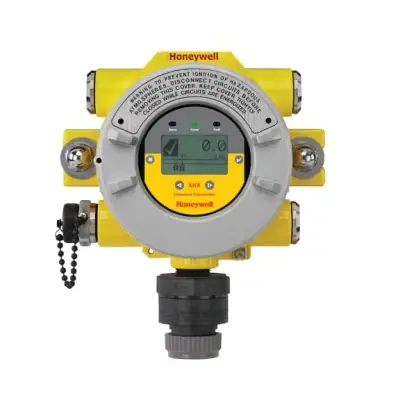
- Honeywell
- ATEX/IECEx/INMETRO
- LCD
Price on request
E3Point
Environmental and Gas Sensors
Toxic and combustible gas detector with 4-20 mA output · Ref. : E3POINT
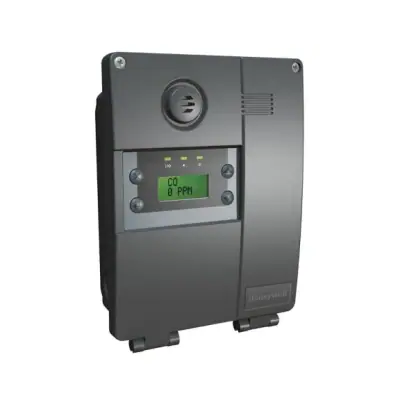
- ± 3% Full Scale @25°C
- Yes
- >85 dBA @3m (10 ft)
Price on request
Midas S2
Environmental and Gas Sensors
Extractive Gas Detector with Electrochemical Cartridge · Ref. : MIDASS2-GAS-DETECTOR
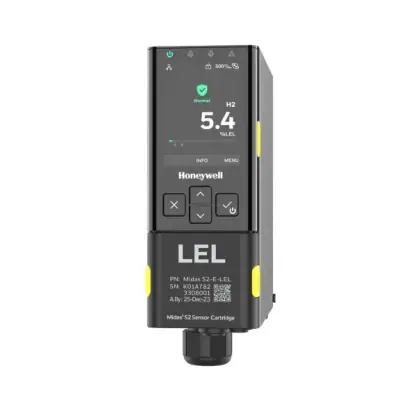
- Honeywell
Price on request
RAEGuard 2 PID
Environmental and Gas Sensors
PID fixed VOC gas detector with internal pump
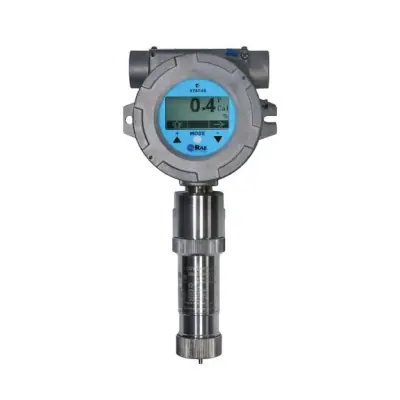
- Yes
- 3-Wire
- 4 to 20 mA
Price on request
LORAWAN-GAS-SENSOR
Environmental and Gas Sensors
LoRaWAN electrochemical gas sensor H₂S, NH₃, O₂ or ethylene
- Factory calibrated
Price on request
S-CO2-01A
CO2 Sensors
NDIR CO2 Sensor with UART and I2C Interfaces · Ref. : 101990665
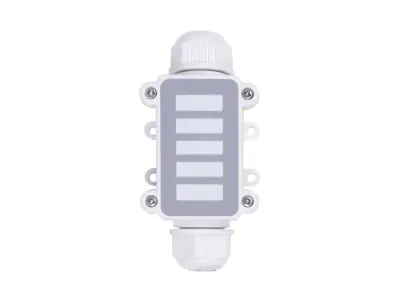
- 400 to 10,000ppm
- ±3%RH
- < 0.25 %RH / year
Price on request
A project? Our engineers build the solution with you.
Send your requirements: Atlas proposes the architecture, the bill of materials and a quotation, then follows the supply.
Request a quotationRelated pages
 Use caseIndoor Air Quality in Logistics & WarehousingHardware architecture and field deployment guide addressing operational requirements. Certified industrial hardware, custom integration, and supply on quotation.
 OfferIndoor Air Quality kit for Logistics & WarehousingComplete hardware package ready for industrial deployment. Verified components, architecture review by Atlas engineering desk, and procurement on quotation.
 ArticleIndoor air quality sensors: NDIR CO2, VOC and particulate measurementBuyer guide to selecting NDIR CO2, MOX VOC, and PM2.5/PM10 indoor air quality sensors and comparing LoRaWAN, BACnet, and Modbus wiring.
 Use caseSmart Building in Robotics & AutomationHardware architecture and field deployment guide addressing operational requirements. Certified industrial hardware, custom integration, and supply on quotation.
 OfferSmart Building kitComplete hardware package ready for industrial deployment. Verified components, architecture review by Atlas engineering desk, and procurement on quotation.
 OfferSmart Building kit for Agriculture & Environmental MonitoringComplete hardware package ready for industrial deployment. Verified components, architecture review by Atlas engineering desk, and procurement on quotation.
 OfferSmart Building kit for Energy, Power Grids & UtilitiesComplete hardware package ready for industrial deployment. Verified components, architecture review by Atlas engineering desk, and procurement on quotation.
 OfferSmart Building kit for Healthcare & Medical DevicesComplete hardware package ready for industrial deployment. Verified components, architecture review by Atlas engineering desk, and procurement on quotation.