
Electromagnetic Coupling and Operating Physics in RFID and NFC
Radio frequency identification operates across distinct physical regimes determined by communication wavelength and antenna coupling mechanisms. High frequency RFID and Near Field Communication utilize inductive coupling in the reactive near-field region through inductive planar coil antennas. In this configuration, the interrogator produces an alternating magnetic field that powers the passive tag integrated circuit via mutual induction. Data transmission occurs through load modulation over restricted communication ranges that typically remain below ten centimeters.
Conversely, ultra high frequency RFID relies on electromagnetic radiative coupling in the far-field propagation zone using modulated backscatter principles. Passive UHF tags capture radiated radio waves emitted by the reader antenna, rectify incoming radio frequency energy into direct current to energize the silicon IC, and backscatter data by toggling their reflection coefficient. This physical mechanism enables reading distances reaching several meters and simultaneous multi-tag identification.
Spectral Allocation and International Protocol Standards
Industrial identification relies on harmonized radio spectrum bands governed by international standardization bodies. The 13.56 MHz high frequency spectrum incorporates ISO 14443 for proximity identification and ISO 15693 for vicinity tracking up to one meter. The NFC Forum defines specialized application modes including card emulation, reader and writer mode, and peer-to-peer data transport. These protocols specify cryptographic authentication handshakes and collision resolution for short-range transaction security.
In the 860 to 960 MHz spectrum, UHF RFID follows the ISO 18000-6 C standard alongside EPCglobal Gen2 protocols. This framework employs dynamic slotted-aloha anti-collision algorithms to inventory hundreds of tags per second across reader interrogation zones. Regional frequency allocations dictate transmission limits, distinguishing European ETSI channels around 865 MHz from North American FCC bands with differing radiated power thresholds.
Silicon Transponders and Hardened Tag Form Factors
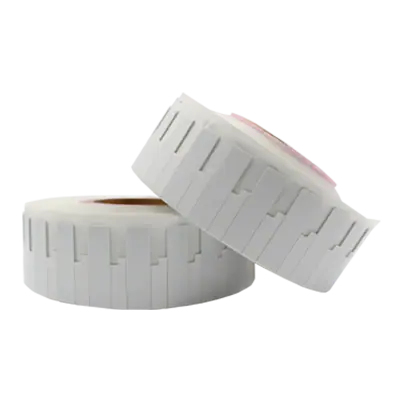
Industrial environments present challenging deployment surfaces that attenuate or detune standard antenna designs. In the UHF RFID Tags category, the SpeedingIoT R5515 transponder features a flexible anti-metal construction with dimensions of 55 x 15 x 1.25 mm. Equipped with the Impinj Monza R6P chip, it specifies a minimum operating temperature of -40 °C or lower for application on metal surfaces.
For temperature monitoring in high frequency operations, the SpeedingIoT N6434 label measures 64 x 34 mm and integrates the FM 13 DT 160 silicon circuit. Engineered for non metal media, it serves cold chain logistics and medical sample tracking. Hardware evaluators must review tag chip read sensitivity, memory bank partition sizes, and substrate resistance against environmental stresses during industrial operation.
Stationary Interrogators and Embedded Reader Modules
Interrogator hardware coordinates radio signal transmission and baseband decoding across industrial control systems. Under the UHF RFID Readers classification, the Chainway R3S reader incorporates Impinj E Series technology with Gen2X within an enclosure measuring 255 mm × 235 mm × 18 mm. It features one Ethernet port, PoE support, Bluetooth 5.0 connectivity, and an operating temperature range of -20°C to 50°C, fitting automated conveyor lines.
For proximity interactions, HF and NFC Readers like the ACS ACR1222L provide USB connectivity through a Standard Type A connector and a 1.5 m cable. This desktop unit measures 133.5 mm x 88.5 mm x 21.0 mm, features a Monotone buzzer, and supports Windows, Linux, and Android. For embedded electronics, the RAKwireless R5515 module for WisBlock operates from an input voltage 3 V 3 S of 3.3 V typical across an ambient temperature of -30 to 80 °C.
Technical Evaluation Parameters on Hardware Datasheets
Selecting radio identification components demands rigorous inspection of electrical, RF, and mechanical constraints documented in product datasheets. System integrators must examine antenna beamwidth and polarization characteristics, distinguishing linear polarization for oriented tag streams from circular polarization for random object trajectories. Environmental ratings such as IP ingress protection and thermal boundaries establish whether hardware withstands washdown cycles or outdoor storage.
On the receiver side, key metrics include receiver sensitivity in decibels-milliwatts, dynamic range, and transmitter output power adjustability. Host connectivity interfaces such as Industrial Ethernet, Modbus, or RS-232 define how smoothly readers integrate into programmable logic controllers. Memory configurations, cryptographic hardware accelerators, and middleware compatibility must be evaluated directly from manufacturer specifications to confirm operational interoperability across enterprise platforms.
Deployment in Industrial Workflows and Automated Facilities
Implementing contactless identification optimizes material tracking through manufacturing cells and distribution facilities. Ultra high frequency RFID enables bulk tracking of returnable transport items, metal pallets, and work-in-progress subassemblies moving through portal antennas at high transit speeds. Automated warehouse management systems record gate crossings without manual optical scanning, maintaining accurate inventory records across automated logistics hubs.
Conversely, NFC protocols serve operator interaction and machine parameter configuration. Industrial technicians tap mobile terminals against equipment tags to access maintenance logs or upload calibration offsets without opening electrical cabinets. This short-range magnetic coupling ensures that configuration actions remain strictly restricted to the physical presence of authorized personnel, preventing accidental commands and strengthening localized equipment security across automated industrial plants.
Frequently asked questions
What is the primary operational difference between UHF RFID and NFC?
UHF RFID operates between 860 and 960 MHz using far-field electromagnetic backscatter, enabling simultaneous multi-tag reading over several meters. NFC functions at 13.56 MHz through near-field inductive coupling, intentionally restricting read ranges to under ten centimeters for localized, secure proximity data transfer.
Why do UHF RFID tags require on-metal spacer materials when mounted on metallic assets?
Metal surfaces reflect electromagnetic waves and detune standard tag antennas, altering input impedance and preventing energy harvesting by the integrated circuit. Anti-metal tags incorporate dielectric spacers or ground-plane antenna geometries that decouple the radiating element from the conductive backing.
Which electrical specifications should be evaluated on an RFID reader datasheet?
Evaluators must check receiver sensitivity expressed in decibels-milliwatts, adjustable output RF power levels, operating power consumption via PoE or DC inputs, and industrial communication interfaces such as Ethernet, Modbus, or RS-232.
When should an installation specify circular rather than linear antenna polarization?
Linear polarization maximizes communication range when tags maintain a fixed, known physical orientation relative to the reader. Circular polarization emits a rotating helical wave pattern that reads tags reliably regardless of their spatial tilt along conveyors.
Products mentioned
ACR1222L
HF and NFC Readers
USB NFC Reader with LCD and 3 SAM Slots · Ref. : ACR1222L

Price on request
R3S
UHF RFID Readers
All-in-one desktop UHF RFID reader with Impinj E Series and Gen2X

- About Chainway
- Near-Field Antenna
- BLE 5.0
Price on request
R5515
UHF RFID Tags
Flexible Anti-metal RFID UHF Label 55 x 15 mm
- metal surface
- Impinj Monza R6P
- > 10 years
Price on request
N6434
UHF RFID Tags
13.56 MHz card RFID label for cold chain tracking

Price on request
A project? Our engineers build the solution with you.
Send your requirements: Atlas proposes the architecture, the bill of materials and a quotation, then follows the supply.
Request a quotationRelated pages
 Use caseUHF RFID Inventory and Traceability in Electronics & OEM/ODMThis technical guide explains UHF RFID implementation to maintain component traceability and inventory control across electronics OEM lines.
 Use caseFleet Transportation and Traceability Architecture for Warehouse LogisticsThis technical guide details cellular gateway integration and RFID tracking architectures for fleet vehicles in warehouse logistics.
 ProjectUHF RFID Readers, NFC Modules & Industrial TagsSelection guide for ETSI 865-868 MHz UHF RFID readers, NFC modules, and anti-metal tags for industrial projects supplied on quotation.
 ProjectHardware for Logistics & Warehousing projectsThis technical guide helps Logistics and Warehousing buyers select UHF RFID, rugged handhelds, and asset trackers on quotation.
- Use caseCold Chain Monitoring in Logistics and WarehousingThis technical guide details the hardware architecture and RF protocols required for cold chain monitoring across warehousing facilities.
 Use caseConnected Livestock in Logistics and Warehousing InfrastructuresThis guide details the integration of livestock tracking tags and LoRaWAN gateways within warehouse management and animal logistics flows.
 Use caseConnected Senior Living in Logistics & WarehousingDiscover how connected senior living logistics overcomes UHF pallet physics and WMS integration through robust multi-sensor architectures.
 Use caseGuard Tour Control in Logistics & WarehousingThis technical guide details guard tour control in logistics warehouses, covering anti-metal checkpoints, rugged terminals, and WMS sync.
 OfferUHF RFID Inventory and Traceability Kit for Electronics & OEM/ODMSpecify a UHF RFID inventory and traceability kit for electronics OEM/ODM lines, from readers to anti-metal tags, supplied on quotation.