
System on Module architecture and carrier board functional split
A System on Module, categorized under System on Modules (SoM) and System on Modules (SoM) & Computer on Modules (CoM), concentrates the core computing subsystem onto a compact daughterboard. It integrates the application processor, volatile DDR or LPDDR memory, non-volatile eMMC or QSPI Flash storage, power management circuits, and precision clock generation. By encapsulating these dense components into a pre-engineered building block, the architecture cleanly separates general-purpose computing from application-specific hardware.
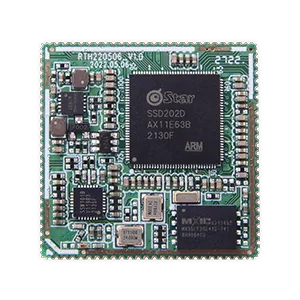
The custom carrier board hosts only the interfaces required by the target equipment, such as industrial fieldbuses, power stages, galvanic isolation, and mechanical connectors. For example, the Geniatech SOM20X uses stamp hole packaging with 96 pins at a 1.1 mm pitch to expose MIPI DSI, RGB, four UART ports, SDIO 2.0, I2C, I2S, SPI, and PWM signals. Architects should check pin assignments in the datasheet.
Evaluating SoM plus carrier board against off-the-shelf SBC and chip-down PCB
Selecting an embedded computing topology requires weighing annual production volumes, enclosure constraints, and NRE engineering budgets. An off-the-shelf SBC suits rapid prototyping or low-volume deployments without tight spatial limits, yet locks connector placement and exposes designs to board-level obsolescence. Conversely, a full chip-down PCB design minimizes per-unit bill of materials at massive scale, but demands substantial upfront layout effort, extended bring-up cycles, and multi-layer fabrication complexity.
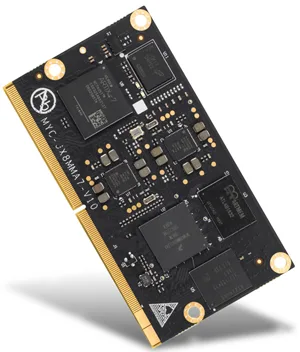
A SoM plus carrier board approach occupies the practical middle ground for small-to-medium industrial series. Leveraging a module from the ARM SOMs family lets engineering teams customize form factors, ruggedized I/O, and power rails without redesigning the CPU core. For instance, the MYIR MYC-JX8MMA7 pairs a quad-core Cortex-A53 with an Artix-7 FPGA, 2 GB LPDDR4, 8 GB eMMC, and 32 MB QSPI Flash inside an 82 by 45 mm footprint.
High-speed DDR and PCIe routing isolation and thermal design
Routing modern processors involves stringent signal integrity rules that a SoM confines to a high-density multi-layer PCB. High-speed DDR, LPDDR4, and DDR3 memory buses require tight trace length matching, controlled differential impedance, and uninterrupted reference ground planes across eight to twelve layers. By isolating these sensitive memory traces on the module, the carrier board often drops to four or six layers, simplifying PCB manufacturing and electromagnetic compliance.
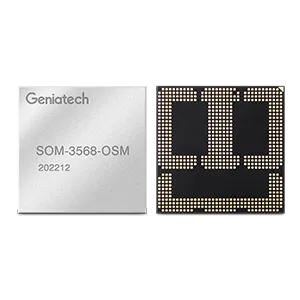
High-speed I/O lanes routed off the module, including PCIe, Gigabit Ethernet, MIPI-DSI, and MIPI-CSI, still demand controlled impedance traces on the carrier board. Thermal dissipation must also align with the enclosure environment. The Geniatech SOM-3568J-OSM, powered by a Rockchip RK3568J quad-core ARM Cortex-A55, specifies a minimum operating temperature of -40 °C or lower alongside two Ethernet ports and CAN bus, which buyers should verify in the datasheet.
Industrial standards: SMARC, COM Express, Qseven and solderable OSM modules
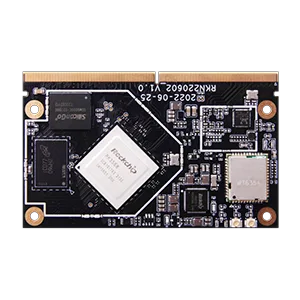
Mechanical and electrical standards safeguard long-term modularity across hardware revisions. SMARC targets low-power ARM architectures through a 314-pin edge connector within an 82 by 50 mm footprint. For example, the Geniatech SOM-3568-SMARC features a quad-core 64-bit Cortex-A55 processor on a 22 nm lithography process up to 2.0 GHz, supporting HDMI, LVDS, eDP, and MIPI-DSI displays alongside MIPI-CSI, audio, CAN bus, and PoE interfaces.
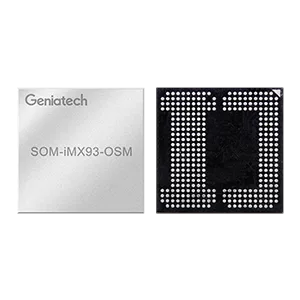
Higher-throughput designs frequently turn to COM Express Modules, which rely on board-to-board connectors engineered for multiple PCIe lanes, while Qseven addresses slim profiles with moderate power envelopes. For harsh shock and vibration environments, solderable OSM-S and OSM-L modules eliminate mechanical connectors altogether. The Geniatech SOM-IMX93-OSM integrates an NXP i.MX93 dual-core ARM Cortex-A55 with an ARM Cortex-M33 and a 0.5 TOPS NPU, exposing two Ethernet ports, CAN-FD, 4-lane MIPI-DSI, and 2-lane MIPI CSI-2.
Lifecycle longevity, Yocto Project maintainability and hardware scaling
Industrial equipment often requires ten to fifteen years of uninterrupted field availability. When a discrete memory IC or power regulator reaches end-of-life, the SoM vendor updates the internal bill of materials while preserving identical pinouts and mechanical dimensions. Original equipment manufacturers thereby avoid redesigning their entire carrier board and secure continued supply on quotation without re-engineering application interfaces.
On the software side, module suppliers maintain Linux board support packages built around Yocto Project layers to sustain the kernel, bootloader, and device tree over time. This abstraction layer also simplifies migrating an existing carrier board to a newer processor generation when compute requirements grow. Before production commitment, engineering teams must verify the supported Linux kernel version, available security patches, and Yocto release branch inside the vendor documentation.
Technical selection checklist before requesting a SoM quotation
Selecting the right SoM begins by mapping native I/O requirements onto the carrier board. The Geniatech SOM-3568-SMARC suits multi-display terminals via HDMI, LVDS, eDP, and MIPI-DSI outputs, whereas the Geniatech SOM-IMX93-OSM fits compact gateways requiring two Ethernet ports, CAN-FD, UART, I2C, SPI, and PWM. For deterministic parallel processing alongside ARM compute, the MYIR MYC-JX8MMA7 integrates RS-232, RS-485, and CAN bus with an Artix-7 FPGA.
Before finalizing an architecture and requesting a supply quotation, buyers should verify critical electrical and environmental ratings in each datasheet. Check the minimum operating temperature, 0 °C or higher on the MYIR MYC-JX8MMA7 versus -40 °C or lower on the Geniatech SOM-3568J-OSM, along with supply rails, memory capacities, footprint, and Yocto BSP coverage. Confirming these parameters early prevents carrier board revisions during hardware bring-up.
Frequently asked questions
What is the core difference between a System on Module and an off-the-shelf SBC?
An SBC combines the processor, memory, and external connectors on a fixed board. A module from the System on Modules (SoM) & Computer on Modules (CoM) family isolates the compute core so engineers can route custom I/O, power, and mechanical layouts on a dedicated carrier board.
When does a chip-down custom PCB become preferable to a SoM architecture?
A chip-down PCB becomes attractive when very high annual production volumes offset high NRE layout costs, multi-layer impedance engineering, and long bring-up schedules. For low-to-medium volumes or product families sharing one compute core, a SoM reduces development risk.
How do SMARC, COM Express, and OSM standards differ in mechanical mounting?
SMARC uses a 314-pin edge connector in an 82 by 50 mm format suited to low-power ARM SoMs, while COM Express Modules employ high-density board-to-board connectors for high-lane PCIe designs. OSM-S and OSM-L are surface-solderable modules that eliminate connector fatigue under vibration.
What should buyers verify regarding Yocto Project support on an ARM SoM?
Buyers should check the module datasheet and BSP release notes for the exact Linux kernel version, bootloader support, Yocto Project branch compatibility, and peripheral drivers covering interfaces such as MIPI-CSI, MIPI-DSI, Ethernet, and CAN-FD.
Products mentioned
SOM-3568J-OSM
System on Modules (SoM) & Computer on Modules (CoM)
RK3568J OSM-L quad-core Cortex-A55 system-on-module · Ref. : SOM-3568J-OSM
- LVDS & HDMI
- PCIe, SDIO 3.0
Price on request
SOM-iMX93-OSM
System on Modules (SoM) & Computer on Modules (CoM)
i.MX93 OSM-S System-on-Module with 0.5 TOPS NPU · Ref. : SOM-IMX93-OSM
- Headphone, MIC IN, SPK
Price on request
SOM20X
System on Modules (SoM) & Computer on Modules (CoM)
Sigmastar SoM module for smart displays
- MIPI DSI; RGB
Price on request
SOM-3568-SMARC
System on Modules (SoM) & Computer on Modules (CoM)
RK3568 quad-core SMARC system-on-module · Ref. : SOM-3568-SMARC
- 82*50 mm
Price on request
MYC-JX8MMA7
System on Modules (SoM) & Computer on Modules (CoM)
Quad-core Cortex-A53 SoM CPU module with Artix-7 FPGA · Ref. : MYC-JX8MMA7
- Parameter
- YES
- 1 x MIPI-CSI
Price on request
A project? Our engineers build the solution with you.
Send your requirements: Atlas proposes the architecture, the bill of materials and a quotation, then follows the supply.
Request a quotationRelated pages
 Buying guideHow to choose COM Express ModulesReference guide for selecting the right equipment from the Atlas catalogue. Technical criteria, architectures, design pitfalls, and bill of materials quotation by our engineers.
 WikiCAN busTechnical definition, operating principles, industrial standards, and datasheet selection criteria for hardware integration projects supported by Atlas engineers.
 ProjectSystem on Modules (SoM) & COM Express Compute ModulesCompare ARM SoM, NVIDIA Jetson, and COM Express modules for carrier board integration, thermal planning, and quotation requests.
 Use caseEdge AI in Electronics & OEM/ODMHardware architecture and field deployment guide addressing operational requirements. Certified industrial hardware, custom integration, and supply on quotation.
 ProjectHardware for Electronics & OEM/ODM projectsSource the right industrial hardware for your deployment. Validated architectures, rugged components, bill of materials review, and full supply on quotation.
 ArticleHow to choose hardware for Electronics & OEM/ODMOEM/ODM hardware buying guide: lifecycle planning, CE/RED radio compliance, and architecture trade-offs across modules, SoMs, and boards.
 Use caseMachine Vision in Electronics & OEM/ODMHardware architecture and field deployment guide addressing operational requirements. Certified industrial hardware, custom integration, and supply on quotation.
 Use caseRaspberry Pi AI Vision in Electronics & OEM/ODMHardware architecture and field deployment guide addressing operational requirements. Certified industrial hardware, custom integration, and supply on quotation.
 Use caseRobotics in Electronics & OEM/ODMHardware architecture and field deployment guide addressing operational requirements. Certified industrial hardware, custom integration, and supply on quotation.