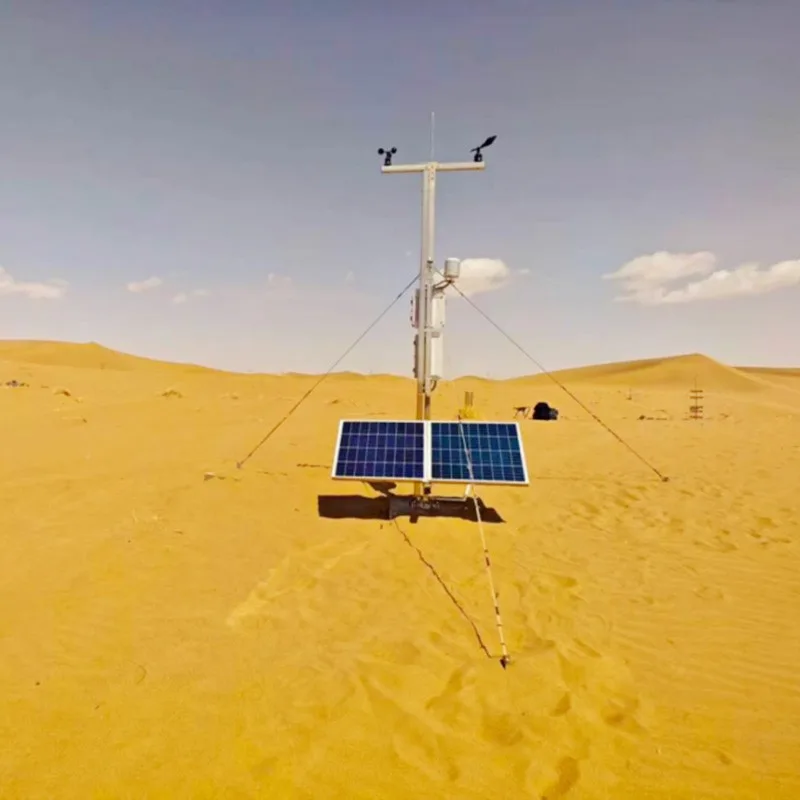
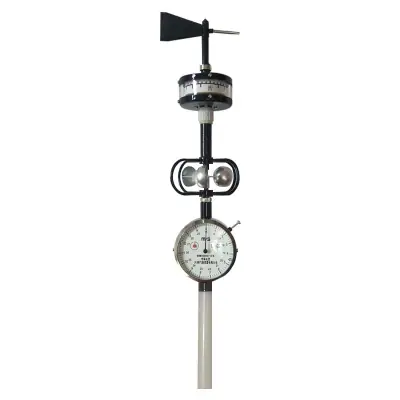
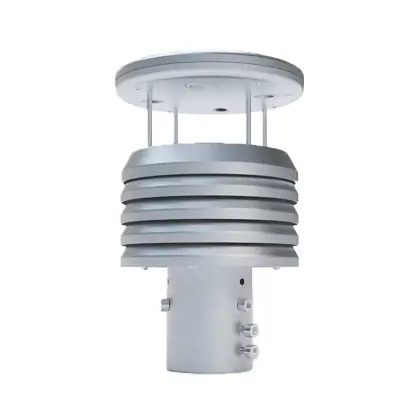
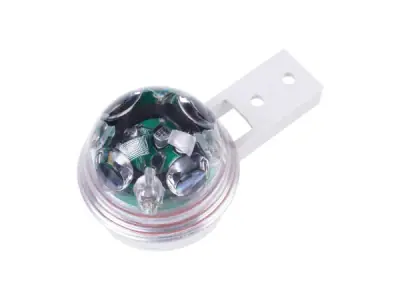
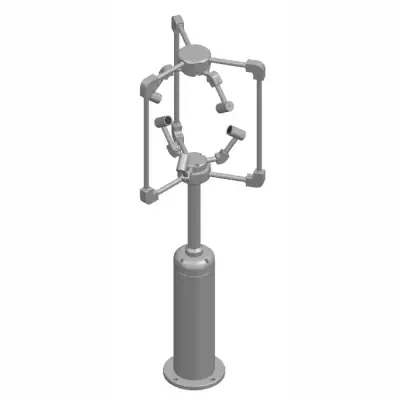
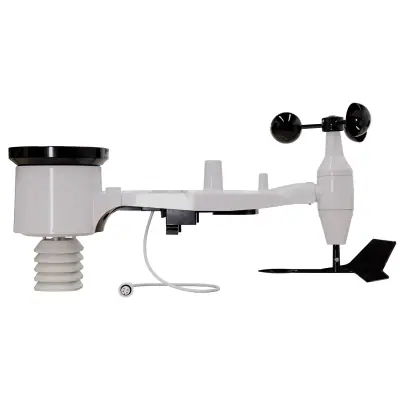
Fengtu FT-FSQ1 automatic weather station measuring sand transport and wind erosion kinetic energy, with continuous recording of meteorological parameters. Available on quotation.
Continuous rainy days and extended range≥15 days
Monitoring Elements — Measurement Range — Resolution — Accuracy — Unit — Number of observation layersWorking Principle
Bracket height2m
Cloud PlatformDual-end access for desktop and mobile
Overview. The Fengtu FT-FSQ1 wind erosion automatic weather station provides continuous, automated monitoring of sand transport rate and wind erosion kinetic energy. It simultaneously records wind speed and direction, air temperature and relative humidity, precipitation and total solar radiation. The system runs unattended, with local data storage and remote data transmission.
Main characteristics. Wind speed measurement from 0 to 50 m/s with 0.1 m/s resolution, wind direction from 0 to 360° with mechanical bearings, ambient temperature from -50 to 80 °C by platinum resistance measurement with ±0.2 °C accuracy, relative humidity from 0 to 100 %RH with ±3 %RH accuracy using a humidity-sensitive capacitor, precipitation from 0 to 999.9 mm by bucket-type gauge, total radiation from 0 to 2500 W/m² by thermoelectric stack, and collected sand weighing from 0 to 5000 g with automatic weighing and automatic sand unloading. The sampling interval is adjustable remotely from 1 min to 24 h. Onboard storage is at least 256 GB, with automatic cyclic storage and no loss of historical data on power failure.
Interfaces and connectivity. 4G/5G full network coverage with BeiDou backup channel, compliant with the SL 651-2014 hydrological monitoring data communication protocol. Transmission protocols include MQTT, TCP and MODBUS TCP. A standard API supports integration with third-party platforms, and the cloud monitoring platform is accessible from desktop and mobile.
Power and installation. Powered by solar battery or 220 V AC. Integrated on-site fixed installation on a 2 m, 304 stainless steel bracket.
Typical uses. Monitoring of desertification, grassland ecosystems, wind erosion of farmland soil, fugitive dust in mining areas and wind-sand hazards along highways and railways, monitoring of soil and water conservation efforts, and assessment of ecological restoration. The collected data can also support monitoring of distributed photovoltaic power plants.
Monitoring Elements — Measurement Range — Resolution — Accuracy — Unit — Number of observation layers
Working Principle
Photovoltaic Weather Stations
Collecting Environmental Data to Support the Stable Operation of Distributed PV Power Plants
Power supply method
Solar battery / 220V AC
Precipitation — 0~999.9 — 0.2 — ±2% — mm — 1
Bucket-type
Project
Parameters
Relative humidity — 0~100 — 1 — ±3 — %RH — 1
Humidity measurement using a humidity-sensitive capacitor
Sampling interval
1 min ~ 24 h, remotely adjustable
Storage and Transmission Layer — Local storage unit, 4G/5G and BeiDou communication unit
Data storage, protocol conversion, remote reporting
Storage Mode
Automatic cyclic storage, checkpointing, and no loss of historical data upon power failure.
Total radiation — 0~2500 — 1 — ±3% — W/m² — 1
Thermoelectric stack
Transmission protocol
MQTT, TCP, MODBUS TCP
Water PH Sensor
Selection, Installation, and Maintenance
Wind direction — 0~360 — 1 — ±3 — ° — 1
Mechanical bearings
Wind speed — 0~50 — 0.1 — ±0.3+0.03V — m/s — 4
Three-cup mechanical bearing
No specification matches.
Last verification : 2026-11-02
Applications and use cases
Architectures in which WIND-EROSION-AUTOMATIC-WEATHER-STATION can play a role, derived from its category. This is not a compatibility statement: check the specifications against your requirements.
Diseases and water stress are noticed once the crop is already affected. A weather station, soil probes and sensor nodes in the field report conditions through an outdoor gateway
To check
Crops, plots and measurement depth of the soil probes
Power of the field devices (battery, solar)
Gateway coverage over the farm
Associated system blocks
Weather stationSoil and field sensorsGateway
Need a complete solution?
Send a request for WIND-EROSION-AUTOMATIC-WEATHER-STATION and the other parts of your project.
Answers to the questions that the recorded characteristics of WIND-EROSION-AUTOMATIC-WEATHER-STATION can answer. A question is not asked when nothing is recorded to answer it.
1Does it support Modbus?
Yes — recorded under "Transmission protocol": MQTT, TCP, MODBUS TCP.
2Does it support 5G?
Yes — recorded under "Communication Method": 4G/5G full network coverage, supports BeiDou backup channel.
3Does it support 4G/LTE?
Yes — recorded under "Communication Method": 4G/5G full network coverage, supports BeiDou backup channel.
Similar parts to answer your needs. Compare the main characteristics. A recorded replacement is a documented relation; a similar product is a similarity only, never a compatibility claim.
Current productFengtu
WIND-EROSION-AUTOMATIC-WEATHER-STATION
Wind erosion automatic weather station
Continuous rainy days and extended range
≥15 days
Monitoring Elements — Measurement Range — Resolution — Accuracy — Unit — Number of observation layers
What is recorded about the regulatory status and the life of this part.
Regulatory compliance
No compliance statement is recorded for this part. Ask the supplier for the RoHS and REACH declarations and, for a radio product, the EU declaration of conformity.
With your consent, we use Google cookies to measure the site’s audience and our advertising. Your quote basket and comparison stay in your browser either way. Details