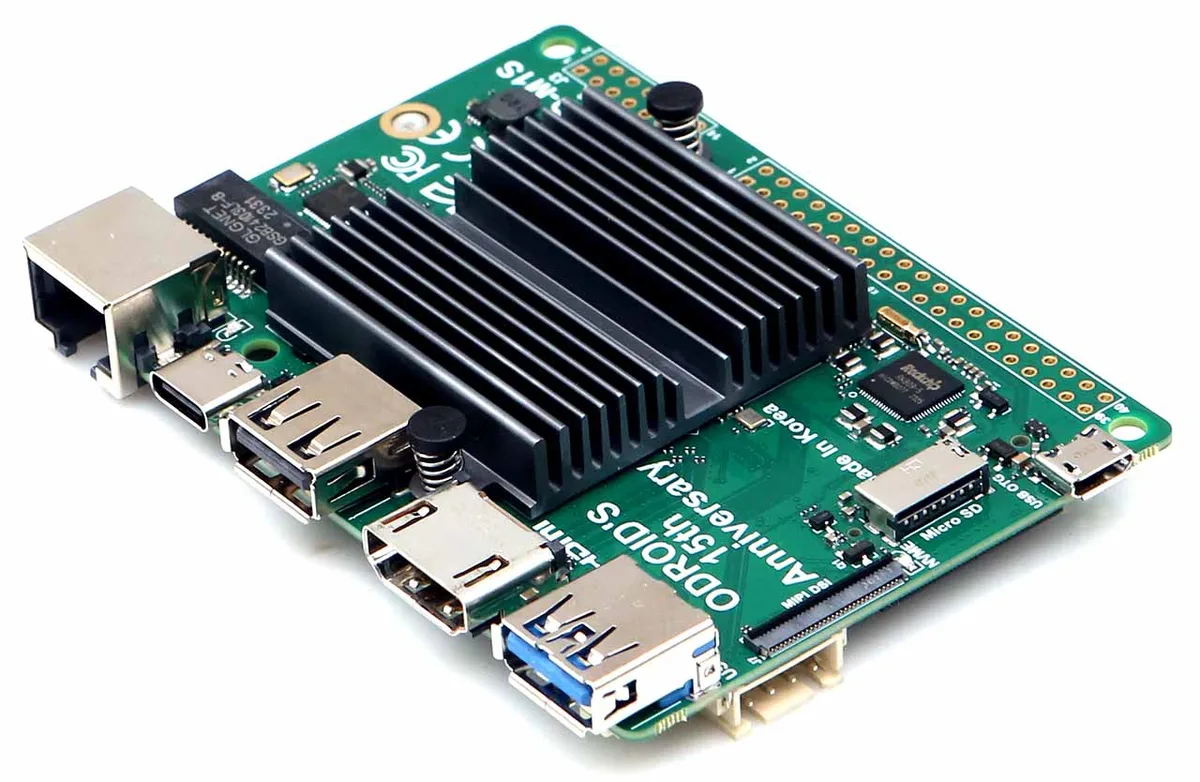
Hardkernel ODROID-M1S. ARM single board computer (SBC) built on a Rockchip RK3566 quad-core Cortex-A55 processor clocked at 1.8 GHz with 8 GB of LPDDR4 memory, in a 90 mm x 65 mm x 16 mm format weighing 52 g including the heatsink.
Processor and memory. Quad-core Cortex-A55 at 1.8 GHz (ARMv8-A architecture with Neon and Crypto extensions), Mali-G52 GPU with 2 execution engines at 800 MHz, LPDDR4 memory with a 32-bit bus at 2112 MT/s. The 512 KB L3 data cache is shared by the four cores.
Artificial intelligence. Integrated RKNN NPU of 0.8 TOPS at INT8, supporting one-click switching of Caffe, TensorFlow, TFLite, ONNX, PyTorch, Keras and Darknet models.
Storage. 64 GB eMMC soldered to the board, UHS-I SDR104 microSD slot whose boot priority is higher than the eMMC, and an M.2 NVMe slot (PCIe 2.1 x 1 lane) in the 2280 form factor.
Connectivity and interfaces. GbE RJ45 port (10/100/1000 Mbps) with Realtek RTL8211F transceiver and activity LEDs, 1 x USB 3.0 host port, 1 x USB 2.0 host port, 1 x USB 2.0 micro OTG port, debug serial console (UART), 40-pin GPIO connector and 14-pin GPIO connector.
Video. HDMI 2.0 output up to 4K@60Hz with HDR and EDID, and a 30-pin MIPI DSI interface.
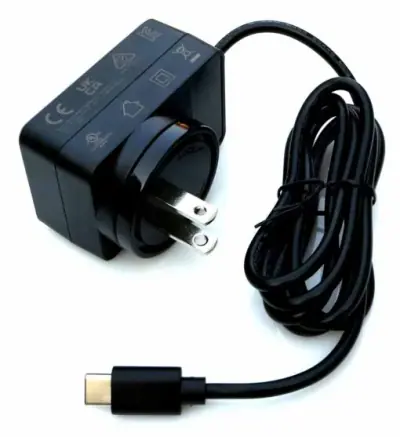
Power. DC input from 4.9 V to 5.3 V, USB Type C 5 V/3 A adapter recommended. Consumption of about 1.1 W at idle and about 3.52 W under CPU stress (performance governor). RTC backup battery connector to keep time and date for several months without main power.
Indicators. Red POWER LED, blue ALIVE LED (flashing while the kernel runs), green network LED at 100 Mbps and amber LED at 1000 Mbps.
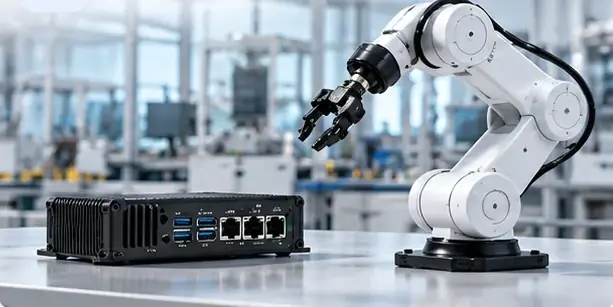
Integration. Hardkernel board-support package including bootloader, kernel, partition table, build instructions, boot sequence and USB-UART console debugging. The GPIO and UART interfaces support the development of custom embedded systems. Available on quotation from Atlas Electronics.