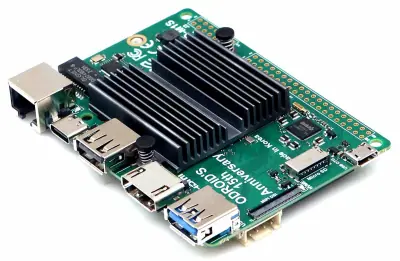
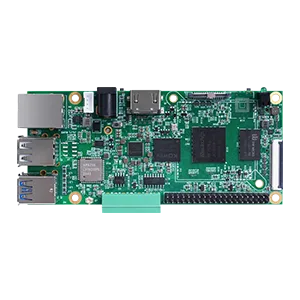
Overview. The Hardkernel ODROID-M1S is an ARM single board computer (reference G231031113237) measuring 90 mm x 65 mm x 16 mm, weighing 52 g including heatsink. It follows the ODROID-M1 design with a thinner board and reduced power consumption.
Processor and memory. The Rockchip RK3566 processor includes four Cortex-A55 cores at 1.8 GHz, an ARMv8-A architecture with Neon and Crypto extensions, and a Mali-G52 GPU at 800 MHz. The 4 GB LPDDR4 memory uses a 32-bit bus width with a data rate of 2112 MT/s.
Storage. A 64 GB eMMC is soldered to the board, a UHS-I SDR104 Micro SD slot is provided with boot priority always higher than eMMC, and an M.2 NVMe slot (PCIe 2.1 x 1 lane) gives access to large data storage.
Connectivity and interfaces. The board offers one GbE RJ45 LAN port (10/100/1000 Mbps, Realtek RTL8211F transceiver), one USB 3.0 host port, one USB 2.0 host port, one USB 2.0 micro OTG port, a UART debug serial console, a 40-pin and a 14-pin GPIO, and an RTC backup battery connector.
Video and display. One HDMI 2.0 output supports up to 4K@60Hz with HDR and EDID, and a 30-pin MIPI DSI interface is available.
AI. An integrated RKNN NPU delivers 0.8 TOPS@INT8 and supports one-click switching between Caffe, TensorFlow, TFLite, ONNX, PyTorch, Keras and Darknet.
Power. Power is supplied through a USB Type C port for power only, with a DC input of 4.9V to 5.3V; a USB Type C 5V/3A power adapter is recommended. Consumption is about 1.1 W idle and about 3.52 W under CPU stress (performance governor), and about 0 W when powered off.
Indicators. A red POWER LED is solid when DC power is connected, and a blue ALIVE LED flashes like a heartbeat while the kernel runs and stays solid during the u-boot stage.
Typical uses. The 40-pin GPIO and UART allow connection to sensors and actuators, and the RKNN NPU suits inference of embedded artificial intelligence models. The software board-support package includes the bootloader, kernel, partition table and build instructions.