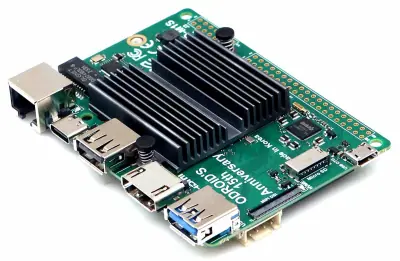
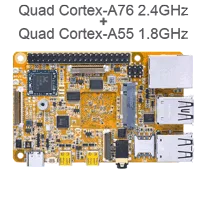
Hardkernel ODROID-M1S Lite 2 GB ARM single board computer with a Rockchip RK3566 quad-core processor, a 0.8 TOPS RKNN NPU and a 32 GB soldered eMMC, for embedded systems.
Product overview
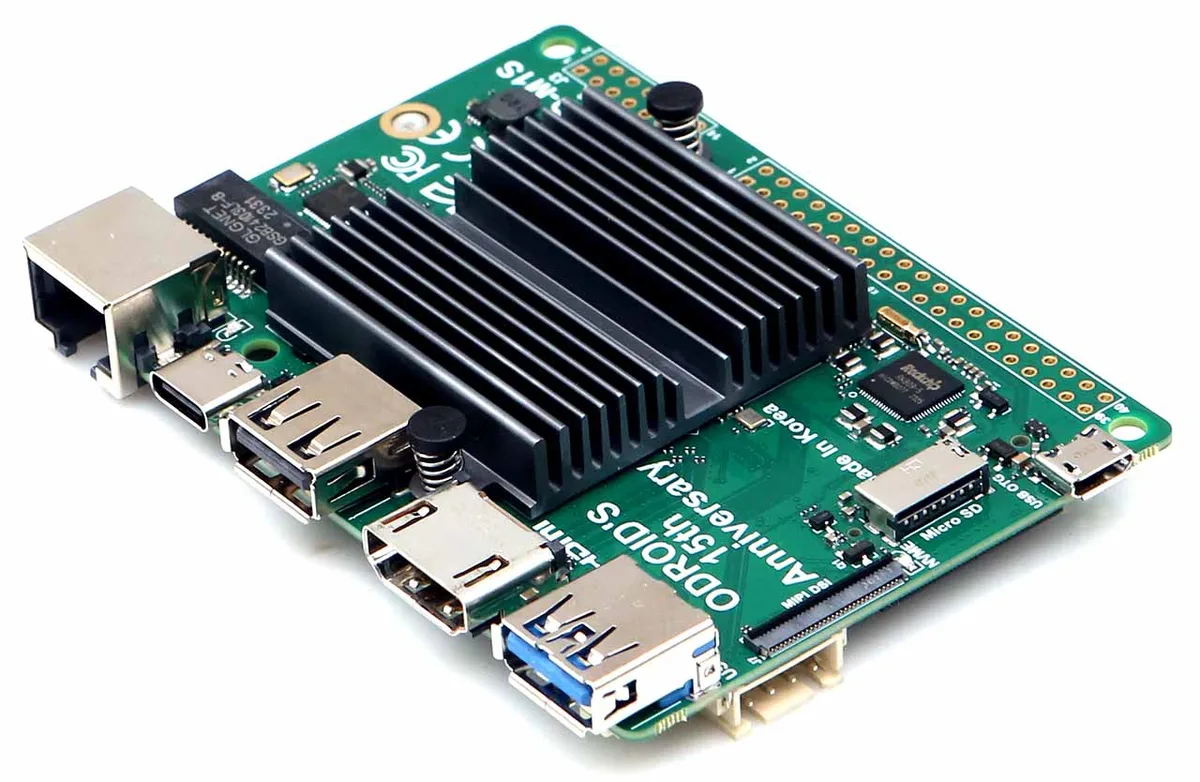
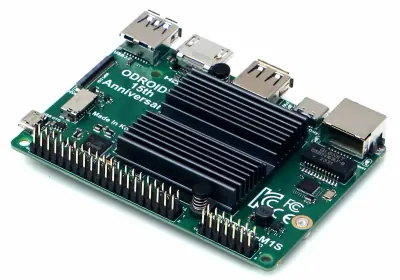
ODROID-M1S Lite 2 GB. ARM single board computer Hardkernel — The Hardkernel ODROID-M1S Lite is an ARM single board computer measuring 90 mm x 65 mm x 16 mm, weighing 52 g including its heatsink. — Processor and memory — The Rockchip RK3566 processor integrates four Cortex-A55 cores at 1.8 GHz (ARMv8-A architecture with Neon and Crypto extensions), a Mali-G52 GPU at 800 MHz and 2 GiB of LPDDR4 memory on a 32-bit bus at 2112 MT/s. An integrated RKNN NPU delivers 0.8 TOPS@INT8 and supports one-click switching between Caffe, TensorFlow, TFLite, ONNX, PyTorch, Keras and Darknet. — Storage — A 32 GB eMMC is soldered to the board, complemented by a UHS-I SDR104 micro SD slot whose boot priority is higher than the eMMC, and by an M.2 NVMe slot (PCIe 2.1 x 1 lane). — Connectivity and interfaces — One GbE RJ45 LAN port (10/100/1000 Mbps) uses a Realtek RTL8211F Ethernet transceiver. The board provides one USB 2.0 host port, one USB 3.0 host port, one USB 2.0 micro OTG port, a debug serial console (UART), a 40-pin GPIO header and a 14-pin GPIO header. — Display — One HDMI 2.0 output supports up to 4K@60Hz with HDR, plus a MIPI DSI interface with a 30-pin connector. — Power — Power is supplied through a dedicated USB Type C port for power only, with a DC input of 4.9 V to 5.3 V; a USB Type C 5 V/3 A power adapter is recommended. Consumption is about 1.1 W idle and about 3.52 W under CPU stress with the Performance governor. An RTC backup battery connector keeps time and date for several months without main power. — Software — A Board Support Package provides the bootloader, kernel, partition table, build instructions, boot sequence and USB-UART console debugging. — Typical uses — Thanks to its GPIO headers, UART console and USB and PCIe interfaces, the board suits the development of embedded systems requiring AI processing at the edge. — Integration — The system LEDs (red POWER, blue ALIVE) indicate power status and kernel boot progress.
No published question about this part yet. Questions are reviewed before publication.
Complete specifications
Every characteristic recorded for G260828000001, with where it comes from. Use the filters to find one quickly.
All specifications (13)
Characteristic
Value
Form factor
Board Dimensions: 90mm x 65mm x 16mm; Weight: 52g including heatsink
Conf=0.25 — CPU (ms) — NPU (ms)
NPU: Cam (fps)
External I/O
1 x USB 2.0 host port; 1 x USB 3.0 host port; 1 x USB 2.0 micro OTG port; 1 x Debug serial console (UART); 1 x 40 pin GPIO and 1 x 14 pin GPIO
M1S — 1288.3 — 70
11.8
Memory
LPDDR4 2GiB with 32-bit bus width, Data rate: 2112 MT/s, up to 1,055MHz
Networking
1 x GbE LAN ports (RJ45, supports 10/100/1000 Mbps); – Realtek RTL8211F Ethernet transceiver; – LED indicators; * Green LED: Flashing by data traffics at 100Mbps connection; * Amber LED: Flashing by data traffics at 1000Mbps connection
NPU
0.8 TOPS@INT8, Integrated AI accelerator RKNN NPU; Supports one-click switching of Caffe/TensorFlow/TFLite/ONNX/PyTorch/Keras/Darknet
Other features
RTC backup battery connector (to keep time and date for several months without main power input); System LED Indicators:; – Red (POWER) – Solid light when DC power is connected; – Blue (ALIVE) – Flashing like heartbeat while Kernel is running. Solid On in the u-boot stage.
Power
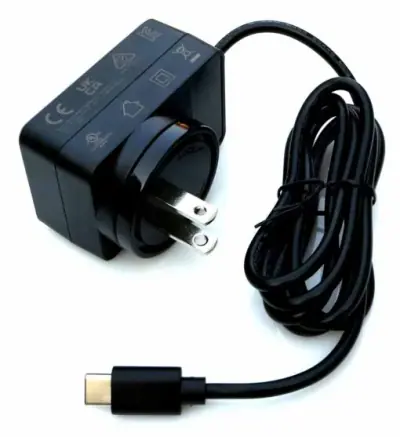
1 x USB Type C for Power only; DC input : 4.9V ~ 5.3V; – USB Type C 5V/3A power adapter is recommended; – IDLE : ≃ 1.1W; – CPU Stress : ≃ 3.52W (Performance governor); – Power Off : ≃ 0W
Processor
Rockchip RK3566 Processor; L1 instruction cache: 32 KB, 4-way set associative (128 sets), 64 byte lines, shared by 1 processor; L1 data cache: 32 KB, 4-way set associative (128 sets), 64 byte lines, shared by 1 processor; L3 data cache: 512KB, 16-way set associative (512 sets), 64 byte lines, shared by 4 processorsQuad-Core Cortex-A55 (1.8GHz); ARMv8-A architecture with Neon and Crypto extensions; Mali-G52 GPU with 2 x Execution Engines (800Mhz)
Software Board-Support-Package
Boot-loader, Kernel, Partition table, How-to-build, Boot-sequence, USB-UART console debugging and so on
Storage
1 x 32GB eMMC embedded (soldered to the PCB); 1 x Micro SD slot (UHS-I SDR104, Boot priority is always higher than eMMC); 1 x NVME M.2 SSD (PCIe 2.1 x 1 lane)
Video
1 x HDMI® 2.0 (up to 4K@60Hz with HDR, EDID); 1 x MIPI DSI Interface (30pin connector which is different from 31pin of the original ODROID-M1)
No specification matches.
Last verification : 2026-11-02
Technical documentation
Official documents and the technical data recorded for G260828000001. For a missing document or a specific revision, our experts send it to you.
1. Technical overview
Hardkernel ODROID-M1S Lite 2 GB ARM single board computer with a Rockchip RK3566 quad-core processor, a 0.8 TOPS RKNN NPU and a 32 GB soldered eMMC, for embedded systems.
Conf=0.25 — CPU (ms) — NPU (ms)NPU: Cam (fps)
M1S — 1288.3 — 7011.8
2. Datasheet extract (recorded values)
Parameter
Value
Form factor
Board Dimensions: 90mm x 65mm x 16mm; Weight: 52g including heatsink
Conf=0.25 — CPU (ms) — NPU (ms)
NPU: Cam (fps)
External I/O
1 x USB 2.0 host port; 1 x USB 3.0 host port; 1 x USB 2.0 micro OTG port; 1 x Debug serial console (UART); 1 x 40 pin GPIO and 1 x 14 pin GPIO
M1S — 1288.3 — 70
11.8
Memory
LPDDR4 2GiB with 32-bit bus width, Data rate: 2112 MT/s, up to 1,055MHz
Networking
1 x GbE LAN ports (RJ45, supports 10/100/1000 Mbps); – Realtek RTL8211F Ethernet transceiver; – LED indicators; * Green LED: Flashing by data traffics at 100Mbps connection; * Amber LED: Flashing by data traffics at 1000Mbps connection
NPU
0.8 TOPS@INT8, Integrated AI accelerator RKNN NPU; Supports one-click switching of Caffe/TensorFlow/TFLite/ONNX/PyTorch/Keras/Darknet
Other features
RTC backup battery connector (to keep time and date for several months without main power input); System LED Indicators:; – Red (POWER) – Solid light when DC power is connected; – Blue (ALIVE) – Flashing like heartbeat while Kernel is running. Solid On in the u-boot stage.
Power
1 x USB Type C for Power only; DC input : 4.9V ~ 5.3V; – USB Type C 5V/3A power adapter is recommended; – IDLE : ≃ 1.1W; – CPU Stress : ≃ 3.52W (Performance governor); – Power Off : ≃ 0W
Processor
Rockchip RK3566 Processor; L1 instruction cache: 32 KB, 4-way set associative (128 sets), 64 byte lines, shared by 1 processor; L1 data cache: 32 KB, 4-way set associative (128 sets), 64 byte lines, shared by 1 processor; L3 data cache: 512KB, 16-way set associative (512 sets), 64 byte lines, shared by 4 processorsQuad-Core Cortex-A55 (1.8GHz); ARMv8-A architecture with Neon and Crypto extensions; Mali-G52 GPU with 2 x Execution Engines (800Mhz)
Software Board-Support-Package
Boot-loader, Kernel, Partition table, How-to-build, Boot-sequence, USB-UART console debugging and so on
Storage
1 x 32GB eMMC embedded (soldered to the PCB); 1 x Micro SD slot (UHS-I SDR104, Boot priority is always higher than eMMC); 1 x NVME M.2 SSD (PCIe 2.1 x 1 lane)
Video
1 x HDMI® 2.0 (up to 4K@60Hz with HDR, EDID); 1 x MIPI DSI Interface (30pin connector which is different from 31pin of the original ODROID-M1)
Applications and use cases
Architectures in which G260828000001 can play a role, derived from its category. This is not a compatibility statement: check the specifications against your requirements.
Charge-point controllers combine a metering and safety controller with a network link (Ethernet, Wi-Fi or cellular) toward a charge-point management system
To check
Outdoor temperature range and ingress protection
Metering accuracy requirements set by local regulation
Not every vision task justifies an industrial vision system. A Raspberry Pi with a camera module and an expansion board runs simple detection and counting models at low cost, close to the scene
To check
Frame rate and model size the board can run
Lighting and lens for the scene
Enclosure and cooling for the installation
Associated system blocks
ComputeCameras
Need a complete solution?
Send a request for G260828000001 and the other parts of your project.
Answers to the questions that the recorded characteristics of G260828000001 can answer. A question is not asked when nothing is recorded to answer it.
1Does it have an Ethernet port?
Yes — recorded under "Networking": 1 x GbE LAN ports (RJ45, supports 10/100/1000 Mbps); – Realtek RTL8211F Ethernet transceiver; – LED indicators; * Green LED: Flashing by data traffics at 100Mbps connection; * Amber LED: Flashing by data traffics at 1000Mbps connection.
2Does it have a USB interface?
Yes — recorded under "External I/O": 1 x USB 2.0 host port; 1 x USB 3.0 host port; 1 x USB 2.0 micro OTG port; 1 x Debug serial console (UART); 1 x 40 pin GPIO and 1 x 14 pin GPIO.
Similar parts to answer your needs. Compare the main characteristics. A recorded replacement is a documented relation; a similar product is a similarity only, never a compatibility claim.
Current productHardkernel
G260828000001
ARM RK3566 quad-core SBC with 2 GB LPDDR4 and 0.8 TOPS NPU
What is recorded about the regulatory status and the life of this part.
Regulatory compliance
No compliance statement is recorded for this part. Ask the supplier for the RoHS and REACH declarations and, for a radio product, the EU declaration of conformity.
No advertising or analytics cookies. A single, strictly necessary cookie is set only if you sign in to your account. Your quote basket and comparison stay in your browser. Details