
CT3602A
Multi-constellation GNSS antenna with right-hand circular polarization
- Operating Temperature
- -60℃~+85℃
- Operation Current
- 9±3mA
- Storage Temperature
- -60℃~+85℃
- Dimensions
- φ 60*54mm
Multi-constellation GNSS antenna with right-hand circular polarization
Combination Multi-Band Antennas
Harxon HX-CT3602A GNSS antenna for time synchronization and precision applications, with multi-constellation L1-band reception and an IP67 enclosure.
Overview. The Harxon HX-CT3602A GNSS antenna is a timing antenna designed for mobile, precision and military applications. It receives GPS L1, BDS B1I/B1C, GLONASS L1, Galileo E1 and QZSS L1 signals.
Main characteristics. It uses a highly circular wideband patch element with a low noise amplifier (LNA) providing 28±3 dB gain and a noise figure of 3.5 dB maximum. Its axial ratio is 3 dB maximum, its peak gain is above 3 dBic and its beam width is 60°. Polarization is right-hand circular (RHCP) and the nominal impedance is 50 Ω.
Rejection and multipath. Out-of-band rejection exceeds 60 dB at f0±100 MHz, limiting unwanted signals outside the GNSS band. The circular response across the bandwidth reduces multipath effects.
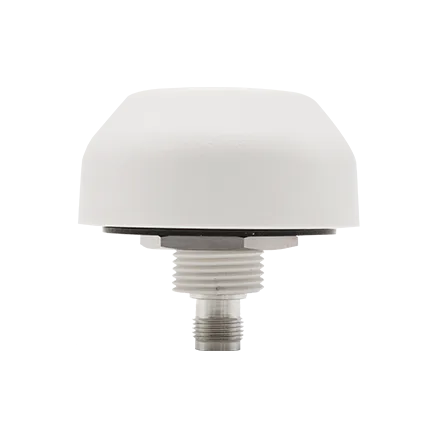
Interfaces and mounting. The antenna has a TNC female connector and is fixed with screws. It measures 60 mm in diameter by 54 mm in height and weighs 85 g maximum.
Power and environment. The operating voltage is 2.7 to 9 V with an operating current of 9±3 mA. The housing is IP67 rated, with an operating and storage temperature range of -60 °C to +85 °C.
Typical uses. It suits time synchronization systems, low power monitoring systems and geological monitoring, in permanent outdoor installations.
No published question about this part yet. Questions are reviewed before publication.
Every characteristic recorded for CT3602A, with where it comes from. Use the filters to find one quickly.
| Characteristic | Value |
|---|---|
| Dimensions | φ 60*54mm |
| Axial Ratio | ≤ 3dB max |
| Connector | TNC female |
| LNA Gain | 28±3dB |
| Mounting | Screws Mount |
| Noise Figure | ≤ 3.5dB max |
| Nominal Impedance | 50&Omega |
| Operating Temperature | -60℃~+85℃ |
| Operation Current | 9±3mA |
| Operation Voltage | 2.7~9V |
| Peak Gain | >3dBic |
| Polarization | RHCP |
| Signal Received | GPS L1; BDS B1I/B1C; GLONASS L1; GALILEO E1; QZSS L1 |
| Storage Temperature | -60℃~+85℃ |
| Water/Dust Resistance | IP67 |
| Weight | ≤ 85g |
No specification matches.
Last verification : 2026-11-02
Official documents and the technical data recorded for CT3602A. For a missing document or a specific revision, our experts send it to you.
Harxon HX-CT3602A GNSS antenna for time synchronization and precision applications, with multi-constellation L1-band reception and an IP67 enclosure.
| Parameter | Value |
|---|---|
| Dimensions | φ 60*54mm |
| Axial Ratio | ≤ 3dB max |
| Connector | TNC female |
| LNA Gain | 28±3dB |
| Mounting | Screws Mount |
| Noise Figure | ≤ 3.5dB max |
| Nominal Impedance | 50&Omega |
| Operating Temperature | -60℃~+85℃ |
| Operation Current | 9±3mA |
| Operation Voltage | 2.7~9V |
| Peak Gain | >3dBic |
| Polarization | RHCP |
| Signal Received | GPS L1; BDS B1I/B1C; GLONASS L1; GALILEO E1; QZSS L1 |
| Storage Temperature | -60℃~+85℃ |
| Water/Dust Resistance | IP67 |
| Weight | ≤ 85g |
Points to check before using CT3602A in a design. They are derived from the recorded characteristics, not from the manufacturer's application circuits.
| Operation Current | 9±3mA |
| Operation Voltage | 2.7~9V |
Check the exact pin assignment and the application circuit in the datasheet, or ask our experts.
Answers to the questions that the recorded characteristics of CT3602A can answer. A question is not asked when nothing is recorded to answer it.
Yes — recorded under "Signal Received": GPS L1; BDS B1I/B1C; GLONASS L1; GALILEO E1; QZSS L1.
-60℃~+85℃ (source: Operating Temperature).
Similar parts to answer your needs. Compare the main characteristics. A recorded replacement is a documented relation; a similar product is a similarity only, never a compatibility claim.
Multi-constellation GNSS antenna with right-hand circular polarization
Gnss antenna hx

Gnss antenna hx

Gnss antenna hx

Describe your application and constraints in a request.
What is recorded about the regulatory status and the life of this part.
No compliance statement is recorded for this part. Ask the supplier for the RoHS and REACH declarations and, for a radio product, the EU declaration of conformity.
| Current status | Status not stated |
| Key dates | Not recorded |
| Manufacturer part number | CT3602A |
| Manufacturer | Harxon |
Combination Multi-Band Antennas
Dual-band L1/L5 multi-GNSS antenna for time synchronisation · Ref. : AU-500/AU-300
Price on request
Combination Multi-Band Antennas
Wide-band SDR kit with GPS antenna for BeagleBone · Ref. : 110060490
Price on request
Combination Multi-Band Antennas
Multi-band GNSS repeater antenna with RHCP polarization · Ref. : GNSS-ANTENNA-HX-CR8602A
Price on request
Combination Multi-Band Antennas
Multi-frequency quadrifilar RTK GNSS antenna · Ref. : BD-900
Price on request
No advertising or analytics cookies. A single, strictly necessary cookie is set only if you sign in to your account. Your quote basket and comparison stay in your browser. Details


