| Battery Life | ~2 years at 5-minute reports · ~4 years at 15-minute reports · ~7+ years at hourly reports |
| Battery life claim | Up to 5 years, conditions not stated |
| Calibrating the estimate to this soil | Note the offset once the probe has settled, per field, per season |
| Choose it when | One parameter is the question, at the lowest cost per point |
| Configuration | AT commands · downlink |
| Continuous | Yes, every few minutes to hourly |
| Cost per point | Moderate |
| Designed and made in | Dragino, China |
| Did the last fertigation dose arrive in the root zone? | Yes: EC and the N, P, K estimates step up within hours and the record shows it |
| Drip-irrigated field crop | Every 15 to 60 minutes, alert on low moisture |
| Electrical conductivity | 0–20,000 µS/cm · 2 % of full scale |
| Electrical conductivity (EC) — 0–10,000 µS/cm — ±3% of full scale — 10 µS/cm | Dissolved salts: fertiliser strength and salinity build-up |
| Enclosure and probe | IP66 body · IP68 probe on pH and NPK · 2 to 3.5 m cables |
| Enclosure outdoors | Typically IP65 to IP67 |
| Every 15 minutes — About 4 years (datasheet estimate) | Recharged daily by the 20 W panel |
| Every 5 minutes — About 2 years (datasheet estimate) | Recharged daily by the 20 W panel |
| Every 60 minutes — About 7+ years (datasheet estimate) | Recharged daily by the 20 W panel |
| Getting the data out | LoRaWAN® |
| How | Stainless-steel electrodes in contact with the soil |
| How much fertiliser should this field get? | No: the absolute values are estimates |
| IN865 for India | Listed |
| Is salinity building up? | Yes: EC in µS/cm, continuously |
| Is the pH drifting out of the crop' s range? | Yes: ±0.3 pH, continuously, with an alert |
| LoRaWAN | v1.0.3 · Class A |
| LoRaWAN class — Class A by default; Class C for sites that need fast downlinks | Maya app |
| Made in | Usually imported |
| Measures | X1: NPK trend · X3: EC · X4: pH, each with temperature |
| Moisture | ±3 % (0–53 %), ±5 % above · 0.01 % resolution |
| Moisture accuracy | Not the primary reading |
| N, P, K and how it is described | 1–1,999 mg/kg · ±2 % FS · described as a ' TDR method', no caveat on the pages checked |
| Network | LoRaWAN® v1.0.4 |
| Nitrogen (N) — 0–1,999 mg/kg — ±2% of full scale — 1 mg/kg | The trend in available nitrogen between soil tests |
| NPK readings | On a dedicated NPK unit, also estimated |
| Nutrients | Trend estimate |
| Orchard or vineyard block | Hourly, alerts on moisture and EC |
| Page | Product page |
| Parameters, one probe? | Moisture, temperature, EC (SE01) + pH (SPH01) + N, P, K (LSNPK01) — three sensors, three holes |
| Park, campus lawn or golf course | Hourly, low-moisture alert to the controller |
| pH | 3–10 · 0.01 resolution · ±2 % at 0–50 °C (SPH01-LB) |
| pH — 3–9 pH — ±0.3 pH — 0.1 pH | Whether the nutrients in the soil are available to the crop |
| Phosphorus (P) — 0–1,999 mg/kg — ±2% of full scale — 1 mg/kg | The trend in available phosphorus between soil tests |
| Points to install for seven readings | Three or more nodes |
| Polyhouse or nursery bed | Every 15 minutes, EC and pH alerts |
| Potassium (K) — 0–1,999 mg/kg — ±2% of full scale — 1 mg/kg | The trend in available potassium between soil tests |
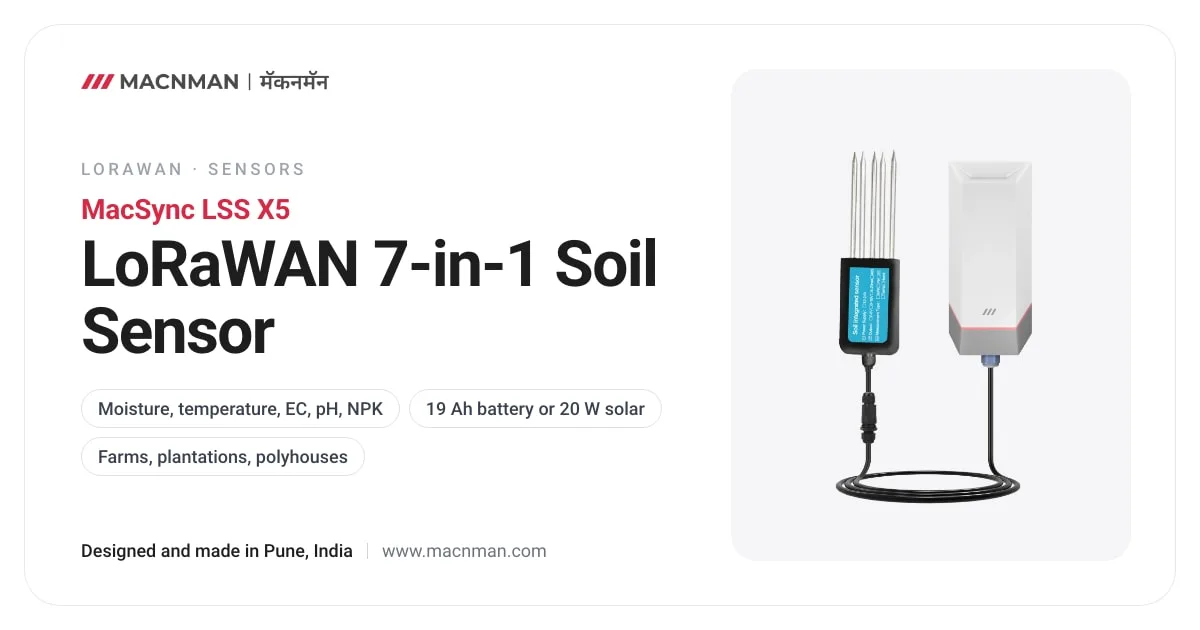
| Power | 19 Ah battery, or 20 W solar + 8,000 mAh |
| Readings | Moisture and temperature; EC or pH or NPK on separate units |
| Reporting interval — 19 Ah battery variant (8821) | Solar variant (8820) |
| Reporting interval — How often an uplink is sent, independent of sampling | Maya app · downlink |
| Reporting mode — Periodic, event-based or hybrid | Maya app · downlink |
| Saline or reclaimed land | Hourly |
| Salinity sensitivity | EC is a reading; moisture is read alongside it |
| Sampling interval — How often the probe is read, from 1 minute to 24 hours | Maya app over BLE · downlink |
| Setting — What it does | Set from |
| Soil moisture — 0–100% VWC — ±5% — 0.1% | When to irrigate, and whether water is reaching the root zone |
| Soil temperature — −45 to +115 °C — ±0.5 °C — 0.1 °C | Germination and root activity; frost and heat stress |
| Sugarcane or banana | Every 15 to 30 minutes |
| Tea, coffee or rubber plantation | Hourly |
| University or KVK trial plot | Every 15 minutes, with the record exported each season |
| Use it for | Irrigation plus fertigation, salinity and pH from one spot |
| What it measures | Moisture, temperature, EC, pH, and an N, P, K estimate |
| What you get | One ready-to-use node per parameter |
| Which way are nutrients moving over the season? | Yes: the trend between lab tests, block by block |