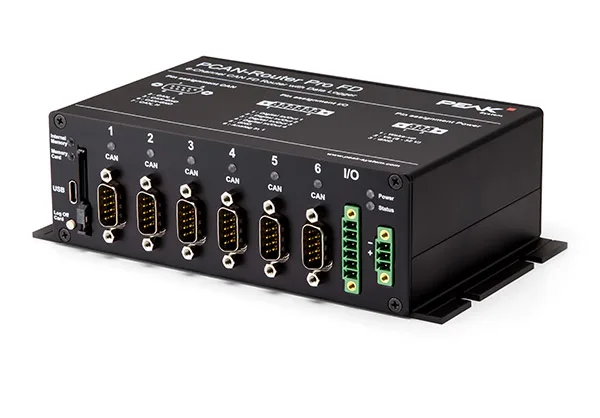
PCAN-ROUTER PRO FD
6-channel CAN and CAN FD router with I/O and data logger
- Feature
- 1 analog input (0 to 32 V)
- Feature
- Recording of CAN data and error frames
- Feature
- Internal memory: 16 GByte pSLC eMMC
- Feature
- SD card slot for additional memory
6-channel CAN and CAN FD router with I/O and data logger
Industrial Protocol Converters
Industrial router from PEAK-System linking CAN 2.0 and CAN FD buses across six channels, recording their frames to internal memory or an SD card.
Six-channel CAN and CAN FD router. The PCAN-Router Pro FD from PEAK-System is a six-channel router for CAN and CAN FD buses (ISO 11898-2), complying with CAN specifications 2.0 A/B and FD. It links the traffic of modern CAN FD buses with that of classic CAN buses, so new CAN FD applications can be integrated into existing CAN 2.0 networks through conversion from CAN to CAN FD or the reverse. It helps manage, monitor and control the data flows of test benches and production plants.
Channels, transceivers and connectors. Each channel uses an NXP TJA1043 transceiver with wake-up, and users can fit alternative transceiver modules themselves. CAN connections are 9-pin D-Sub connectors in accordance with CiA 106, and termination is switchable separately for each channel. CAN bit rates run from 40 kbit/s to 1 Mbit/s, and CAN FD data fields (64 bytes max.) run from 40 kbit/s to 12 Mbit/s, with support for both ISO and non-ISO standards.
Digital and analog inputs. Four digital I/Os, each usable as input or output: two with high-side switching and two with low-side switching. One analog input accepts 0 to 32 V. The wake-up function can be triggered from a separate input, the CAN bus or the real-time clock.
Recording and memory. On delivery, the firmware records CAN and CAN FD traffic together with error frames, to a 16 GByte pSLC eMMC internal memory or to an inserted SD card. Recorded data is read out through USB and converted into various output formats with the Windows software PEAK-Converter. The battery-buffered real-time clock can also be used for wake-up, and a slot for a backup battery provides defined switch-off, for example to save log data.
Programming and processor. The behavior of the router can be programmed freely. Firmware is built with the included development package, which provides a GNU compiler for C and C++, then transferred to the module via CAN, which requires a PEAK CAN interface. Programming examples such as message forwarding or recording help implementation. The module is built around an STM32F765NIH6 microcontroller (Arm® Cortex® M7) and has 32 MByte of SDRAM in addition to the microcontroller RAM.
Power, housing and temperature. The module accepts 8 to 32 V, with protection against overvoltage and reverse polarity. Its aluminum casing has a flange. Status LEDs indicate the CAN channels, memory cards and power supply, and a beeper adds audible feedback. The extended operating temperature range is -40 to +85 °C (-40 to +185 °F).
Ethernet variant. The Ethernet interface via RJ-45 socket, with a maximum of 100 Mbit/s, is available only on IPEH-002222.
No published question about this part yet. Questions are reviewed before publication.
Every characteristic recorded for PCAN-ROUTER PRO FD, with where it comes from. Use the filters to find one quickly.
| Characteristic | Value |
|---|---|
| Feature | 6 High-speed CAN channels (ISO 11898-2) Comply with CAN specifications 2.0 A/B and FD |
| Feature | 2 digital I/Os, each usable as digital input or output with Low-side switch |
| Feature | 1 analog input (0 to 32 V) |
| Feature | Recording of CAN data and error frames |
| Feature | Internal memory: 16 GByte pSLC eMMC |
| Feature | SD card slot for additional memory |
| Feature | USB connection for accessing the data memory (e.g. recorded log data) |
| Feature | Conversion of logging data to various output formats using the Windows software PEAK-Converter |
| Feature | Battery-buffered real-time clock (RTC), can also be used for wake-up |
| Feature | Beeper |
| Feature | Status LEDs for CAN channels, memory cards, and power supply |
| Feature | CAN FD support for ISO and Non-ISO standards |
| Feature | Microcontroller STM32F765NIH6 (based on Arm® Cortex® M7) |
| Feature | 32 MByte SDRAM in addition to microcontroller RAM |
| Feature | Aluminum casing with flange |
| Feature | 8 to 32 V power supply, protection against overvoltage and reverse polarity |
| Feature | Slot for a backup battery for defined switch-off behavior (e.g. for log data saving) |
| Feature | Ethernet interface via RJ-45 socket, max. 100 Mbit/s (only for IPEH-002222) |
| Feature | Extended operating temperature range from -40 to +85 °C (-40 to +185 °F) |
| Feature | CAN FD bit rates for the data field (64 bytes max.) from 40 kbit/s up to 12 Mbit/s |
| Feature | CAN bit rates from 40 kbit/s up to 1 Mbit/s |
| Feature | NXP TJA1043 CAN transceiver with wake-up (alternative transceiver modules ) |
| Feature | CAN connections are D-Sub, 9-pin (in accordance with CiA® 106) |
| Feature | CAN termination switchable, separately for each CAN channel |
| Feature | Wake-up function using separate input, CAN bus, or real-time clock |
| Feature | 2 digital I/Os, each usable as digital input or output with High-side switch |
No specification matches.
Last verification : 2026-11-25
Official documents and the technical data recorded for PCAN-ROUTER PRO FD. For a missing document or a specific revision, our experts send it to you.
Industrial router from PEAK-System linking CAN 2.0 and CAN FD buses across six channels, recording their frames to internal memory or an SD card.
| Parameter | Value |
|---|---|
| Feature | 6 High-speed CAN channels (ISO 11898-2) Comply with CAN specifications 2.0 A/B and FD |
| Feature | 2 digital I/Os, each usable as digital input or output with Low-side switch |
| Feature | 1 analog input (0 to 32 V) |
| Feature | Recording of CAN data and error frames |
| Feature | Internal memory: 16 GByte pSLC eMMC |
| Feature | SD card slot for additional memory |
| Feature | USB connection for accessing the data memory (e.g. recorded log data) |
| Feature | Conversion of logging data to various output formats using the Windows software PEAK-Converter |
| Feature | Battery-buffered real-time clock (RTC), can also be used for wake-up |
| Feature | Beeper |
| Feature | Status LEDs for CAN channels, memory cards, and power supply |
| Feature | CAN FD support for ISO and Non-ISO standards |
| Feature | Microcontroller STM32F765NIH6 (based on Arm® Cortex® M7) |
| Feature | 32 MByte SDRAM in addition to microcontroller RAM |
| Feature | Aluminum casing with flange |
| Feature | 8 to 32 V power supply, protection against overvoltage and reverse polarity |
| Feature | Slot for a backup battery for defined switch-off behavior (e.g. for log data saving) |
| Feature | Ethernet interface via RJ-45 socket, max. 100 Mbit/s (only for IPEH-002222) |
| Feature | Extended operating temperature range from -40 to +85 °C (-40 to +185 °F) |
| Feature | CAN FD bit rates for the data field (64 bytes max.) from 40 kbit/s up to 12 Mbit/s |
| Feature | CAN bit rates from 40 kbit/s up to 1 Mbit/s |
| Feature | NXP TJA1043 CAN transceiver with wake-up (alternative transceiver modules ) |
| Feature | CAN connections are D-Sub, 9-pin (in accordance with CiA® 106) |
| Feature | CAN termination switchable, separately for each CAN channel |
| Feature | Wake-up function using separate input, CAN bus, or real-time clock |
| Feature | 2 digital I/Os, each usable as digital input or output with High-side switch |
Answers to the questions that the recorded characteristics of PCAN-ROUTER PRO FD can answer. A question is not asked when nothing is recorded to answer it.
Yes — recorded under "Feature": 6 High-speed CAN channels (ISO 11898-2) Comply with CAN specifications 2.0 A/B and FD.
Yes — recorded under "Feature": Ethernet interface via RJ-45 socket, max. 100 Mbit/s (only for IPEH-002222).
Yes — recorded under "Feature": USB connection for accessing the data memory (e.g. recorded log data).
Similar parts to answer your needs. Compare the main characteristics. A recorded replacement is a documented relation; a similar product is a similarity only, never a compatibility claim.
6-channel CAN and CAN FD router with I/O and data logger
2-Channel Isolated RS485 Expansion HAT for Raspberry Pi
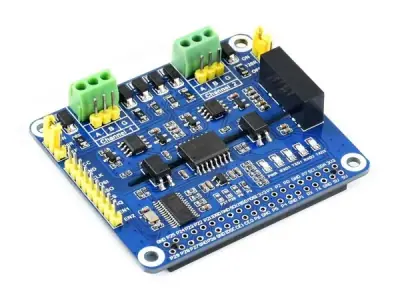
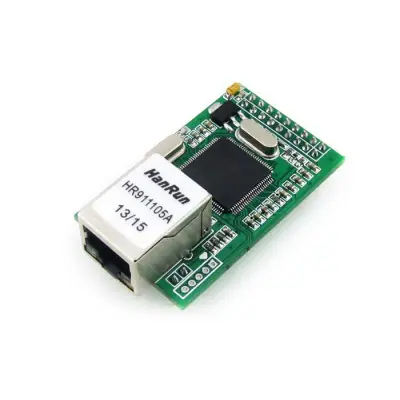
UART ETH Serial UART TTL to Ethernet Converter
Describe your application and constraints in a request.
What is recorded about the regulatory status and the life of this part.
No compliance statement is recorded for this part. Ask the supplier for the RoHS and REACH declarations and, for a radio product, the EU declaration of conformity.
| Current status | Status not stated |
| Key dates | Not recorded |
| Manufacturer part number | PCAN-ROUTER PRO FD |
| Manufacturer | PEAK-System |
Industrial Protocol Converters
Galvanically isolated CAN repeater for CAN CC and CAN FD
Price on request
Industrial Protocol Converters
8-channel Ethernet and WiFi network I/O controller with RS485 · Ref. : USR-IO808
Price on request
Industrial Protocol Converters
2-channel isolated RS485 expansion HAT for Raspberry Pi
Price on request
Industrial Protocol Converters
TTL serial to Ethernet converter with 3 serial ports · Ref. : E001
Price on request
With your consent, we use Google cookies to measure the site’s audience and our advertising. Your quote basket and comparison stay in your browser either way. Details