Product overview
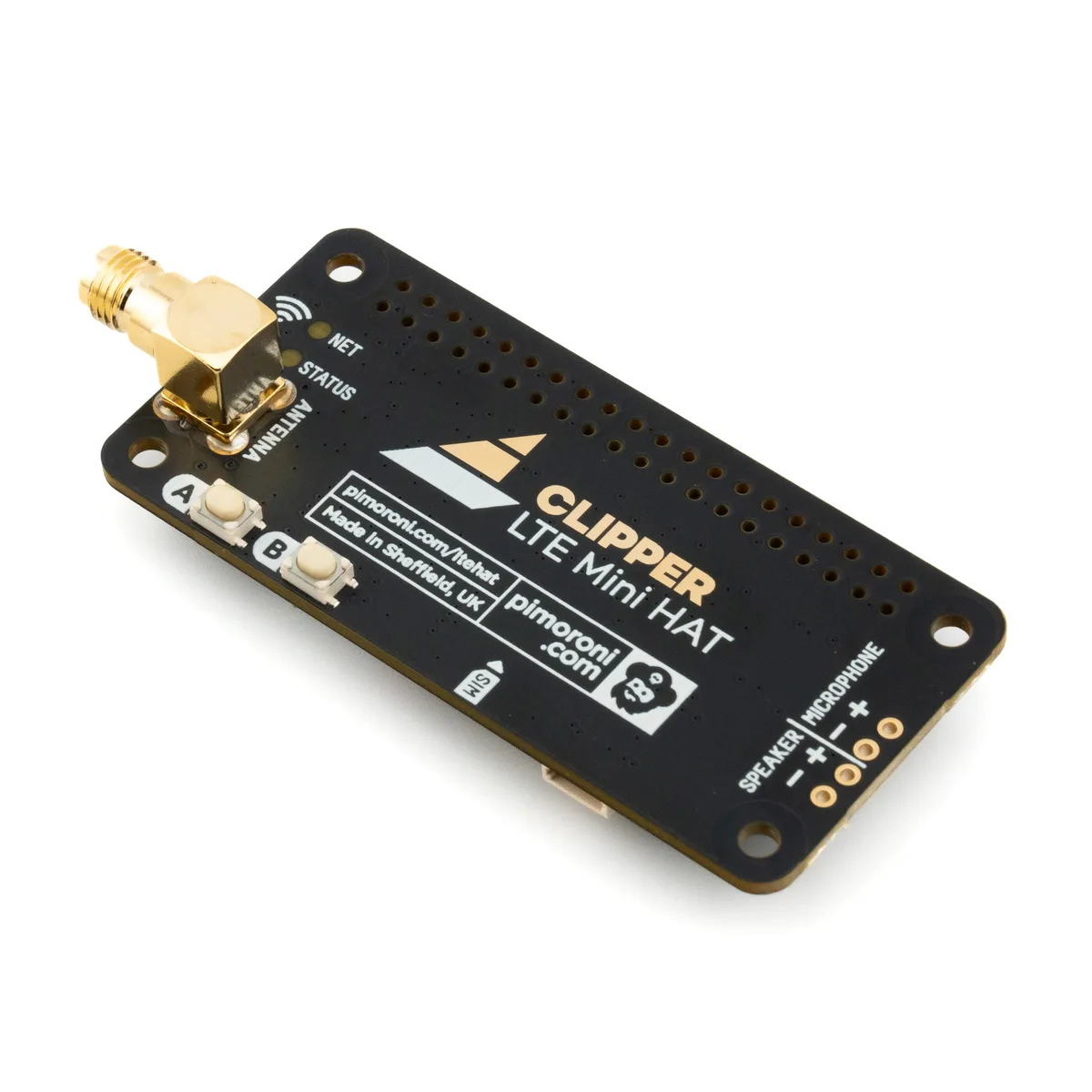
Overview. The Pimoroni Clipper HAT Mini (PIM717) is an expansion HAT for Raspberry Pi fitted with the SIMCom A7683E 4G LTE module. It lets the Raspberry Pi send and receive data over cellular networks, for projects located beyond the reach of a Wi-Fi network, outdoors or on the move.
Main characteristics. The module supports LTE-FDD bands B1/B3/B5/B7/B8/B20/B28. It is controlled via AT commands and includes a SIM card slot. Two user buttons (labelled A and B) and STATUS and NET indicator LEDs show the state of the module.
Interfaces and connectivity. An SMA connector takes an external antenna, sold separately. A Qw/ST (Qwiic / STEMMA QT) connector eases the attachment of I2C breakouts using the matching cables. Unpopulated headers are provided for a speaker and a microphone. The HAT fits on the 40-pin header of the Raspberry Pi through a pre-soldered socket header, with no soldering required.
Power and consumption. Measured VDD consumption: 17 mA idle, 0.12 mA to 1.63 mA in sleep modes. Peak consumption while transmitting reaches 700 mA.
Dimensions. 65 x 30 x 17 mm (L x W x D, including connectors). With a Pi Zero 2 W attached on 10 mm standoffs, the total depth is around 23 mm.
Use. Suitable for transmitting sensor readings from remote locations, for example a beehive or a canal boat. Raspberry Pi OS includes the ppp library for setting up the LTE module. Before any deployment outside Europe, check that local carriers offer 4G on these bands, as North American networks use only a few of them.