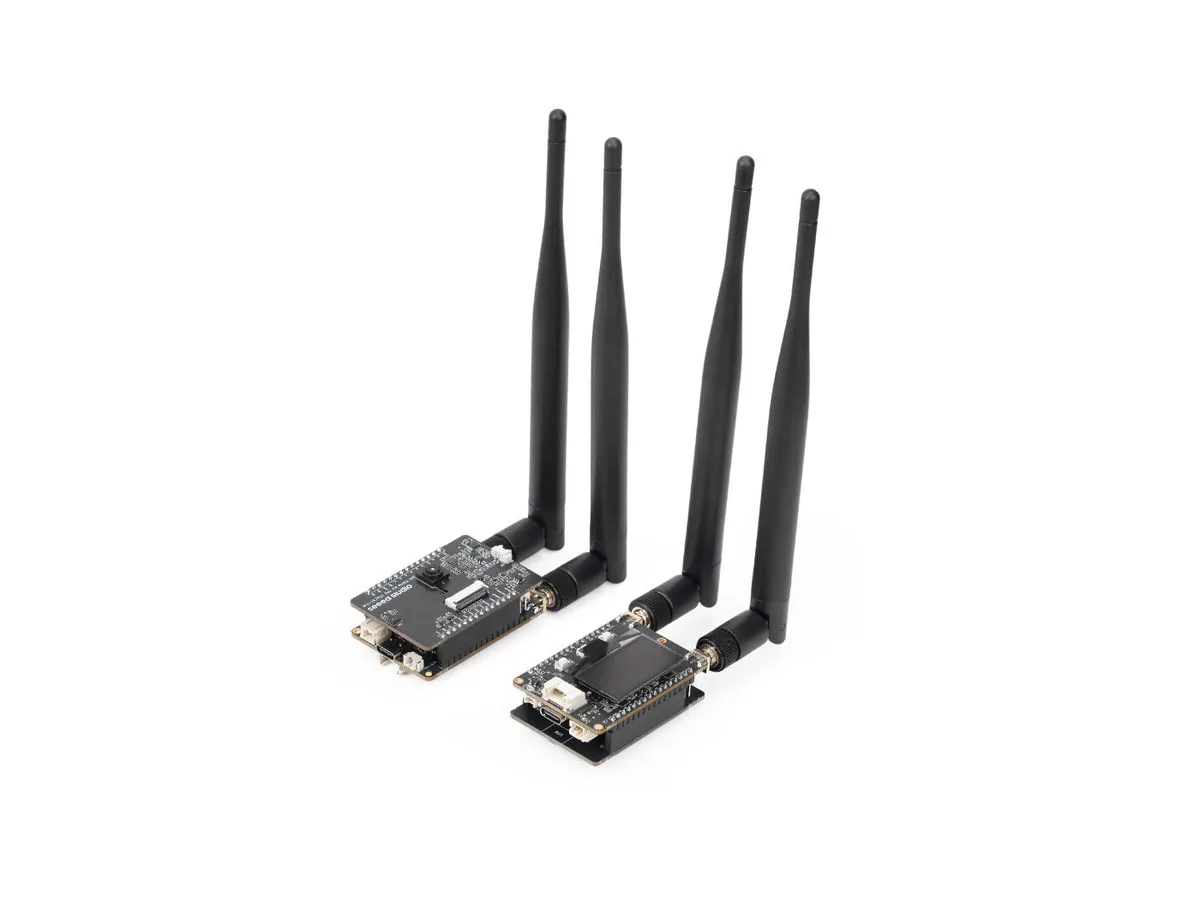
Seeed Studio development kit pairing a dual-band 868-915 MHz and 2.4 GHz LoRa radio with an ESP32-S3 microcontroller and a camera and audio media HAT.
External Flash16 MB SPI NOR flash
Flash384 KB ROM
RAM512 KB SRAM, 8 MB PSRAM
Display128 × 64 monochrome OLED, CH1116
Maximum Transmit Power+22 dBm @ Sub-GHz, +12 dBm @ 2.4GHz
MCU ChipsetESP32-S3R8
Product overview
Seeed Studio Wio-LR2021 Dev Kit. dual-band LoRa development kit for connected nodes. The board combines on one module the Semtech LR2021 transceiver, covering the 868-915 MHz sub-GHz and 2.4 GHz bands, with the ESP32-S3R8 microcontroller. A single prototype can therefore move from a long-range sub-GHz link to a 2.4 GHz link without changing the board.
Radio performance. transmit power reaches +22 dBm in sub-GHz and +12 dBm at 2.4 GHz. Receiver sensitivity is -141.1 dBm in sub-GHz and -133 dBm at 2.4 GHz, measured for a LoRa signal with 125 kHz bandwidth and spreading factor SF 12. Two SMA-based antennas and three IPEX connectors are provided, and the kit includes two stick antennas.
On-board computing and memory. the dual-core Xtensa LX7 processor runs at 240 MHz and has 512 KB of SRAM and 8 MB of PSRAM, complemented by 16 MB of external SPI NOR flash. The PSRAM holds image buffers and detection models executed directly on the board.
Camera and audio media HAT. the detachable expansion board carries a camera, a 128 × 64 monochrome OLED display with CH1116 controller, a speaker and several Grove connectors. The main board and media HAT both measure 55 × 38.5 mm.
Power and autonomy. the board accepts 5 V USB Type-C power, a 5 V solar panel through a 2.0 mm JST connector, or a 3.7 V lithium-ion battery through a 1.25 mm JST connector. Consumption is 76.3 µA in sleep mode and 200.7 mA with all RF functions active.
Connectivity. besides the LoRa radio, the ESP32-S3 module provides 2.4 GHz Wi-Fi 802.11 b/g/n and Bluetooth 5 LE.
No published question about this part yet. Questions are reviewed before publication.
Complete specifications
Every characteristic recorded for 100038329, with where it comes from. Use the filters to find one quickly.
All specifications (17)
Characteristic
Value
Dimensions
Main board: 55 × 38.5mm; Media HAT: 55 × 38.5mm
Antenna
2 × SMA (Wio-LR2021 Sub-GHz and 2.4 GHz); 3 × IPEX1 (Wio-LR2021 Sub-GHz and 2.4 GHz / ESP32-S3 2.4GHz)
Display
128 × 64 monochrome OLED, CH1116
External Flash
16 MB SPI NOR flash
Flash
384 KB ROM
Frequency Bands
868-915 MHz @ Sub-GHz, 2400–2500 MHz @ 2.4 GHz
Interface
Type-C USB; Lithium battery connector (1.25 mm JST); Solar panel connector (2.0 mm JST); Grove connector
Maximum Transmit Power
+22 dBm @ Sub-GHz, +12 dBm @ 2.4GHz
MCU Chipset
ESP32-S3R8
Part list
Wio-LR2021 Dev Kit Main Board x1; Wio-LR2021 Media HAT x1; 2.4GHz Stick Antenna x1; 868-915MHz Stick Antenna x1; 2.4GHz FPC Antenna x1; 16 Pin Header x2; Speaker x1
Power consumption
Sleep mode: 76.3 uA; Total consumption (all RF functioning): 200.7 mA
Power Inputs
5 V USB Type-C; 5 V Solar panel; 3.7 V Li-ion battery
Processor
Dual-core Xtensa LX7, 240 MHz
RAM
512 KB SRAM, 8 MB PSRAM
Receiver Sensitivity
-141.1dBm @ SubGHz, BW=125KHz, SF = 12; -133dBm @ 2.4GHz, BW=125KHz, SF = 12
RF Transceiver
Semtech LR2021, integrated in the Wio-LR2021 module
Wi-Fi and Bluetooth
2.4 GHz Wi-Fi 802.11 b/g/n, Bluetooth 5 LE
No specification matches.
Last verification : 2026-11-21
Technical documentation
Official documents and the technical data recorded for 100038329. For a missing document or a specific revision, our experts send it to you.
1. Technical overview
Seeed Studio development kit pairing a dual-band 868-915 MHz and 2.4 GHz LoRa radio with an ESP32-S3 microcontroller and a camera and audio media HAT.
External Flash16 MB SPI NOR flash
Flash384 KB ROM
RAM512 KB SRAM, 8 MB PSRAM
Display128 × 64 monochrome OLED, CH1116
Maximum Transmit Power+22 dBm @ Sub-GHz, +12 dBm @ 2.4GHz
2. Datasheet extract (recorded values)
Parameter
Value
Dimensions
Main board: 55 × 38.5mm; Media HAT: 55 × 38.5mm
Antenna
2 × SMA (Wio-LR2021 Sub-GHz and 2.4 GHz); 3 × IPEX1 (Wio-LR2021 Sub-GHz and 2.4 GHz / ESP32-S3 2.4GHz)
Display
128 × 64 monochrome OLED, CH1116
External Flash
16 MB SPI NOR flash
Flash
384 KB ROM
Frequency Bands
868-915 MHz @ Sub-GHz, 2400–2500 MHz @ 2.4 GHz
Interface
Type-C USB; Lithium battery connector (1.25 mm JST); Solar panel connector (2.0 mm JST); Grove connector
Maximum Transmit Power
+22 dBm @ Sub-GHz, +12 dBm @ 2.4GHz
MCU Chipset
ESP32-S3R8
Part list
Wio-LR2021 Dev Kit Main Board x1; Wio-LR2021 Media HAT x1; 2.4GHz Stick Antenna x1; 868-915MHz Stick Antenna x1; 2.4GHz FPC Antenna x1; 16 Pin Header x2; Speaker x1
Power consumption
Sleep mode: 76.3 uA; Total consumption (all RF functioning): 200.7 mA
Power Inputs
5 V USB Type-C; 5 V Solar panel; 3.7 V Li-ion battery
Processor
Dual-core Xtensa LX7, 240 MHz
RAM
512 KB SRAM, 8 MB PSRAM
Receiver Sensitivity
-141.1dBm @ SubGHz, BW=125KHz, SF = 12; -133dBm @ 2.4GHz, BW=125KHz, SF = 12
RF Transceiver
Semtech LR2021, integrated in the Wio-LR2021 module
Wi-Fi and Bluetooth
2.4 GHz Wi-Fi 802.11 b/g/n, Bluetooth 5 LE
Applications and use cases
Architectures in which 100038329 can play a role, derived from its category. This is not a compatibility statement: check the specifications against your requirements.
A proprietary PLC locks the project into one vendor’s tools. Industrial controllers built on the Raspberry Pi Compute Module run Linux, Node-RED, Python or CODESYS on DIN rail, with I/O modules, an operator panel and a cellular router for remote access
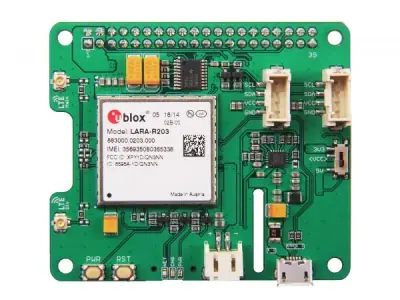
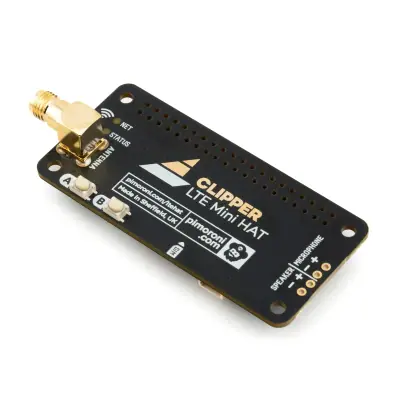
Adding a mobile connection to a product means choosing a modem, a SIM and a way to manage both. A cellular modem or HAT, an IoT SIM and a router or gateway form one connectivity chain, managed from a single platform
To check
Countries and networks where the devices will operate
Data volume per device and per month
Network technology (LTE-M, NB-IoT, 4G, 5G) supported by the modem and the SIM
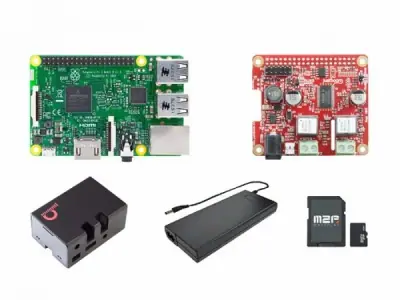
Not every vision task justifies an industrial vision system. A Raspberry Pi with a camera module and an expansion board runs simple detection and counting models at low cost, close to the scene
To check
Frame rate and model size the board can run
Lighting and lens for the scene
Enclosure and cooling for the installation
Associated system blocks
ComputeCameras
Need a complete solution?
Send a request for 100038329 and the other parts of your project.
Similar parts to answer your needs. Compare the main characteristics. A recorded replacement is a documented relation; a similar product is a similarity only, never a compatibility claim.
Current productSeeed Studio
100038329
Dual-band LoRa development kit with camera and audio HAT
What is recorded about the regulatory status and the life of this part.
Regulatory compliance
No compliance statement is recorded for this part. Ask the supplier for the RoHS and REACH declarations and, for a radio product, the EU declaration of conformity.
No advertising or analytics cookies. A single, strictly necessary cookie is set only if you sign in to your account. Your quote basket and comparison stay in your browser. Details