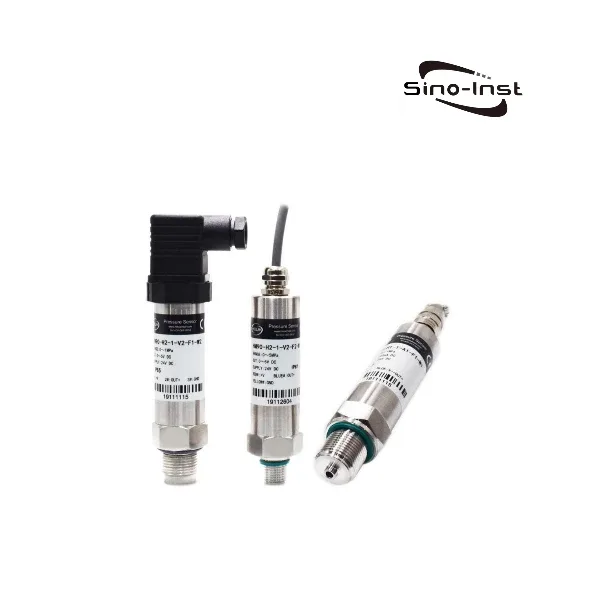
Overview. The Sino-Inst SI-90 is a high-frequency dynamic pressure sensor with a fast response, designed to measure transient pressure variations without distortion. Its measuring range extends from -100 kPa to 100 MPa, in gauge, absolute or sealed gauge pressure depending on the code selected.
Main characteristics. Three bandwidth versions are offered: H1 from 0 to 1 kHz or 3 kHz with a static accuracy of ±0.1%FS, H2 from 0 to 20 kHz with ±0.25%FS, and H3 from 0 to 200 kHz with ±0.4%FS and a rise time of 1 µs or less. The natural frequency reaches 2 MHz in the fastest version. The sensor withstands an overload of 150%FS above 10 MPa and 200%FS below, with an effective measurement life of more than 10⁶ pressure cycles (10-90%FS).
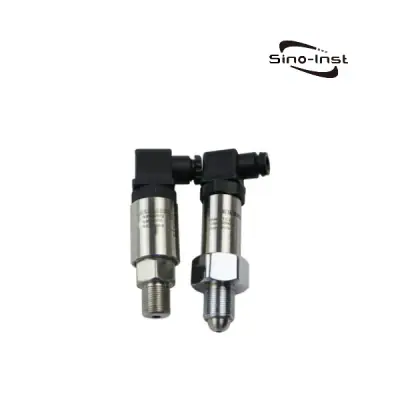
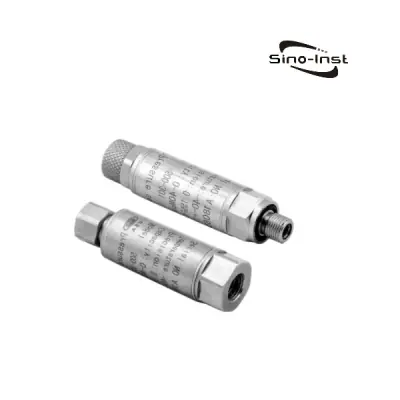
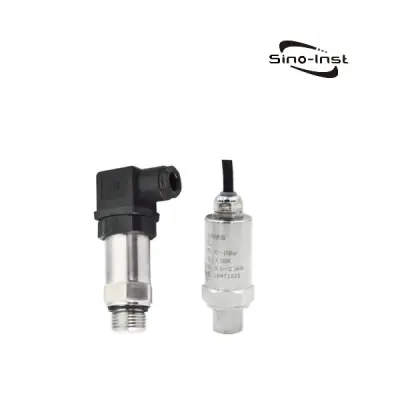
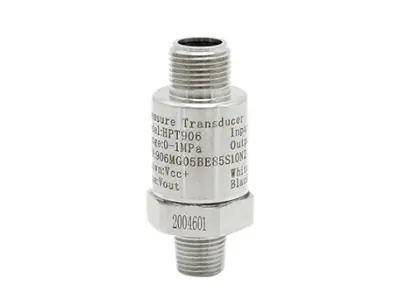
Interfaces and connectivity. The analog signal is available as 4-20 mA, 0-5 V, 1-5 V, 0-10 V or 0.5-4.5 V, and the digital signal as RS485. Electrical connections are made by Hirschmann connector, aviation connector or 1 m straight cable. Pressure interfaces are M20×1.5, G1/4B, G1/2B or NPT1/4, with a flush diaphragm, and the materials are 304/316L stainless steel and a silicon monocrystalline or 316L diaphragm. The protection rating is IP65 for the connector version and IP67 for the cable version.
Power and environment. The power supply is 12 to 36 VDC (24 VDC typical), or ±15 VDC. The sensor operates from -40 to 85 ℃, with a special version up to 200 ℃, and temperature compensation covers -10 to 70 ℃. Sensitivity and zero temperature drift are typically ±0.02%FS/℃. Long-term stability is typically ±0.1%FS per year. The explosion-proof certification is Exia II BT5.
Typical uses. This sensor suits military engineering, chemical explosion testing, well testing and petroleum exploration, mechanics and civil engineering. Typical measurements include hydraulic shocks, reciprocating pump and compressor pulsation, water hammer, engine combustion pressure and shock waves. The RS485 signal allows integration into a PLC or data acquisition system.