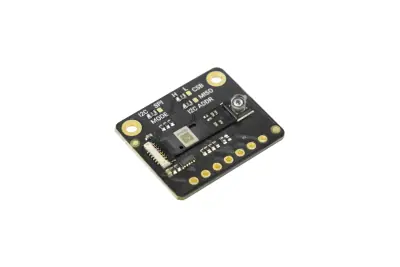
Temtop PMS10 pump-suction laser particle sensor that measures in real time the mass concentration of PM1.0, PM2.5, PM10 and TSP in ambient air, with RS485 output.
Storage Temperature Range-10℃~60℃
Working Temperature Range0~50℃
PM2.5 Measuring Range0-5000ug/m³
Dimensions4.45*3.46*1.50 Inches
Response time<7s
Communication modeRS485
Product overview
Temtop PMS10. The Temtop PMS10 is a pump-suction laser particle sensor, reference PMS10-2PACK, designed to measure the mass concentration of particles in the atmosphere.
Measurement principle. The sensor uses the laser Mie-scattering principle. It detects PM1.0, PM2.5, PM10 and TSP, and its signals are processed by a microprocessor before being output through a universal digital interface. It is calibrated with a beta-ray scattering detector.
Main characteristics. Four-wire vacuum pump for higher sampling efficiency, all-metal grounded optical structure, user-defined six-channel particle size options. PM2.5 measuring range: 0-5000 ug/m³. Flow rate: 1.0 L/min standard, 2.83 L/min on customization. Response time: less than 7 s. Sampling rate user-defined.
Interfaces and communication. The communication mode is RS485, allowing the sensor to be connected to a data acquisition system or a controller.
Dimensions and environment. Dimensions: 4.45 × 3.46 × 1.50 inches. Weight: 0.8 lb. Working temperature range: 0 to 50 °C. Storage temperature range: -10 to 60 °C.
Typical uses. Ambient air quality monitoring and integration into a measurement system with an RS485 link.
No published question about this part yet. Questions are reviewed before publication.
Complete specifications
Every characteristic recorded for PMS10-2PACK, with where it comes from. Use the filters to find one quickly.
All specifications (9)
Characteristic
Value
Dimensions
4.45*3.46*1.50 Inches
Response time
<7s
Communication mode
RS485
Flow rate
1.0L/min (Standard)(Customize:2.83L/min, about 2 weeks to do customization)
PM2.5 Measuring Range
0-5000ug/m³
Sampling Rate
User-defined
Storage Temperature Range
-10℃~60℃
Working Principle
Laser Mie-scattering Principle
Working Temperature Range
0~50℃
No specification matches.
Last verification : 2026-11-03
Technical documentation
Official documents and the technical data recorded for PMS10-2PACK. For a missing document or a specific revision, our experts send it to you.
1. Technical overview
Temtop PMS10 pump-suction laser particle sensor that measures in real time the mass concentration of PM1.0, PM2.5, PM10 and TSP in ambient air, with RS485 output.
Storage Temperature Range-10℃~60℃
Working Temperature Range0~50℃
PM2.5 Measuring Range0-5000ug/m³
Dimensions4.45*3.46*1.50 Inches
Response time<7s
2. Datasheet extract (recorded values)
Parameter
Value
Dimensions
4.45*3.46*1.50 Inches
Response time
<7s
Communication mode
RS485
Flow rate
1.0L/min (Standard)(Customize:2.83L/min, about 2 weeks to do customization)
PM2.5 Measuring Range
0-5000ug/m³
Sampling Rate
User-defined
Storage Temperature Range
-10℃~60℃
Working Principle
Laser Mie-scattering Principle
Working Temperature Range
0~50℃
Applications and use cases
Architectures in which PMS10-2PACK can play a role, derived from its category. This is not a compatibility statement: check the specifications against your requirements.
Offices and classrooms get stuffy without anyone measuring why. Indoor air quality monitoring places CO2, VOC and particle sensors in the rooms and reports their values through a gateway, so ventilation can be adjusted to real occupancy
To check
Parameters to measure (CO2 alone or CO2, VOC and particles)
Battery-powered sensors or mains-powered sensors with display
Integration with the ventilation control or building management system
Associated system blocks
Air sensorsGateway
Need a complete solution?
Send a request for PMS10-2PACK and the other parts of your project.
Similar parts to answer your needs. Compare the main characteristics. A recorded replacement is a documented relation; a similar product is a similarity only, never a compatibility claim.
What is recorded about the regulatory status and the life of this part.
Regulatory compliance
No compliance statement is recorded for this part. Ask the supplier for the RoHS and REACH declarations and, for a radio product, the EU declaration of conformity.
No advertising or analytics cookies. A single, strictly necessary cookie is set only if you sign in to your account. Your quote basket and comparison stay in your browser. Details