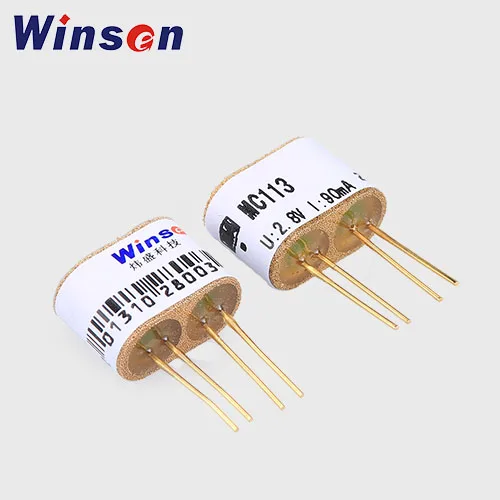
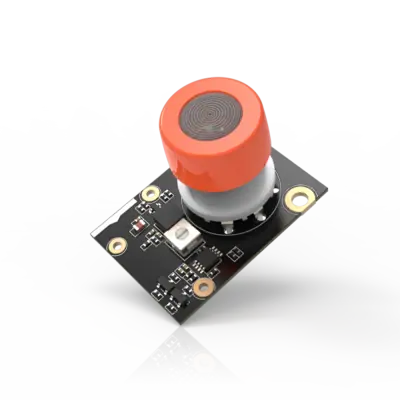
Overview. The Winsen MC113 is a catalytic flammable gas sensor, offered in the MC113 and MC113C versions. It uses catalytic combustion: a test element and a compensation element form two arms of a bridge, the test element's resistance rising with combustible gas and the bridge output voltage changing in proportion to concentration, while the compensation element corrects for temperature and humidity.
Main characteristics. It measures 0 to 100 %LEL with 20~40 mV sensitivity for the MC113 and 16~35 mV for the MC113C, linearity of 5 % or less, a response time (90 %) of 10 s or less and a recovery time of 30 s or less. Its life span is 3 years.
Targets and certification. It detects combustible gases such as industrial natural gas, LPG, coal gas and alkanes. Its anti-explosion mark is Exd I Mb, with a detection range of 0-100 %LEL (ExdibⅠ).
Power and environment. It operates at 2.8±0.1 V with a working current of 90±10 mA for the MC113 and 95±10 mA for the MC113C. Its working environment is -40 to +70 °C with humidity below 95 %RH, and it is stored between -25 and +70 °C, below 95 %RH.
Dimensions and package. The metal package with metallurgy powder mesh measures 19×9.5×14 mm for the MC113 and 14×8×10 mm for the MC113C.
Bridge output voltage in linear, fast response, good repeatability and selectivity
Detection Principle
catalytic combustion
Detection range
0-100%LEL(Anti-explosion Mark:ExdibⅠ)
Life span
3 years
Linearity
≤ 5%
Measuring range(%LEL)
0~100
Model
MC113
Recovery Time (90%)
≤ 30s
Response time (90%)
≤ 10s
Sensitivity (mV)
MC113: 20~40; MC113C: 16~35
Sensor Type
Catalytic
Size
113:19×9.5×14 113C:14×8×10
SIZE; mm
MC113: 19×9.5×14; MC113C: 14×8×10
Standard Encapsulation
Metal, Metallurgy powder mesh
Storage Environment
-25 to+70℃, less than 95%RH
Target
Combustible gases such as industrial natural gas,LPG, coal gas and alkanes
Working Conditions
Working voltage:2.8±0.1V; 113:Working current:90±10mA; 113C:Working current:95±10mA
Working current(mA)
MC113: 90±10; MC113C: 95±10
Working Environment
-40 ~+70℃, less than 95%RH
Working Voltage (V)
2.8±0.1
Applications and use cases
Architectures in which MC113 can play a role, derived from its category. This is not a compatibility statement: check the specifications against your requirements.
Offices and classrooms get stuffy without anyone measuring why. Indoor air quality monitoring places CO2, VOC and particle sensors in the rooms and reports their values through a gateway, so ventilation can be adjusted to real occupancy
To check
Parameters to measure (CO2 alone or CO2, VOC and particles)
Battery-powered sensors or mains-powered sensors with display
Integration with the ventilation control or building management system
Associated system blocks
Air sensorsGateway
Need a complete solution?
Send a request for MC113 and the other parts of your project.
Similar parts to answer your needs. Compare the main characteristics. A recorded replacement is a documented relation; a similar product is a similarity only, never a compatibility claim.
What is recorded about the regulatory status and the life of this part.
Regulatory compliance
No compliance statement is recorded for this part. Ask the supplier for the RoHS and REACH declarations and, for a radio product, the EU declaration of conformity.
No advertising or analytics cookies. A single, strictly necessary cookie is set only if you sign in to your account. Your quote basket and comparison stay in your browser. Details