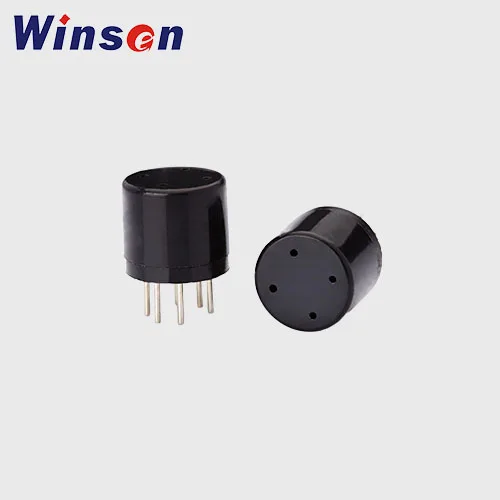
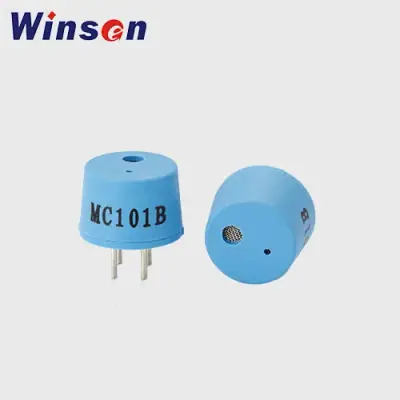
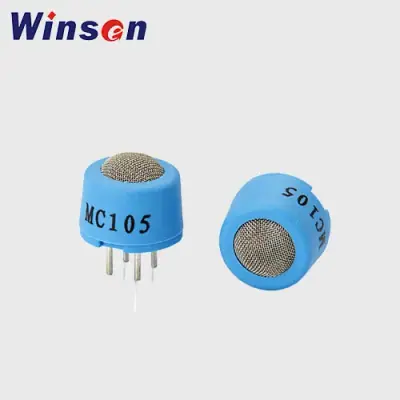
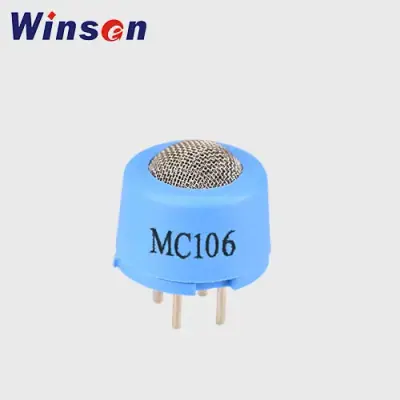
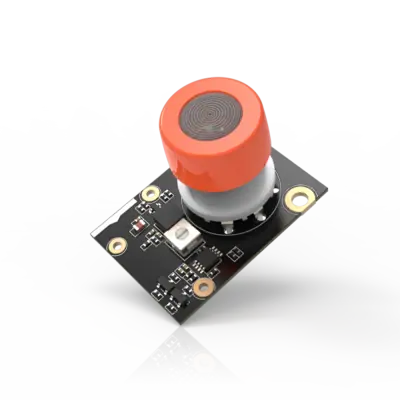
The MQ131-L is a Winsen semiconductor sensor for detecting low concentration ozone (O3) over a 10 to 1000 ppb range.
Detection range10-1000ppb
CharacteristicsGood sensitivity to O3
Detection PrincipleSemiconductor
Life span5 years
ModelMQ131-L
Noteslow concentration
Product overview
Overview. The Winsen MQ131-L is a semiconductor ozone sensor designed for detecting low concentration ozone (O3). Its conductivity, low in clean air, rises with the concentration of the target gas, and a simple circuit converts this change into an output signal.
Main characteristics. The sensor covers a detection range of 10 to 1000 ppb and shows good sensitivity to O3. Its sensor resistance is 35 Ω ±3 Ω at room temperature, under standard test conditions of 20 °C ±2 °C and 55 % ±5 % RH. Its life span is 5 years.
Power and environment. The standard circuit operates at 5.0 V ±0.1 V DC, with a loop voltage of 5 ±0.1 V and a heater voltage of 5 ±0.1 V. Heater consumption is at most 800 mW. The oxygen content is 21 %, not less than 18 %. Oxygen concentration affects the initial value, sensitivity and repeatability of the sensor, so the manufacturer should be consulted when using it under low oxygen concentration.
Package. The sensor uses a standard plastic cap encapsulation measuring φ16 × 13.9.
Typical uses. This sensor suits low concentration ozone monitoring in air quality measurement devices that integrate signal processing electronics.
No published question about this part yet. Questions are reviewed before publication.
Complete specifications
Every characteristic recorded for MQ131, with where it comes from. Use the filters to find one quickly.
All specifications (16)
Characteristic
Value
Characteristics
Good sensitivity to O3
Detection Principle
Semiconductor
Detection range
10-1000ppb
Life span
5 years
Model
MQ131-L
Notes
low concentration
Oxygen content
21% (not less than 18%, (oxygen concentration will affect the initial value, sensitivity and repeatability of the sensor, please consult when using it under low oxygen concentration)
Official documents and the technical data recorded for MQ131. For a missing document or a specific revision, our experts send it to you.
1. Technical overview
The MQ131-L is a Winsen semiconductor sensor for detecting low concentration ozone (O3) over a 10 to 1000 ppb range.
Detection range10-1000ppb
CharacteristicsGood sensitivity to O3
Detection PrincipleSemiconductor
Life span5 years
ModelMQ131-L
2. Datasheet extract (recorded values)
Parameter
Value
Characteristics
Good sensitivity to O3
Detection Principle
Semiconductor
Detection range
10-1000ppb
Life span
5 years
Model
MQ131-L
Notes
low concentration
Oxygen content
21% (not less than 18%, (oxygen concentration will affect the initial value, sensitivity and repeatability of the sensor, please consult when using it under low oxygen concentration)
Architectures in which MQ131 can play a role, derived from its category. This is not a compatibility statement: check the specifications against your requirements.
Offices and classrooms get stuffy without anyone measuring why. Indoor air quality monitoring places CO2, VOC and particle sensors in the rooms and reports their values through a gateway, so ventilation can be adjusted to real occupancy
To check
Parameters to measure (CO2 alone or CO2, VOC and particles)
Battery-powered sensors or mains-powered sensors with display
Integration with the ventilation control or building management system
Associated system blocks
Air sensorsGateway
Need a complete solution?
Send a request for MQ131 and the other parts of your project.
Similar parts to answer your needs. Compare the main characteristics. A recorded replacement is a documented relation; a similar product is a similarity only, never a compatibility claim.
What is recorded about the regulatory status and the life of this part.
Regulatory compliance
No compliance statement is recorded for this part. Ask the supplier for the RoHS and REACH declarations and, for a radio product, the EU declaration of conformity.
With your consent, we use Google cookies to measure the site’s audience and our advertising. Your quote basket and comparison stay in your browser either way. Details