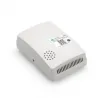
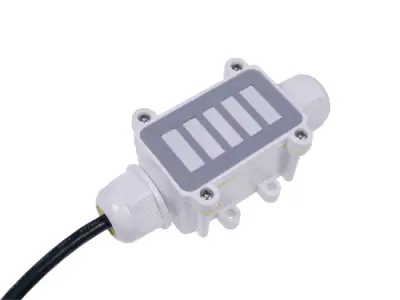
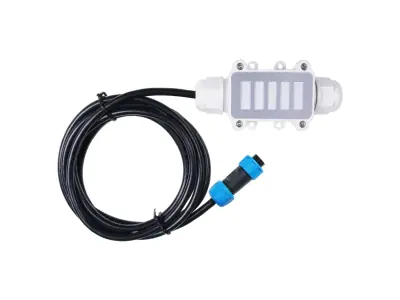
The Dragino LAQ4 LoRaWAN sensor measures TVOC, eCO2, temperature and relative humidity of ambient air and sends the data to an IoT server over LoRaWAN.
Operating Temperature-40 ~ 85°C
Range-40 to + 80°C
Supply voltagebuilt in 4000mAh Li-SOCI2 battery
AccuracyTyp ±0.3 @ 0-90 °C
AS923Default frequency band AS923
AU915Default frequency band AU915
Product overview
Dragino LAQ4. The Dragino LAQ4 is a LoRaWAN air quality sensor for Internet of Things deployments. It measures total volatile organic compounds (TVOC), equivalent CO2 (eCO2), temperature and relative humidity, then uploads the data to an IoT server over the LoRaWAN wireless protocol.
Measurements. The TVOC sensor covers 0 to 29206 ppb and the eCO2 sensor covers 400 to 32768 ppm, both with temperature and humidity compensation. eCO2 is calculated from the TVOC value and is not a real CO2 measurement. The temperature sensor covers -40 to +80 °C with a typical accuracy of ±0.3 °C between 0 and 90 °C and a resolution of 0.01 °C. The relative humidity sensor covers 0 to 99.9 % RH with an accuracy of ±3 %RH between 0 and 100 %RH. The sensor requires calibration for more accurate TVOC and eCO2 measurement.
Protocol and functions. The LAQ4 supports LoRaWAN v1.0.3 Class A. Uplinks can be sent periodically or on interrupt. Temperature and humidity alarms are available, parameters can be changed through AT commands or downlink, and stored data can be retrieved remotely with LoRaWAN commands.
Power and environment. The sensor is powered by a built-in 4000mAh Li-SOCI2 battery. Consumption is 9 µA in deep sleep or IDLE mode, 11.8 mA for 2 s every 60 seconds in sampling mode, and 125 mA in LoRaWAN transmit mode. The stated battery life is 7 to 10 months. The operating temperature range is -40 to 85 °C. Dimensions are 110 x 70 x 30 mm for a weight of 130 g.
Frequency bands. The LAQ4 is available for the CN470, EU433, KR920, US915, EU868, AS923, AU915 and IN865 bands, the default band being indicated by the suffix of the reference (LAQ4-XX).
Typical uses. Air quality monitoring in buildings, home and building automation, and industrial monitoring and control. Available on quotation from Atlas Electronics.
No published question about this part yet. Questions are reviewed before publication.
Complete specifications
Every characteristic recorded for LAQ4, with where it comes from. Use the filters to find one quickly.
All specifications (18)
Characteristic
Value
Supply voltage
built in 4000mAh Li-SOCI2 battery
Accuracy
Typ ±0.3 @ 0-90 °C
AS923
Default frequency band AS923
AU915
Default frequency band AU915
Bands
CN470/EU433/KR920/US915 EU868/AS923/AU915/IN865
CN470
Default frequency band CN470
Deep Sleep Mode / IDLE Mode
9uA
Device Size
110 x 70 x 30 mm
Device weight
130g
EU433
Default frequency band EU433
EU868
Default frequency band EU868
IN865
Default frequency band IN865
KR920
Default frequency band KR920
Long Term Shift
Typ <0.02 °C/yr
Operating Temperature
-40 ~ 85°C
Range
-40 to + 80°C
Resolution
0.01°C
US915
Default frequency band US915
No specification matches.
Last verification : 2026-10-31
Integration
Points to check before using LAQ4 in a design. They are derived from the recorded characteristics, not from the manufacturer's application circuits.
1Powerplan for a supply compatible with built in 4000mAh Li-SOCI2 battery.
2Thermalrated operating range -40 ~ 85°C — check it against the installation environment.
Power and communication
Supply voltage
built in 4000mAh Li-SOCI2 battery
Check the exact pin assignment and the application circuit in the datasheet, or ask our experts.
Implementation checklist
Power : plan for a supply compatible with built in 4000mAh Li-SOCI2 battery.
Thermal : rated operating range -40 ~ 85°C — check it against the installation environment.
Applications and use cases
Architectures in which LAQ4 can play a role, derived from its category. This is not a compatibility statement: check the specifications against your requirements.
Diseases and water stress are noticed once the crop is already affected. A weather station, soil probes and sensor nodes in the field report conditions through an outdoor gateway
To check
Crops, plots and measurement depth of the soil probes
A LoRaWAN project needs sensors, gateways, a network server and an application that work together. Sensor nodes report to indoor or outdoor gateways, which forward the data to the network server and the customer’s platform
To check
Regional frequency plan (EU868, US915 and others)
Network server: public, private or embedded in the gateway
Milesight sensors, LoRaWAN gateways and cellular routers can be brought together on the Milesight Development Platform, which manages the devices and passes their data to other applications through an API and webhooks
To check
Development Platform for device management, API and webhooks, or another network server and application
Devices provisioned through Milesight RPS must have that provisioning removed before being added to the Development Platform
Data flows to the customer’s own application through webhooks
RAKwireless WisGate gateways run WisGateOS 2 and are managed from WisDM, RAKwireless’ cloud device management platform with a built-in network server, alongside RAK sensor nodes, radio modules and concentrators
To check
WisDM built-in network server, or a third-party one (ChirpStack, TTN/TTS, AWS IoT Core, Actility)
Remote configuration and updates of the gateways from WisDM
Regional frequency plan of the gateways and nodes
Associated system blocks
GatewaysSensors and modulesDevelopment boardsMounting
Seeed SenseCAP sensors connect to Seeed’s SenseCAP cloud platform and app, and Seeed edge computers, camera modules, Grove and XIAO boards complete the chain for custom devices and local processing
To check
SenseCAP cloud platform and app, or the customer’s own network server
Prototype on Grove and XIAO, then move to industrial versions
Local processing on the edge computers or in the cloud
Associated system blocks
SensorsEdge computingDevelopment boards
Need a complete solution?
Send a request for LAQ4 and the other parts of your project.
Similar parts to answer your needs. Compare the main characteristics. A recorded replacement is a documented relation; a similar product is a similarity only, never a compatibility claim.
SenseCAP SOLO CO2 5000 (A1) - NDIR CO2 Sensor, MODBUS-RTU RS485 & SDI-12
A
The default output of the sensor is RS485 and the slave address is 1. If you need to use SDI-12 output, you need to open the cover and push the button on the board to ''1'' and ''2''. At the same time, check whether the wire sequence is correct.
SenseCAP SOLO CO2 5000 (A2) - NDIR CO2 Sensor, MODBUS-RTU RS485 & SDI-12, with Waterproof Aviation Connector
A
The default output of the sensor is RS485 and the slave address is 1. If you need to use SDI-12 output, you need to open the cover and push the button on the board to ''1'' and ''2''. At the same time, check whether the wire sequence is correct.
What is recorded about the regulatory status and the life of this part.
Regulatory compliance
No compliance statement is recorded for this part. Ask the supplier for the RoHS and REACH declarations and, for a radio product, the EU declaration of conformity.
No advertising or analytics cookies. A single, strictly necessary cookie is set only if you sign in to your account. Your quote basket and comparison stay in your browser. Details