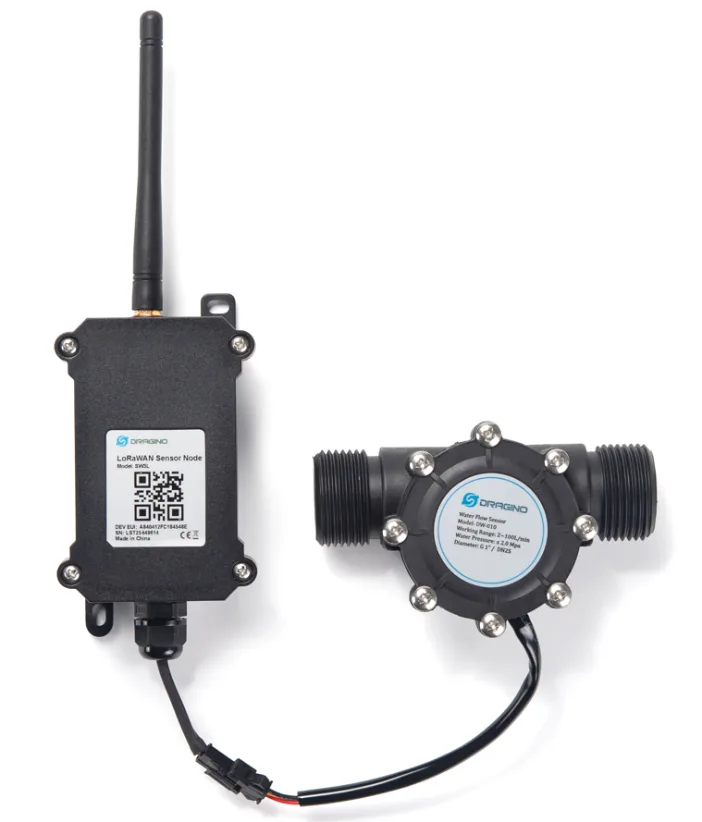
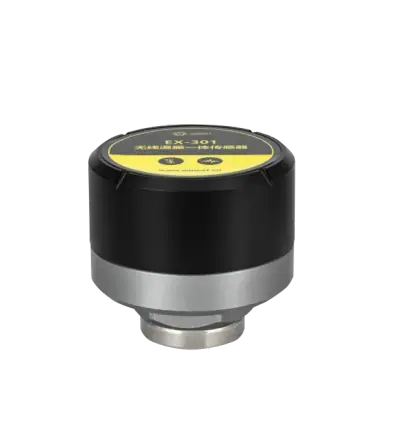
The Dragino SW3L is a LoRaWAN water flow sensor for monitoring building water consumption and detecting waste such as faulty toilet cisterns, for indoor and outdoor use.
Operating Temperature-40°C to +85°C
Storage Temperature-40°C to +85°C
Battery8500mAh
Battery TypeLi-SOCI2
DiameterG1/2” / DN15
ProtocolLoRaWAN v1.0.3 Class A
Product overview
Overview. The Dragino SW3L is a LoRaWAN flow sensor from the manufacturer Dragino. It measures the volume of water flowing through a pipe and sends the data to an IoT server over the LoRaWAN network, to monitor water usage in buildings.
Main characteristics. Powered by a non-rechargeable 8500mAh Li-SOCI2 industrial battery, the SW3L sends the water flow volume every 20 minutes. It can also detect the water flow status and send an alarm, for example for a broken toilet cistern. Each unit is pre-loaded with a set of unique keys for LoRaWAN registration. The pulse rate is 450 pulse = 1 L with a G1/2" / DN15 diameter, and parameters can be changed remotely by LoRa downlink or with AT commands.
Interfaces and connectivity. The SW3L implements the LoRaWAN v1.0.3 Class A protocol and supports the frequency bands CN470, EU433, KR920, US915, EU868, AS923, AU915, IN865 and RU864. Firmware is upgradable via the program port.
Power and environment. 8500mAh Li-SOCI2 battery. Operating temperature -40°C to +85°C and storage temperature -40°C to +85°C. Weatherproof enclosure designed for outdoor use.
Typical uses. Water control, waste water monitoring, detection of water waste on toilet flushing systems.
Integration. Install in the water pipe respecting the flow direction; wall mounting is possible. Register the keys on the LoRaWAN server, after which the device connects automatically when powered on.
Official documents and the technical data recorded for SW3L. For a missing document or a specific revision, our experts send it to you.
1. Technical overview
The Dragino SW3L is a LoRaWAN water flow sensor for monitoring building water consumption and detecting waste such as faulty toilet cisterns, for indoor and outdoor use.
Points to check before using SW3L in a design. They are derived from the recorded characteristics, not from the manufacturer's application circuits.
1Thermalrated operating range -40°C to +85°C — check it against the installation environment.
Power and communication
Battery
8500mAh
Battery Type
Li-SOCI2
Check the exact pin assignment and the application circuit in the datasheet, or ask our experts.
Implementation checklist
Thermal : rated operating range -40°C to +85°C — check it against the installation environment.
Applications and use cases
Architectures in which SW3L can play a role, derived from its category. This is not a compatibility statement: check the specifications against your requirements.
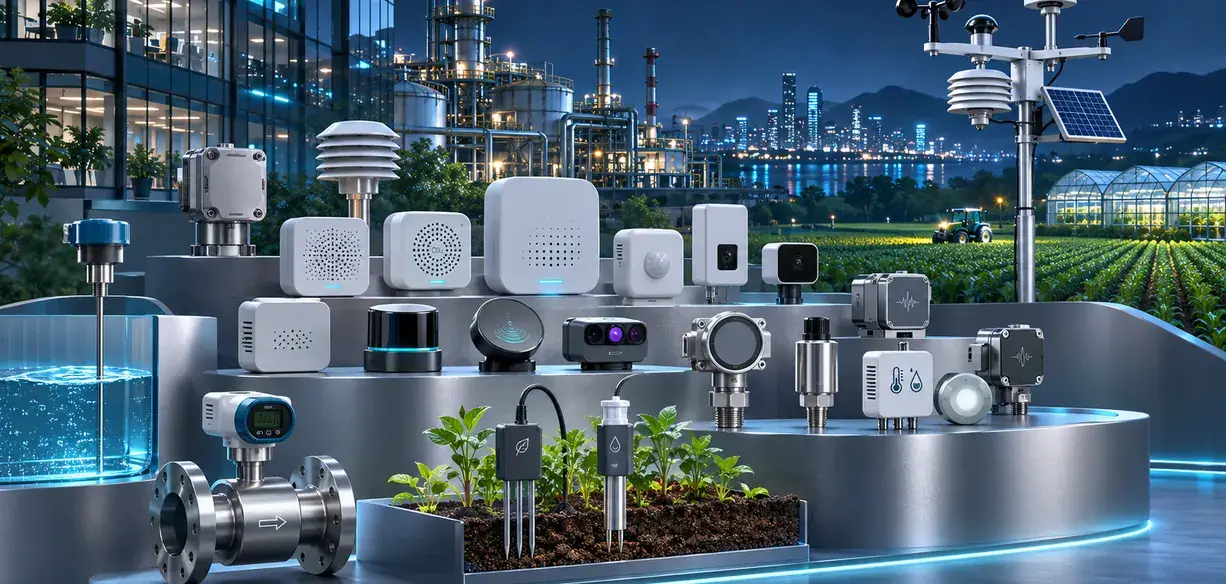
Diseases and water stress are noticed once the crop is already affected. A weather station, soil probes and sensor nodes in the field report conditions through an outdoor gateway
To check
Crops, plots and measurement depth of the soil probes
A LoRaWAN project needs sensors, gateways, a network server and an application that work together. Sensor nodes report to indoor or outdoor gateways, which forward the data to the network server and the customer’s platform
To check
Regional frequency plan (EU868, US915 and others)
Network server: public, private or embedded in the gateway
Milesight sensors, LoRaWAN gateways and cellular routers can be brought together on the Milesight Development Platform, which manages the devices and passes their data to other applications through an API and webhooks
To check
Development Platform for device management, API and webhooks, or another network server and application
Devices provisioned through Milesight RPS must have that provisioning removed before being added to the Development Platform
Data flows to the customer’s own application through webhooks
RAKwireless WisGate gateways run WisGateOS 2 and are managed from WisDM, RAKwireless’ cloud device management platform with a built-in network server, alongside RAK sensor nodes, radio modules and concentrators
To check
WisDM built-in network server, or a third-party one (ChirpStack, TTN/TTS, AWS IoT Core, Actility)
Remote configuration and updates of the gateways from WisDM
Regional frequency plan of the gateways and nodes
Associated system blocks
GatewaysSensors and modulesDevelopment boardsMounting
Seeed SenseCAP sensors connect to Seeed’s SenseCAP cloud platform and app, and Seeed edge computers, camera modules, Grove and XIAO boards complete the chain for custom devices and local processing
To check
SenseCAP cloud platform and app, or the customer’s own network server
Prototype on Grove and XIAO, then move to industrial versions
Local processing on the edge computers or in the cloud
Associated system blocks
SensorsEdge computingDevelopment boards
Need a complete solution?
Send a request for SW3L and the other parts of your project.
Similar parts to answer your needs. Compare the main characteristics. A recorded replacement is a documented relation; a similar product is a similarity only, never a compatibility claim.
SenseCAP SOLO CO2 5000 (A1) - NDIR CO2 Sensor, MODBUS-RTU RS485 & SDI-12
A
The default output of the sensor is RS485 and the slave address is 1. If you need to use SDI-12 output, you need to open the cover and push the button on the board to ''1'' and ''2''. At the same time, check whether the wire sequence is correct.
SenseCAP SOLO CO2 5000 (A2) - NDIR CO2 Sensor, MODBUS-RTU RS485 & SDI-12, with Waterproof Aviation Connector
A
The default output of the sensor is RS485 and the slave address is 1. If you need to use SDI-12 output, you need to open the cover and push the button on the board to ''1'' and ''2''. At the same time, check whether the wire sequence is correct.
What is recorded about the regulatory status and the life of this part.
Regulatory compliance
No compliance statement is recorded for this part. Ask the supplier for the RoHS and REACH declarations and, for a radio product, the EU declaration of conformity.
With your consent, we use Google cookies to measure the site’s audience and our advertising. Your quote basket and comparison stay in your browser either way. Details