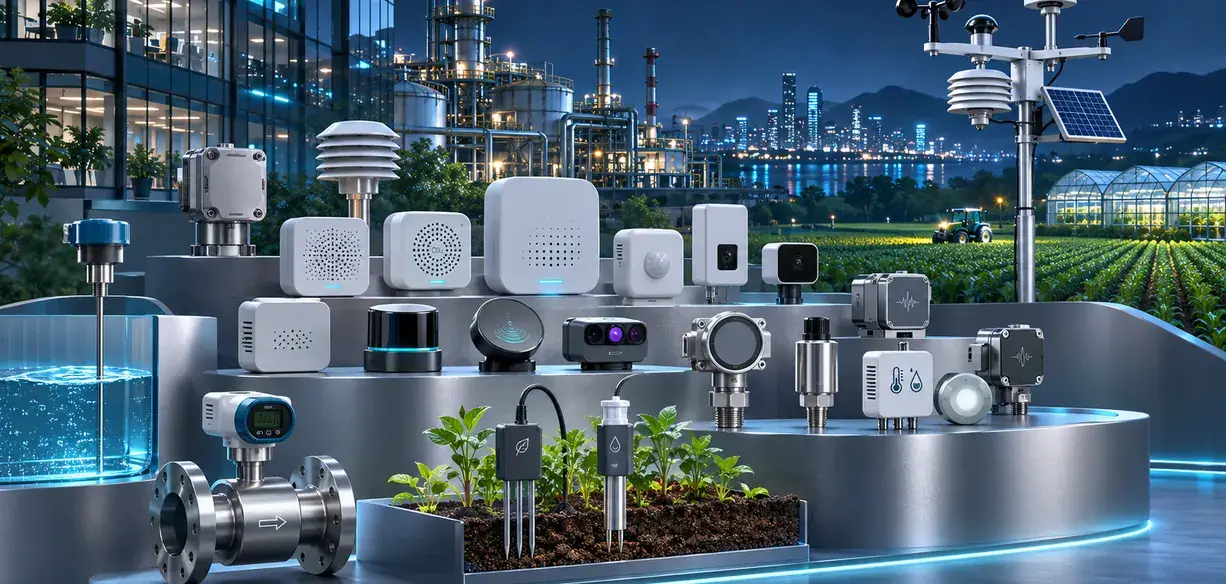
The Heltec HRI-3621 is a modular LoRa/LoRaWAN sensor hub for indoor industrial environmental monitoring, with replaceable sensor probes.
Operating Temperature-20 ~ 60 ℃
Charging InterfaceMagnetic charging interface
Device Parameters Change MethodWeb page via Wi-Fi, or Bluetooth via APP
Dimensions11 × 4 × 4 cm
IP ratingIP66
Battery Capacity1100mAh
Product overview
Overview. Heltec Sensor Hub HRI-3621 is a ready-to-use LoRa/LoRaWAN environmental sensor node for indoor industrial applications. Its modular design allows the sensor probes to be replaced to suit different projects.
Main characteristics. The stainless-steel shell and high-strength plastic provide an IP66 protection rating. The module integrates a BMP280 barometric pressure and temperature sensor, a GXHTC3 temperature and humidity sensor, an IIS3DWB vibration sensor and weighs 260 g. It comes with an 1100 mAh 18350 rechargeable lithium battery and a magnetic charging interface.
Gas detection and air quality. The hub accepts MEMS sensors for methane CH4, carbon monoxide CO, hydrogen sulfide H2S, formaldehyde HCHO, ammonia NH3 and smoke, as well as TVOC sensors for air quality, carbon dioxide CO2 and odour detection.
Connectivity. The LoRa module uses the SX1262 chip and covers the 433 MHz, 470~510 MHz, 863~870 MHz and 902~928 MHz bands. It complies with LoRaWAN 1.0.2 Rev. B, Class A/C, with OTAA/ABP activation. Maximum transmit power is +20 ± 2 dBm and receiving sensitivity is -136 dBm at SF12, BW=125 kHz. Parameters can be changed through a Wi-Fi web page or via Bluetooth through an app, and registration is done by QR code scan or manually. OTA firmware upgrade is supported.
Power and environment. Operation is specified from -20 to 60 °C, with 0 to 90 % humidity, non-condensing.
Installation and integration. The hub can be wall-mounted, cylinder-mounted or rail-mounted. A built-in Python engine lets users add logic through scripts without changing the core functions of the device.
No published question about this part yet. Questions are reviewed before publication.
Complete specifications
Every characteristic recorded for SENSOR-HUB, with where it comes from. Use the filters to find one quickly.
All specifications (28)
Characteristic
Value
Dimensions
11 × 4 × 4 cm
IP rating
IP66
Barometric pressure & Temperature
BMP280 Chip Based Sensor; can also measured temperature and altitude
Battery Capacity
1100mAh
Battery Type
18350 rechargeable Li-On battery
CH4 Gas Detection
MEMS Methane CH4 Gas Detection Sensor
Charging Interface
Magnetic charging interface
CO Gas Detection
MEMS Carbon Monoxide CO Gas Detection Sensor
Device Parameters Change Method
Web page via Wi-Fi, or Bluetooth via APP
Device Register Method
QR code scan by APP, or Manual registration
H2S Gas Detection
MEMS Hydrogen Sulfide H2S Gas Detection Sensor
HCHO Gas Detection
MEMS Formaldehyde HCHO Gas Detection Sensor
LoRa Band
433MHz, 470~510MHz, 863~870MHz, 902~928MHz
LoRa Node Chip
SX1262
LoRaWAN
LoRaWAN 1.0.2 Rev. B, Class A/C, OTAA/ABP
Max Tx Power
+20 ± 2 dBm
NH3 Gas Detection
MEMS Ammonia NH3 Gas Detection Sensor
Operating Humidity
0 ~ 90%, no-condensing
Operating Temperature
-20 ~ 60 ℃
Product Main Model
HRI-3621
Receiving Sensitivity
-136dBm@SF12 BW=125KHz
Sensor Type
Function Description
Smoke Gas Detection
MEMS Smoke Gas Detection Sensor
Temperature and humidity
GXHTC3 Chip Based Sensor
TVOC (Air Quality, CO2)
MEMS carbon dioxide Gas Detection Sensor
TVOC (Odor Detection)
MEMS Odor Smell Gas Detection Sensor
Vibrate
IIS3DWB
Weight
260 g
No specification matches.
Last verification : 2026-11-02
Technical documentation
Official documents and the technical data recorded for SENSOR-HUB. For a missing document or a specific revision, our experts send it to you.
1. Technical overview
The Heltec HRI-3621 is a modular LoRa/LoRaWAN sensor hub for indoor industrial environmental monitoring, with replaceable sensor probes.
Operating Temperature-20 ~ 60 ℃
Charging InterfaceMagnetic charging interface
Device Parameters Change MethodWeb page via Wi-Fi, or Bluetooth via APP
Dimensions11 × 4 × 4 cm
IP ratingIP66
2. Datasheet extract (recorded values)
Parameter
Value
Dimensions
11 × 4 × 4 cm
IP rating
IP66
Barometric pressure & Temperature
BMP280 Chip Based Sensor; can also measured temperature and altitude
Battery Capacity
1100mAh
Battery Type
18350 rechargeable Li-On battery
CH4 Gas Detection
MEMS Methane CH4 Gas Detection Sensor
Charging Interface
Magnetic charging interface
CO Gas Detection
MEMS Carbon Monoxide CO Gas Detection Sensor
Device Parameters Change Method
Web page via Wi-Fi, or Bluetooth via APP
Device Register Method
QR code scan by APP, or Manual registration
H2S Gas Detection
MEMS Hydrogen Sulfide H2S Gas Detection Sensor
HCHO Gas Detection
MEMS Formaldehyde HCHO Gas Detection Sensor
LoRa Band
433MHz, 470~510MHz, 863~870MHz, 902~928MHz
LoRa Node Chip
SX1262
LoRaWAN
LoRaWAN 1.0.2 Rev. B, Class A/C, OTAA/ABP
Max Tx Power
+20 ± 2 dBm
NH3 Gas Detection
MEMS Ammonia NH3 Gas Detection Sensor
Operating Humidity
0 ~ 90%, no-condensing
Operating Temperature
-20 ~ 60 ℃
Product Main Model
HRI-3621
Receiving Sensitivity
-136dBm@SF12 BW=125KHz
Sensor Type
Function Description
Smoke Gas Detection
MEMS Smoke Gas Detection Sensor
Temperature and humidity
GXHTC3 Chip Based Sensor
TVOC (Air Quality, CO2)
MEMS carbon dioxide Gas Detection Sensor
TVOC (Odor Detection)
MEMS Odor Smell Gas Detection Sensor
Vibrate
IIS3DWB
Weight
260 g
Integration
Points to check before using SENSOR-HUB in a design. They are derived from the recorded characteristics, not from the manufacturer's application circuits.
1Thermalrated operating range -20 ~ 60 ℃ — check it against the installation environment.
Power and communication
Battery Capacity
1100mAh
Battery Type
18350 rechargeable Li-On battery
Max Tx Power
+20 ± 2 dBm
Check the exact pin assignment and the application circuit in the datasheet, or ask our experts.
Implementation checklist
Thermal : rated operating range -20 ~ 60 ℃ — check it against the installation environment.
Applications and use cases
Architectures in which SENSOR-HUB can play a role, derived from its category. This is not a compatibility statement: check the specifications against your requirements.
Diseases and water stress are noticed once the crop is already affected. A weather station, soil probes and sensor nodes in the field report conditions through an outdoor gateway
To check
Crops, plots and measurement depth of the soil probes
A LoRaWAN project needs sensors, gateways, a network server and an application that work together. Sensor nodes report to indoor or outdoor gateways, which forward the data to the network server and the customer’s platform
To check
Regional frequency plan (EU868, US915 and others)
Network server: public, private or embedded in the gateway
Milesight sensors, LoRaWAN gateways and cellular routers can be brought together on the Milesight Development Platform, which manages the devices and passes their data to other applications through an API and webhooks
To check
Development Platform for device management, API and webhooks, or another network server and application
Devices provisioned through Milesight RPS must have that provisioning removed before being added to the Development Platform
Data flows to the customer’s own application through webhooks
RAKwireless WisGate gateways run WisGateOS 2 and are managed from WisDM, RAKwireless’ cloud device management platform with a built-in network server, alongside RAK sensor nodes, radio modules and concentrators
To check
WisDM built-in network server, or a third-party one (ChirpStack, TTN/TTS, AWS IoT Core, Actility)
Remote configuration and updates of the gateways from WisDM
Regional frequency plan of the gateways and nodes
Associated system blocks
GatewaysSensors and modulesDevelopment boardsMounting
Seeed SenseCAP sensors connect to Seeed’s SenseCAP cloud platform and app, and Seeed edge computers, camera modules, Grove and XIAO boards complete the chain for custom devices and local processing
To check
SenseCAP cloud platform and app, or the customer’s own network server
Prototype on Grove and XIAO, then move to industrial versions
Local processing on the edge computers or in the cloud
Associated system blocks
SensorsEdge computingDevelopment boards
Need a complete solution?
Send a request for SENSOR-HUB and the other parts of your project.
Similar parts to answer your needs. Compare the main characteristics. A recorded replacement is a documented relation; a similar product is a similarity only, never a compatibility claim.
SenseCAP SOLO CO2 5000 (A1) - NDIR CO2 Sensor, MODBUS-RTU RS485 & SDI-12
A
The default output of the sensor is RS485 and the slave address is 1. If you need to use SDI-12 output, you need to open the cover and push the button on the board to ''1'' and ''2''. At the same time, check whether the wire sequence is correct.
SenseCAP SOLO CO2 5000 (A2) - NDIR CO2 Sensor, MODBUS-RTU RS485 & SDI-12, with Waterproof Aviation Connector
A
The default output of the sensor is RS485 and the slave address is 1. If you need to use SDI-12 output, you need to open the cover and push the button on the board to ''1'' and ''2''. At the same time, check whether the wire sequence is correct.
No advertising or analytics cookies. A single, strictly necessary cookie is set only if you sign in to your account. Your quote basket and comparison stay in your browser. Details