Product overview
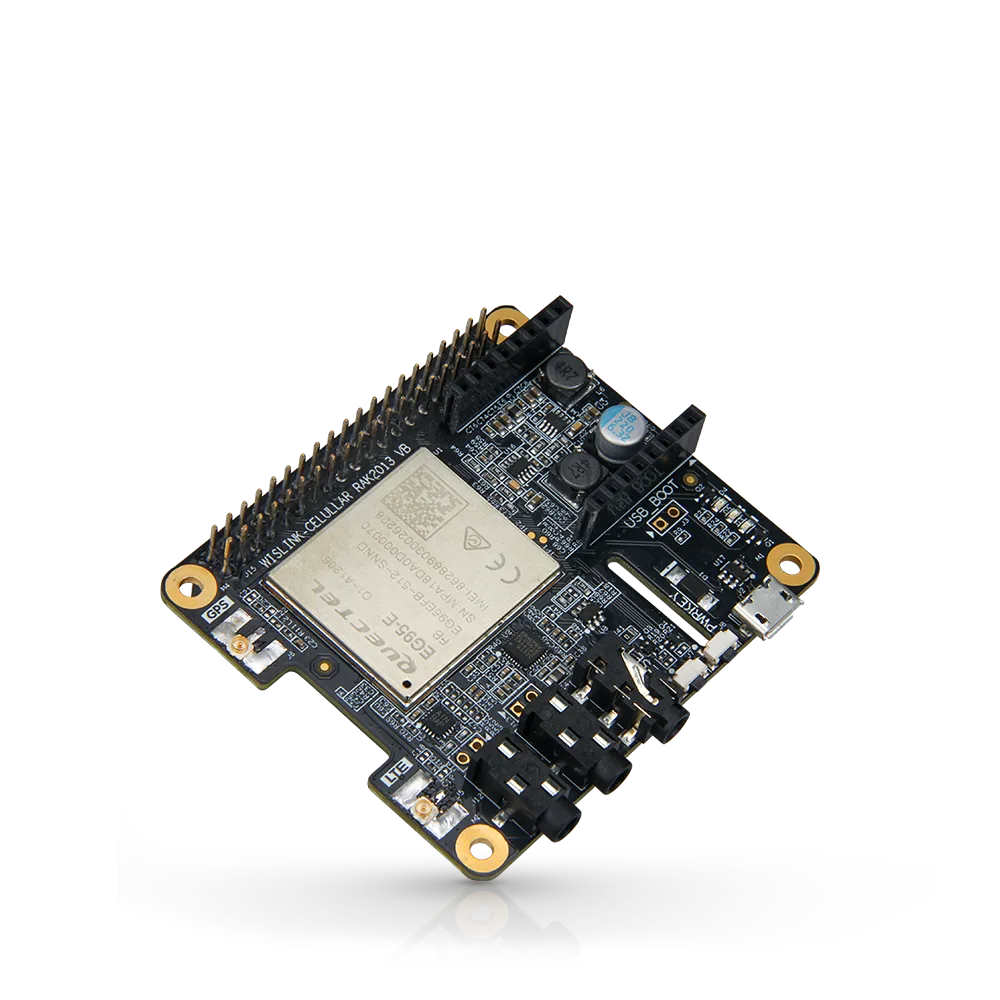
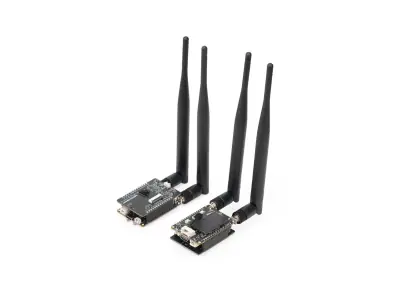
RAK2013 cellular module from RAKwireless. Raspberry Pi cellular expansion HAT, compatible with Raspberry Pi 3B+ and 4. Overview — The RAK2013 brings LPWAN connectivity to IoT devices through the Quectel BG96 module, configurable for LTE Cat M1/NB1 under the Nb-IoT and CAT-M standards. The board measures 65 mm x 56 mm x 19.5 mm and weighs approximately 28 g. Main characteristics — The module supports LTE FDD bands B1, B2, B3, B4, B5, B8, B12 and B18, LTE TDD band B39 for CAT M1 only, and EGPRS at 850/900/1800/1900 MHz. It accepts nano SIM and eSIM. An integrated audio amplifier and codec enable high-definition Voice over LTE (VoLTE). Interfaces and connectivity — The 40-pin connector follows the Raspberry Pi pinout and includes a mikroBUS header. The Raspberry Pi SPI, UART and GPIO pins are assigned to the BG96 signals, PWRKEY, RESET and DTR. An optional GPS receiver is supported with the BG96, with a dedicated GPS antenna supplied. Power and environment — Power input is 3 to 5 V, with a typical power-off current of 10 mA and a typical current of 300 mA in CAT M mode, with GSM peaks up to 2000 mA. The operating temperature range is -35 °C to +75 °C, and the extended range is -40 °C to +80 °C. Certified CE and FCC. Typical uses — The module suits environmental monitoring, presence sensing and any IoT project requiring a cellular link, using the sensors compatible with mikroBUS. Integration — The module ships with two LTE antennas, one GPS antenna and a micro USB cable. An onboard EEPROM stores automatic configuration options. The manufacturer's configuration notes state that this HAT is not compatible with the RAK2245 and the WisGate RAK7243/44 gateways without cellular module.