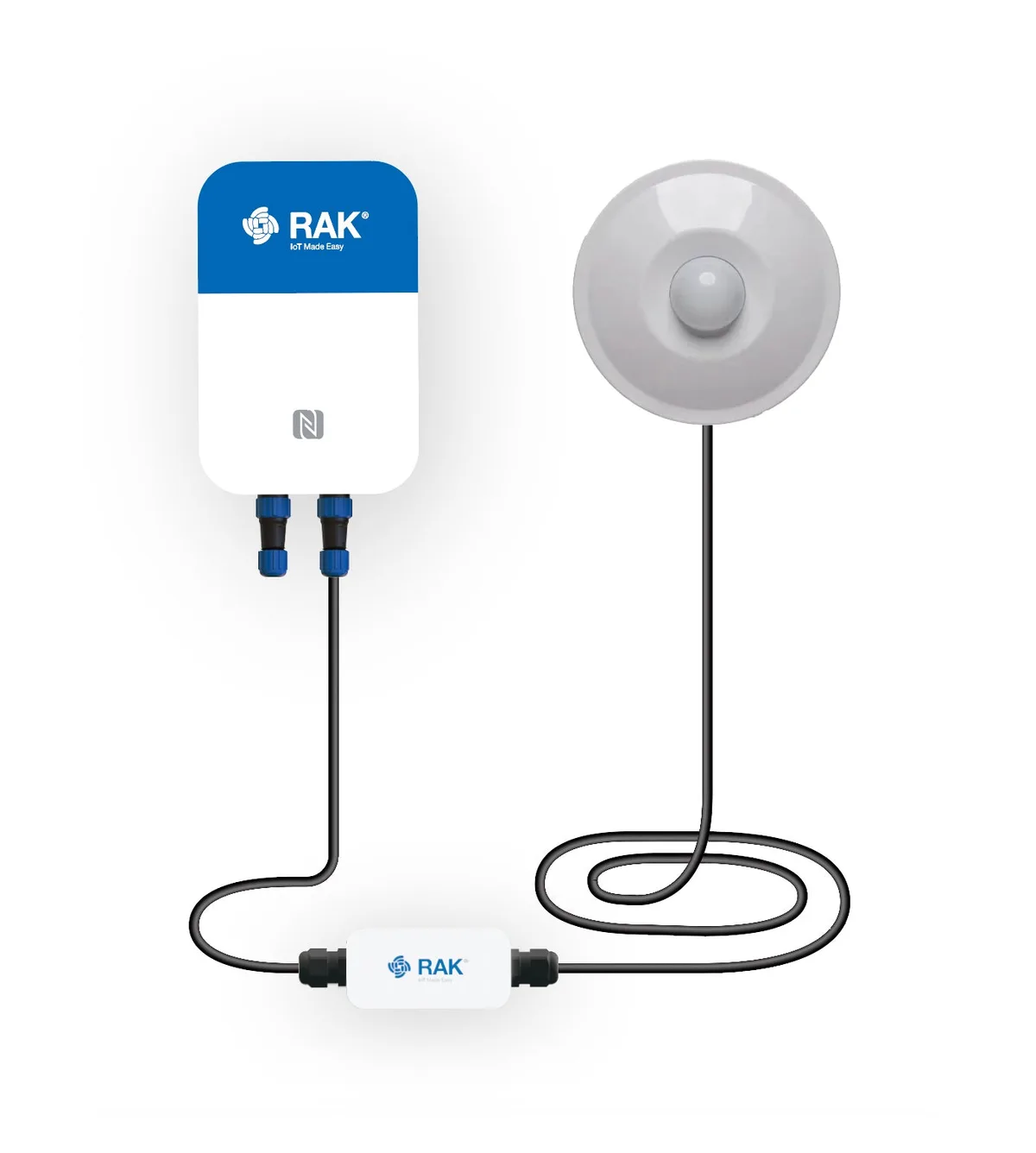
RAKwireless light sensing hub for indoor light intensity monitoring, in LoRaWAN and NB-IoT variant, AU915 frequency band.
Temperature and humidity range-40 ℃ ~ +60 ℃; 0% RH ~ 80% RH
Light intensity range0-65535 Lux; 0-200,000 Lux
Maximum power consumption0.4 W
Frequency bandAU915
VariantLoRaWAN+NB IoT
Product overview
Overview. The RAKwireless Sensor Hub Light Sensing, reference C17016, is a light sensor designed for indoor light intensity monitoring. It is supplied with a hub, a ProbeIO sensor probe, an RS-GZ-N01-XD light sensor and a power supply.
Main characteristics. Light measurement range of 0 to 65535 Lux, and 0 to 200,000 Lux depending on configuration. Light precision of ±7% at 25 ℃, humidity precision of ±3% RH at 60% RH and 25 ℃, and temperature precision of ±0.5 °C at 25 °C. Temperature and humidity range of -40 ℃ to +60 ℃ and 0% RH to 80% RH. Maximum power consumption of 0.4 W.
Interfaces and connectivity. LoRaWAN+NB IoT variant, with an NB-IoT module supporting LTE categories CAT M1 and CAT NB2. Frequency band AU915.
Power and environment. Powered by the included power supply; the hub with connected probe and sensor cannot run on batteries. Solar panel and external DC power supply options are available. Rigid and robust construction.
Typical uses. Laboratories, archives and electronic equipment production lines, as indicated by the manufacturer.
Integration. The splitter cable connects several sensor probes and probe IOs to a single hub port, and the extension cable extends the distance between the hub and the probes. The RS-GZ-N01-XD sensor uses RS485 communication with the Modbus-RTU protocol, with configurable address and baud rate and a maximum communication distance of 2000 m.
Architectures in which C17016 can play a role, derived from its category. This is not a compatibility statement: check the specifications against your requirements.
Diseases and water stress are noticed once the crop is already affected. A weather station, soil probes and sensor nodes in the field report conditions through an outdoor gateway
To check
Crops, plots and measurement depth of the soil probes
A LoRaWAN project needs sensors, gateways, a network server and an application that work together. Sensor nodes report to indoor or outdoor gateways, which forward the data to the network server and the customer’s platform
To check
Regional frequency plan (EU868, US915 and others)
Network server: public, private or embedded in the gateway
Milesight sensors, LoRaWAN gateways and cellular routers can be brought together on the Milesight Development Platform, which manages the devices and passes their data to other applications through an API and webhooks
To check
Development Platform for device management, API and webhooks, or another network server and application
Devices provisioned through Milesight RPS must have that provisioning removed before being added to the Development Platform
Data flows to the customer’s own application through webhooks
RAKwireless WisGate gateways run WisGateOS 2 and are managed from WisDM, RAKwireless’ cloud device management platform with a built-in network server, alongside RAK sensor nodes, radio modules and concentrators
To check
WisDM built-in network server, or a third-party one (ChirpStack, TTN/TTS, AWS IoT Core, Actility)
Remote configuration and updates of the gateways from WisDM
Regional frequency plan of the gateways and nodes
Associated system blocks
GatewaysSensors and modulesDevelopment boardsMounting
Seeed SenseCAP sensors connect to Seeed’s SenseCAP cloud platform and app, and Seeed edge computers, camera modules, Grove and XIAO boards complete the chain for custom devices and local processing
To check
SenseCAP cloud platform and app, or the customer’s own network server
Prototype on Grove and XIAO, then move to industrial versions
Local processing on the edge computers or in the cloud
Associated system blocks
SensorsEdge computingDevelopment boards
Need a complete solution?
Send a request for C17016 and the other parts of your project.
Similar parts to answer your needs. Compare the main characteristics. A recorded replacement is a documented relation; a similar product is a similarity only, never a compatibility claim.
Current productRAKwireless
C17016
LoRaWAN and NB-IoT light sensing hub for environmental monitoring
SenseCAP SOLO CO2 5000 (A1) - NDIR CO2 Sensor, MODBUS-RTU RS485 & SDI-12
A
The default output of the sensor is RS485 and the slave address is 1. If you need to use SDI-12 output, you need to open the cover and push the button on the board to ''1'' and ''2''. At the same time, check whether the wire sequence is correct.
SenseCAP SOLO CO2 5000 (A2) - NDIR CO2 Sensor, MODBUS-RTU RS485 & SDI-12, with Waterproof Aviation Connector
A
The default output of the sensor is RS485 and the slave address is 1. If you need to use SDI-12 output, you need to open the cover and push the button on the board to ''1'' and ''2''. At the same time, check whether the wire sequence is correct.
What is recorded about the regulatory status and the life of this part.
Regulatory compliance
No compliance statement is recorded for this part. Ask the supplier for the RoHS and REACH declarations and, for a radio product, the EU declaration of conformity.
No advertising or analytics cookies. A single, strictly necessary cookie is set only if you sign in to your account. Your quote basket and comparison stay in your browser. Details