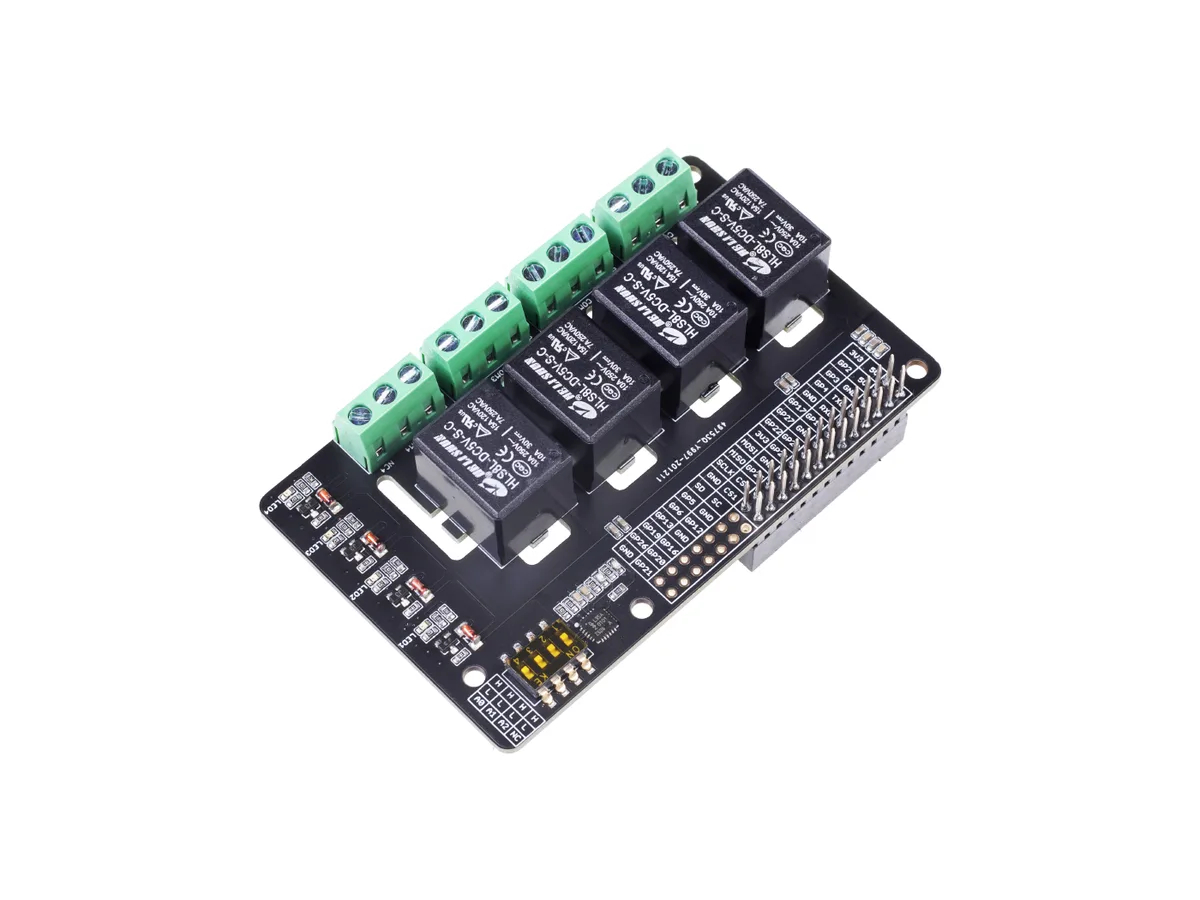

Raspberry Pi shield fitted with four SPDT relays offering NO/NC contacts, for switching high-current loads controlled over the I2C bus.
Max. Switching Current15A
Frequency1Hz
Dimensions91.2 x 56 x 32mm
Max. Switching Voltage30VDC/ 250VAC
Power supply4.75 ~ 5.5V
Product overview
Overview. The 4-Channel SPDT Relay HAT from Seeed Studio is a shield-format expansion board for Raspberry Pi that integrates four high-quality SPDT (single pole - double throw) relays. It allows high-current loads to be controlled from a Raspberry Pi.
Main characteristics. Each relay provides COM, NO (Normally Open) and NC (Normally Closed) pins, with screw terminals for easy connection. The maximum switching current is 15A and the maximum switching voltage 30VDC / 250VAC. Four LED indicators show the on/off state of each relay.
Interfaces and connectivity. Control is performed over an I2C interface, with three hardware switches SW1 (1, 2, 3) selecting the fixed I2C bus address. The board is compatible with Raspberry Pi 1, 2, 3 and 4.
Power and environment. Power supply from 4.75 to 5.5 V. Dimensions: 91.2 x 56 x 32 mm.
Typical uses. This board suits controlling devices that cannot be driven directly from the I2C bus. When carrying a heavy inductive load for a long period, the on-board MCU may go down and require a reset procedure.
Raspberry Pi shield fitted with four SPDT relays offering NO/NC contacts, for switching high-current loads controlled over the I2C bus.
Max. Switching Current15A
Frequency1Hz
Dimensions91.2 x 56 x 32mm
Max. Switching Voltage30VDC/ 250VAC
Power supply4.75 ~ 5.5V
2. Datasheet extract (recorded values)
Parameter
Value
Dimensions
91.2 x 56 x 32mm
Frequency
1Hz
Max. Switching Current
15A
Max. Switching Voltage
30VDC/ 250VAC
Power supply
4.75 ~ 5.5V
Applications and use cases
Architectures in which 114992543 can play a role, derived from its category. This is not a compatibility statement: check the specifications against your requirements.
A proprietary PLC locks the project into one vendor’s tools. Industrial controllers built on the Raspberry Pi Compute Module run Linux, Node-RED, Python or CODESYS on DIN rail, with I/O modules, an operator panel and a cellular router for remote access

Adding a mobile connection to a product means choosing a modem, a SIM and a way to manage both. A cellular modem or HAT, an IoT SIM and a router or gateway form one connectivity chain, managed from a single platform
To check
Countries and networks where the devices will operate
Data volume per device and per month
Network technology (LTE-M, NB-IoT, 4G, 5G) supported by the modem and the SIM
Not every vision task justifies an industrial vision system. A Raspberry Pi with a camera module and an expansion board runs simple detection and counting models at low cost, close to the scene
To check
Frame rate and model size the board can run
Lighting and lens for the scene
Enclosure and cooling for the installation
Associated system blocks
ComputeCameras
Need a complete solution?
Send a request for 114992543 and the other parts of your project.
Similar parts to answer your needs. Compare the main characteristics. A recorded replacement is a documented relation; a similar product is a similarity only, never a compatibility claim.
What is recorded about the regulatory status and the life of this part.
Regulatory compliance
No compliance statement is recorded for this part. Ask the supplier for the RoHS and REACH declarations and, for a radio product, the EU declaration of conformity.
No advertising or analytics cookies. A single, strictly necessary cookie is set only if you sign in to your account. Your quote basket and comparison stay in your browser. Details