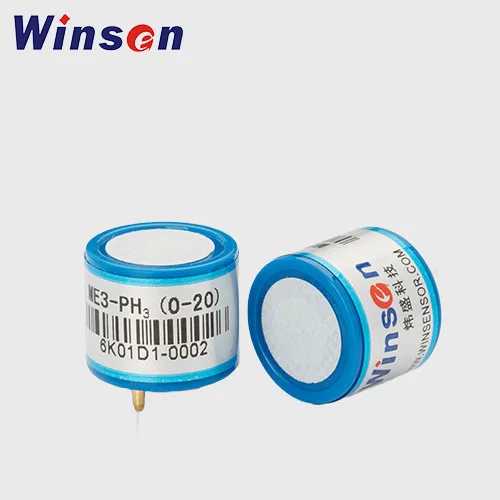
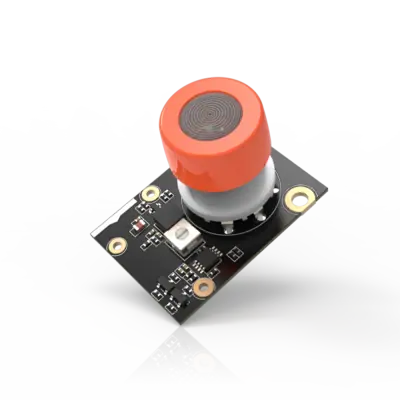
Winsen ME3-PH3 electrochemical sensor for detecting phosphine (PH3) in industrial, underground mining and environmental protection applications.
Pressure range(kPa)90-110
Detection range0-10ppm, Max 20ppm
Measurement Range0~10ppm
Storage humidity15﹪~90﹪RH
Storage Temperature-20℃~50℃
Anticipated using life2years(In air)
Product overview
Overview. The Winsen ME3-PH3 is an electrochemical PH3 phosphine gas sensor. It measures gas concentration from the current produced by electrochemical oxidation of the target gas on the working electrode, this current being proportional to concentration according to Faraday's law.
Main characteristics. Measurement range 0 to 10 ppm, maximum detecting concentration 20 ppm, resolution 0.05 ppm and sensitivity (1.70±0.30) µA/ppm. T90 response time is at or below 30 s, repeatability is below 2% of output value and stability below 2% per month. Zero drift is 0.7 ppm between -20 and 40 ℃. The output is linear and the anticipated service life is 2 years in air.
Power and environment. Pressure range 90 to 110 kPa, storage temperature -20 ℃ to 50 ℃ and storage humidity 15% to 90% RH. The sensor measures 20 × 16.4 mm (φ20×16.4) and has low consumption.
Typical uses. Detection of toxic or hazardous PH3 gas in modern grain storage circulation fumigation, on farms and in industrial fields.
Integration. Recommended load resistance 10 Ω. A bias voltage of 0 mV is specified. The sensor has no sleeping mode, which can be set in programming if needed.
No published question about this part yet. Questions are reviewed before publication.
Complete specifications
Every characteristic recorded for ME3-PH3, with where it comes from. Use the filters to find one quickly.
All specifications (23)
Characteristic
Value
Anticipated using life
2years(In air)
Bias voltage
0mV
Characteristics
Detection of phosphine in industrial, underground mining and environmental protection fields
Detection Gas
PH3
Detection Principle
Electrochemical
Detection range
0-10ppm, Max 20ppm
Load resistance(recommend)
10&Omega
Max detecting concentration
20ppm
Measurement Range
0~10ppm
Model
ME3-PH3
Output Linearity
linear
Pressure range(kPa)
90-110
Repeatability
<2﹪output value
Resolution ratio
0.05ppm
Response Time (T90)
≤ 30S
Sensitivity
(1.70±0.30)µA/ppm
Size
φ20×16.4
Stability (/month)
<2﹪
Storage humidity
15﹪~90﹪RH
Storage Temperature
-20℃~50℃
Target
PH3
Working Conditions
Resolution ratio 0.05ppm; Response time≤30s; Anticipated using life 2 years
Zero drift (-20~40℃)
0.7ppm
No specification matches.
Last verification : 2026-11-02
Technical documentation
Official documents and the technical data recorded for ME3-PH3. For a missing document or a specific revision, our experts send it to you.
1. Technical overview
Winsen ME3-PH3 electrochemical sensor for detecting phosphine (PH3) in industrial, underground mining and environmental protection applications.
Pressure range(kPa)90-110
Detection range0-10ppm, Max 20ppm
Measurement Range0~10ppm
Storage humidity15﹪~90﹪RH
Storage Temperature-20℃~50℃
2. Datasheet extract (recorded values)
Parameter
Value
Anticipated using life
2years(In air)
Bias voltage
0mV
Characteristics
Detection of phosphine in industrial, underground mining and environmental protection fields
Detection Gas
PH3
Detection Principle
Electrochemical
Detection range
0-10ppm, Max 20ppm
Load resistance(recommend)
10&Omega
Max detecting concentration
20ppm
Measurement Range
0~10ppm
Model
ME3-PH3
Output Linearity
linear
Pressure range(kPa)
90-110
Repeatability
<2﹪output value
Resolution ratio
0.05ppm
Response Time (T90)
≤ 30S
Sensitivity
(1.70±0.30)µA/ppm
Size
φ20×16.4
Stability (/month)
<2﹪
Storage humidity
15﹪~90﹪RH
Storage Temperature
-20℃~50℃
Target
PH3
Working Conditions
Resolution ratio 0.05ppm; Response time≤30s; Anticipated using life 2 years
Zero drift (-20~40℃)
0.7ppm
Applications and use cases
Architectures in which ME3-PH3 can play a role, derived from its category. This is not a compatibility statement: check the specifications against your requirements.
Offices and classrooms get stuffy without anyone measuring why. Indoor air quality monitoring places CO2, VOC and particle sensors in the rooms and reports their values through a gateway, so ventilation can be adjusted to real occupancy
To check
Parameters to measure (CO2 alone or CO2, VOC and particles)
Battery-powered sensors or mains-powered sensors with display
Integration with the ventilation control or building management system
Associated system blocks
Air sensorsGateway
Need a complete solution?
Send a request for ME3-PH3 and the other parts of your project.
Similar parts to answer your needs. Compare the main characteristics. A recorded replacement is a documented relation; a similar product is a similarity only, never a compatibility claim.
Current productWinsen
ME3-PH3
Electrochemical phosphine PH3 gas sensor, 0-10 ppm
What is recorded about the regulatory status and the life of this part.
Regulatory compliance
No compliance statement is recorded for this part. Ask the supplier for the RoHS and REACH declarations and, for a radio product, the EU declaration of conformity.
With your consent, we use Google cookies to measure the site’s audience and our advertising. Your quote basket and comparison stay in your browser either way. Details