
What the HART protocol is in industrial instrumentation
HART, short for Highway Addressable Remote Transducer, is a hybrid industrial communication protocol that combines an analog 4-20 mA current loop with bidirectional digital signaling over the same twisted-pair wiring. Designed to preserve legacy analog infrastructure, it lets control systems and handheld configurators exchange configuration, calibration, and health data with field devices without interrupting continuous analog process measurement.
Across process automation plants, HART is widely implemented in Industrial Pressure Transmitters (4-20 mA / IO-Link), Temperature Transmitters, and Level Transmitters. While the DC loop current carries the primary process variable, the superimposed digital channel gives maintenance teams remote access to secondary variables, device identification, tag descriptors, and diagnostic status flags, reducing routine field trips and streamlining loop commissioning.
How HART works with Bell 202 FSK modulation on 4-20 mA loops
On wired loops, HART uses Frequency Shift Keying based on the Bell 202 standard operating at 1200 bits per second. A logic 1 is encoded at 1200 Hz and a logic 0 at 2200 Hz. Because this sinusoidal AC signal of roughly 0.5 mA peak-to-peak has a zero average DC value, it rides transparently atop the 4-20 mA analog signal without distorting the primary measurement.
To convert the modulated current into a voltage readable by a HART modem or analog input card, the circuit requires at least 250 ohms of total loop resistance. HART operates as a master-slave protocol supporting two masters: typically a DCS or PLC as primary master and a handheld tool as secondary master. Point-to-point mode keeps analog signaling active, whereas multidrop mode locks current at 4 mA to poll multiple devices.
HART protocol revisions, WirelessHART, and device integration
Successive protocol revisions expanded HART from basic parameter setup in HART 5 to HART 7, which adds extended dynamic variables, timestamped event notifications, and flexible burst-mode scheduling. WirelessHART, standardized as IEC 62591, applies the same HART command set over a 2.4 GHz IEEE 802.15.4 self-healing mesh network using Time Division Multiple Access to schedule deterministic low-power communications.
At the plant network tier, HART-IP encapsulates HART transactions over standard Ethernet and IP networks, allowing asset management servers and edge gateways to communicate with field instruments through multiplexers or wireless gateways. To ensure host software interprets vendor-specific parameters without custom drivers, manufacturers supply standardized integration files such as EDDL descriptions, FDT/DTM packages, or unified FDI device packages.
Where HART is used across industrial plants and IIoT architectures
HART remains prevalent in oil and gas, chemical processing, water treatment, pharmaceuticals, and power generation where extensive twisted-pair 4-20 mA cable trays are already installed. Plant engineers keep the fast analog current signal for regulatory control and safety interlocks while using the digital layer to trim sensor ranges, verify loop integrity, and capture early diagnostic warnings.
In Industrial IoT deployments, HART multiplexers and edge gateways bridge existing 4-20 mA loops to Modbus TCP, OPC UA, or MQTT brokers without disturbing the primary PLC scan. WirelessHART adapters similarly bring stranded measurements from remote storage tanks, rotating machinery, or temporary monitoring points into centralized maintenance platforms, delivering continuous health and multi-variable telemetry without pulling new signal cables.
What to check in a HART transmitter datasheet before quoting
Before requesting an instrument supply on quotation, review the supported HART revision, minimum compliance voltage, and maximum allowable loop resistance on the manufacturer datasheet. Confirm whether the receiving PLC analog input module provides built-in HART communication and at least 250 ohms of loop impedance, or whether an external resistor or impedance decoupler is required to stay within the 250 to 1100 ohm operating window.
Check that EDDL, DTM, or FDI device files match your control system version, verify digital update rates, and review NAMUR NE 43 fault current levels around 3.5 mA. For hazardous-area installations, inspect ATEX or IECEx ratings and intrinsic safety entity parameters (Ui, Ii, Ci, and Li) alongside process wetted materials, operating temperature limits, and enclosure ingress protection ratings.
Atlas Electronics catalogue transmitters for 4-20 mA and digital loops
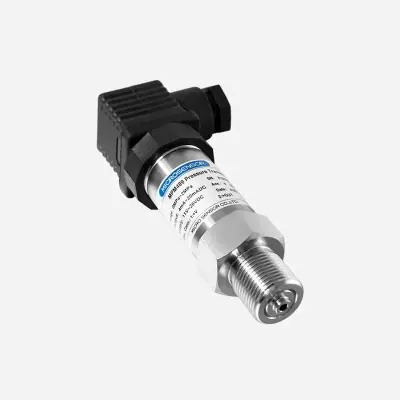
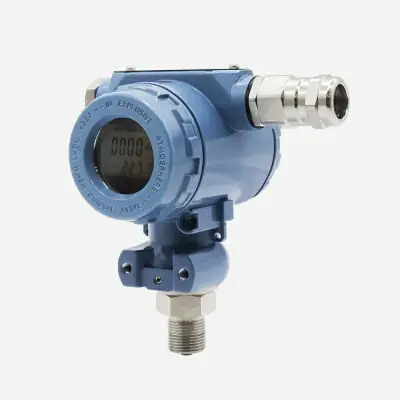
Atlas Electronics supplies Industrial Pressure Transmitters (4-20 mA / IO-Link) and Level Transmitters on quotation for analog and digital field architectures. For process pressure, the Microsensor MPM489 ATEX pressure transmitter with flush diaphragm offers ±0.25%FS, ±0.5%FS, or ±1%FS accuracy, a 316 SS flushing ring, DN25DN100 or 1 in 4 in flanges, and 4 mA 20 mA DC output. The Microsensor MDM483DM covers -1 bar...00.1 bar…1000 bar with accuracy down to ±0.1%FS.
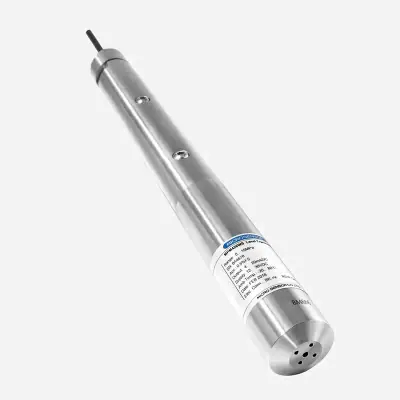
For level monitoring, the Microsensor MPM426WS measures 0 mH 2 O 2 mH 2 O…200 mH 2 O over a 4-20 mA output with a 316 SS flushing ring and ±0.25%FS, ±0.5%FS, or ±1%FS accuracy. Where ultrasonic sensing is preferred, the Holykell ULTRASONIC-LEVEL-SENSOR combines 4-20 mA and RS485 Modbus RTU down to -10 °C, with a 12 beam angle and ≤300 mm blind area at 10 m. Always confirm native HART support or external gateway compatibility in the datasheet.
Frequently asked questions
Can a HART transmitter communicate without a 250 ohm resistor in the loop?
No. Bell 202 FSK modulation requires a minimum loop impedance of roughly 230 to 250 ohms between the power supply and the transmitter so the 0.5 mA current swing creates a voltage signal a HART modem can detect. If the PLC input card has lower internal resistance, a series loop resistor must be added per the datasheet.
What is the difference between HART point-to-point mode and multidrop mode?
In point-to-point mode, a single transmitter at polling address 0 outputs the primary variable as a live 4-20 mA current while digital diagnostics ride on the same wire. In multidrop mode, multiple transmitters share one wire pair, their analog current is fixed at 4 mA, and all process values are read digitally.
Does WirelessHART replace wired HART across industrial plants?
Not entirely. WirelessHART uses the same application commands over an IEC 62591 2.4 GHz mesh network, making it suited for monitoring points where cabling is impractical. Wired HART remains standard where loops already exist or where fast 4-20 mA analog control and loop power are required.
How do 4-20 mA or Modbus transmitters integrate when native HART is absent?
Transmitters offering only analog 4-20 mA or RS485 Modbus RTU connect directly to standard PLC analog cards, serial interfaces, or protocol gateways. Always inspect the manufacturer datasheet to determine whether a HART communication option is built in or whether an external multiplexer or gateway is needed.
Products mentioned
ULTRASONIC-LEVEL-SENSOR
Level Transmitters
Ultrasonic level sensor with 4-20 mA and RS485 Modbus RTU

Price on request
MPM489
Industrial Pressure Transmitters (4-20mA / IO-Link)
ATEX pressure transmitter with flush diaphragm · Ref. : MPM489
- *
- DN25~DN100, 1-in~4-in
- 316 SS
Price on request
MPM483DM
Industrial Pressure Transmitters (4-20mA / IO-Link)
Explosion-proof digital pressure transmitter · Ref. : MDM483DM
- *
- DN25~DN100, 1-in~4-in
- 316 SS
Price on request
MPM426WS
Level Transmitters
Deep-water level transmitter with 4-20 mA output · Ref. : MPM426WS
Price on request
A project? Our engineers build the solution with you.
Send your requirements: Atlas proposes the architecture, the bill of materials and a quotation, then follows the supply.
Request a quotationRelated pages
 ArticleUnderstanding HART: architecture, standards & hardwareTechnical guide to the HART protocol: IEC layers, 4-20 mA and WirelessHART topology, loop impedance checks, pitfalls, and field instruments.
 Wiki4-20 mA Current Loop: Principle, Architecture, and Industrial InstrumentationThis technical guide explains the 4-20 mA current loop, covering wiring topologies, datasheet evaluation criteria, and compatible sensors.
 Project4-20 mA Process Sensors: Pressure, Level & Flow MetersB2B technical guide for specifying 4-20 mA pressure transmitters, level sensors and industrial flow meters for supply on quotation.
 ArticleHow does a 4-20 mA transmitter work? Loop power and wiring rulesUnderstand how a 4-20 mA transmitter works, 2 wire vs 3/4 wire wiring, 250 ohm loop budget calculations, and live-zero fault signaling.