SEN0412
I2C Triple Axis Accelerometer ±100g/±200g Low Power
- Operating Temperature
- -40℃~+85℃
- Interface
- Gravity-I2C
- Frequency
- 0.5Hz~1KHz
- Mounting Hole Size
- inner diameter 3mm/outer diameter 6mm
I2C Triple Axis Accelerometer ±100g/±200g Low Power
DFRobot Gravity Sensor & Actuator System
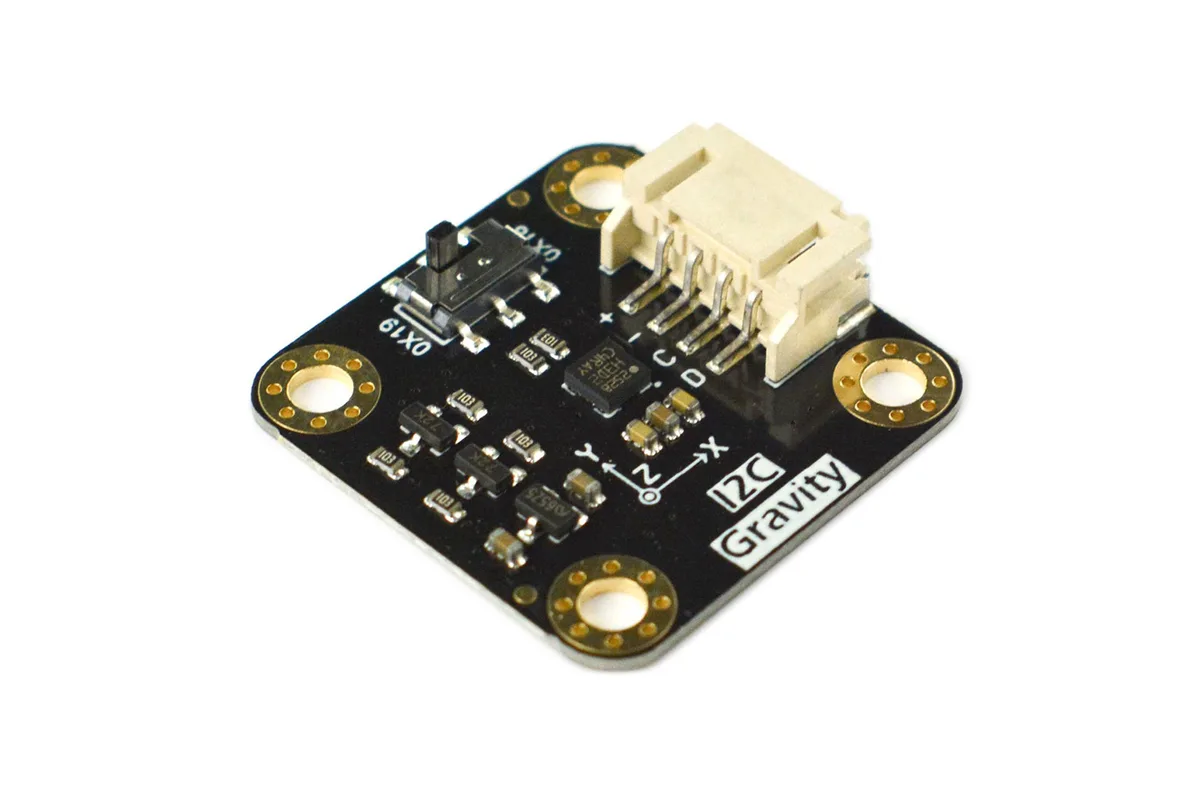
DFRobot H3LIS200DL triple axis accelerometer with Gravity-I2C interface, for shock detection, free-fall detection and vehicle crash testing.
Overview. The DFRobot SEN0412 Gravity H3LIS200DL is a triple axis linear accelerometer module with I2C interface, designed to measure accelerations on three axes with a very low consumption of 10uA in low power mode.
Main characteristics. The measurement scales are selectable between ±100g and ±200g. The output data rate ranges from 0.5Hz to 1KHz, with 8-bit data output. The module withstands a high shock survivability of 10000g.
Interfaces and connectivity. The module uses a Gravity-I2C interface, requiring no soldering. The I2C address is 0x19 by default and 0x18 optional, selectable by the toggle switch. A Gravity-4P I2C/UART sensor connector is supplied.
Power and environment. The operating voltage is 3.3V to 5V. The operating current is 0.3mA to 0.4mA in normal mode. The operating temperature range is -40℃ to +85℃. The product is ECOPACK, RoHS and "Green" compliant.
Dimensions and mounting. The module measures 27*27mm (1.06*1.06 inches) and has mounting holes of 3mm inner diameter and 6mm outer diameter.
Typical uses. Shock detection and recording, free-fall detection and vehicle crash testing.
No published question about this part yet. Questions are reviewed before publication.
Every characteristic recorded for SEN0412, with where it comes from. Use the filters to find one quickly.
| Characteristic | Value |
|---|---|
| Frequency | 0.5Hz~1KHz |
| Gravity | I2C H3LIS200DL Triple Axis Accelerometer (±100g/±200g) |
| I2C Address | 0x19 (Default)/0x18 (Optional) |
| Interface | Gravity-I2C |
| Module size | 27*27mm/1.06*1.06” |
| Mounting Hole Size | inner diameter 3mm/outer diameter 6mm |
| Operating Current | 10uA(low power mode)/0.3mA-0.4mA(Normal mode) |
| Operating Temperature | -40℃~+85℃ |
| Operating Voltage | 3.3V~5V |
| Selectable Scale | ±100g/±200g |
| Selectable scales | ±100g/±200g |
No specification matches.
Last verification : 2026-11-02
Official documents and the technical data recorded for SEN0412. For a missing document or a specific revision, our experts send it to you.
DFRobot H3LIS200DL triple axis accelerometer with Gravity-I2C interface, for shock detection, free-fall detection and vehicle crash testing.
| Parameter | Value |
|---|---|
| Frequency | 0.5Hz~1KHz |
| Gravity | I2C H3LIS200DL Triple Axis Accelerometer (±100g/±200g) |
| I2C Address | 0x19 (Default)/0x18 (Optional) |
| Interface | Gravity-I2C |
| Module size | 27*27mm/1.06*1.06” |
| Mounting Hole Size | inner diameter 3mm/outer diameter 6mm |
| Operating Current | 10uA(low power mode)/0.3mA-0.4mA(Normal mode) |
| Operating Temperature | -40℃~+85℃ |
| Operating Voltage | 3.3V~5V |
| Selectable Scale | ±100g/±200g |
| Selectable scales | ±100g/±200g |
Points to check before using SEN0412 in a design. They are derived from the recorded characteristics, not from the manufacturer's application circuits.
| Operating Current | 10uA(low power mode)/0.3mA-0.4mA(Normal mode) |
| Operating Voltage | 3.3V~5V |
Check the exact pin assignment and the application circuit in the datasheet, or ask our experts.
Answers to the questions that the recorded characteristics of SEN0412 can answer. A question is not asked when nothing is recorded to answer it.
Yes — recorded under "Gravity": I2C H3LIS200DL Triple Axis Accelerometer (±100g/±200g).
-40℃~+85℃ (source: Operating Temperature).
Similar parts to answer your needs. Compare the main characteristics. A recorded replacement is a documented relation; a similar product is a similarity only, never a compatibility claim.
I2C Triple Axis Accelerometer ±100g/±200g Low Power
Gravity: I2C LIS331HH Triple Axis Accelerometer (±6g/±12g/±24g)

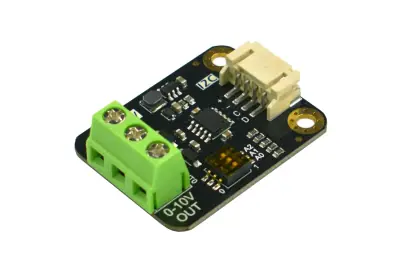
Gravity: 2-Channel I2C DAC Module (0-10V)
Gravity: I2C LIS2DW12 Triple Axis Accelerometer Sensor (±2g/±4g/±8g/±16g)

Describe your application and constraints in a request.
What is recorded about the regulatory status and the life of this part.
No compliance statement is recorded for this part. Ask the supplier for the RoHS and REACH declarations and, for a radio product, the EU declaration of conformity.
| Current status | Status not stated |
| Key dates | Not recorded |
| Manufacturer part number | SEN0412 |
| Manufacturer | DFRobot |
DFRobot Gravity Sensor & Actuator System
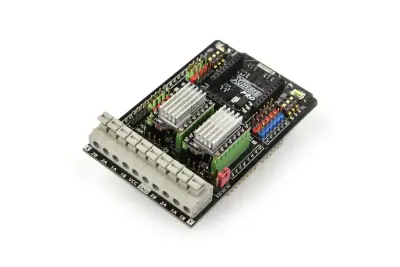
Dual bipolar stepper motor shield for Arduino with DRV8825 driver · Ref. : DRI0023
Price on request
DFRobot Gravity Sensor & Actuator System
Analog Piezo Disk Vibration Sensor · Ref. : DFR0052
Price on request
DFRobot Gravity Sensor & Actuator System
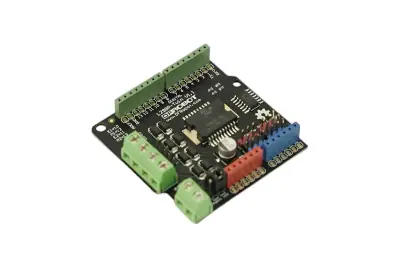
2x2A dual-channel motor shield for Arduino
Price on request
DFRobot Gravity Sensor & Actuator System
Expansion board for Raspberry Pi Pico and Pico 2 · Ref. : DFR0848
Price on request
No advertising or analytics cookies. A single, strictly necessary cookie is set only if you sign in to your account. Your quote basket and comparison stay in your browser. Details